Explore Science-first Philosophy

History

History of the Lands

Hand Axe

70,400 Generations Ago (from 2020 CE) By about 1.76 million BCE, early humans began to create hand axes. They would strike really large flakes, then continue to shape them around the edges. On the right, the hand axe pictured dates to circa 1.1 million BCE. It was found at Isampur, India.  

Hand Axe Read More »

Rigveda Samhita, Veda Book 1 of 4

The Rigveda, Sanskrit for “praise knowledge”, is a collection of sacred texts of Hinduism first written down between 1700 and 1100 BCE. The sounds and texts of Rigveda have been orally transmitted since at least circa 2000 BCE. It discusses cosmology, praises deities, and covers philosophical questions including… 1.164.34: “What is the ultimate limit of

Rigveda Samhita, Veda Book 1 of 4 Read More »

Trevethy Quoit a Portal Dolmen in Cornwall

Neolithic Revolution

468 Generations Ago (from 2020 CE) The Neolithic Revolution is the earliest known Agricultural Revolution. It is very likely that humans practiced forms of agriculture earlier. How much earlier? Well, without evidence, we are guessing. For convenience, anthropologists label humans as hunter-gatherers prior to the Neolithic Revolution. The fact is that the current theory states

Neolithic Revolution Read More »

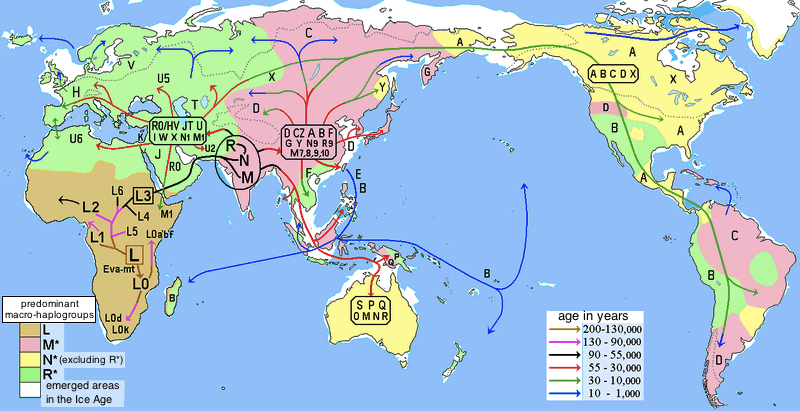
Successful Out of Africa Migration

Through minor DNA changes, we know which early humans have descendants alive today. This successful “out of Africa” migration, the Southern Dispersal, took place around 70,000 to 50,000 BCE. Our ancestors proceeded to colonize all the continents and larger islands, arriving in… Eurasia circa 60,000 BCE Australia circa 65,000 BCE South America circa 30,000 BCE

Successful Out of Africa Migration Read More »

Hyoid Bone: Speach Emerges

Around 700,000 years ago, the development of a human-like hyoid bone suggests early hominins may have begun transitioning from simple vocalizations to more structured speech. This period marks a critical evolutionary point for Homo heidelbergensis, whose anatomical adaptations for speech, coupled with advanced tool use and complex social structures, indicate possible use of rudimentary language.

Hyoid Bone: Speach Emerges Read More »

Homo habilis: Our Intelligence Settles.

92,000 Generations Ago Earliest Identified Human: Earlier hominins are “humanoid,” due to their human-like features, but the term “human” is reserved for species in the genus Homo. Homo habilis is the earliest known of these “early humans.” First Earth Explorer: Known as the “handy man,” Homo habilis’s association with the earliest stone tools is evidence

Homo habilis: Our Intelligence Settles. Read More »

Homo neanderthalensis: Verified True Symbolic Thought

16,000 Generations Ago True symbolic thought emerges before 430,000 BCE: The discovery in 2018 of Neanderthal art dating back to 68,000 years ago, proved symbolic thought in Neanderthals. It also indicates strongly that symbolic thought evolved in or before our common ancestor about 430,000 years ago. This must be true unless either they evolved it

Homo neanderthalensis: Verified True Symbolic Thought Read More »

St Geaorge Monastery Desert

Jericho Founded

360 Generations Ago Earliest known permanent settlement in the Africa/Middle East zone.  Jericho, located in the West Bank, Palestinian Territories, stands as one of the earliest known permanent settlements in the Africa/Middle East zone, with continuous habitation dating back to at least the 9th millennium BCE. Situated near an oasis in the Jordan Valley, Jericho’s

Jericho Founded Read More »

Scroll to Top