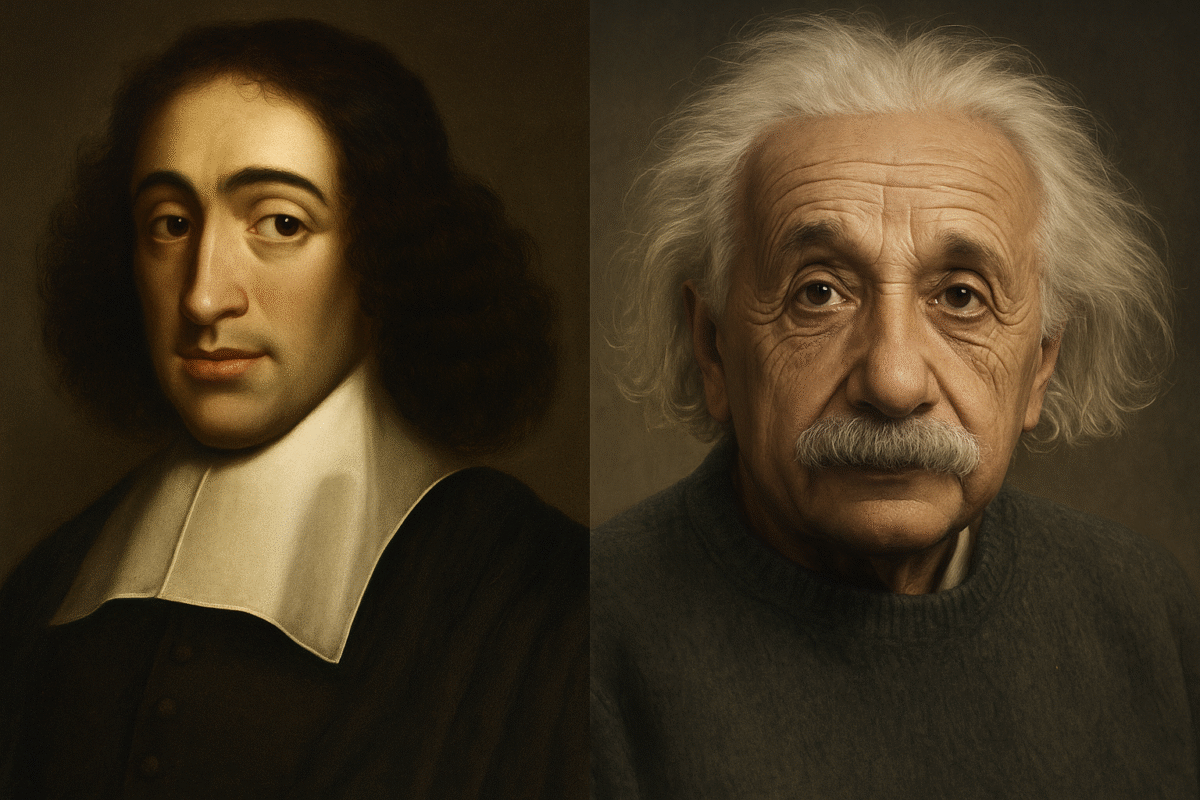
Yes—profoundly. Some of the greatest scientific breakthroughs were guided not just by data, but by belief. Especially the belief in determinism—the idea that everything has a cause, and the universe unfolds with order.
Take Einstein. Long before he had equations, he believed the universe was rational and rule-bound. That belief shaped his theories of relativity. He wasn’t just describing the universe—he was searching for one that made sense. And he found one, at least in part, because he believed it had to exist.
His inspiration? Spinoza.
Spinoza believed that everything—thought, motion, even emotion—followed from the very nature of God or Nature with absolute necessity. To him, free will was an illusion, and randomness didn’t exist. Einstein called himself a Spinozist, and even wrote Spinoza a poem. That’s how personal—and how philosophical—his science really was.
And Spinoza wasn’t alone.
Aristotle believed the universe was filled with purpose. That every object, every motion, had a reason for being. Not random—just misunderstood.
His teacher Plato agreed, but added a layer of structure—fixed, eternal Forms. The world might be messy, but the blueprint behind it was perfect. And behind Plato was Socrates, who believed that understanding the world started with understanding ourselves.
All of these thinkers believed in an ordered universe.
They assumed something guided reality—whether it was logic, necessity, or purpose.
But then came quantum mechanics. And with it, a shock: nature might include real randomness. Probabilistic outcomes. Uncertainty—not from ignorance, but from the way the universe is.
Still, Einstein couldn’t accept that.
“God does not play dice with the universe.”
So yes—belief in determinism has absolutely shaped science.
Sometimes it’s what pushes the questions forward.
Sometimes, it’s what keeps us from accepting the answers.