
Phil • Cr. Think • Science • Hist •
TST PRACTICE

The Philosophy Website

QUOTE

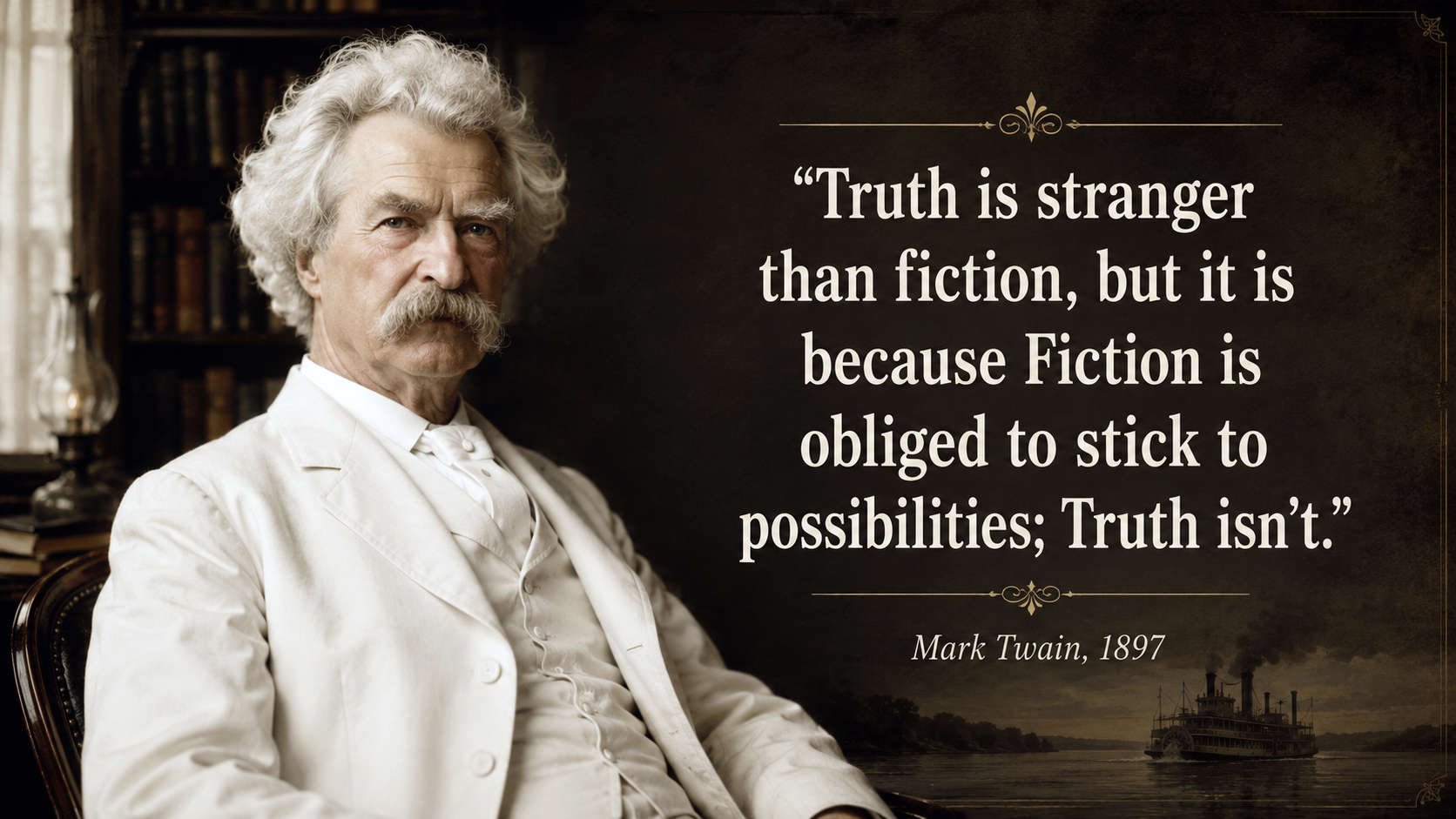
“Truth is stranger than fiction…[which] is obliged to stick to possibilities;”
☐ Read
☑ Read
You’ve read this 0 times.
You’ve listened to this 0 times.
Related Quotes
“The first person who thought of saying ‘This is mine’ was the real founder of civil society.”
“A wise man proportions his belief to the evidence.”
“Reality is self-creating by definition… our impressions of it are what we use to build knowledge.”
“…allegories…lay hold of the hidden sense which is concealed beneath the words”
“It is wrong always, everywhere, and for anyone, to believe anything upon insufficient evidence.”
“Where ignorance is bliss, ’tis folly to be wise.”
Share :
Email
Print

Mike's Takeaway:

Mark Twain sensed the tension between truth and fiction. In this famous quote, he feels the nature of latent ideas. Fiction lives within the possibilities of reality. Truth must answer to reality itself.

The mind can recombine real impressions in endless ways, but it cannot create from nothing. Fiction can rearrange impressions, exaggerate them, symbolize them, and turn them into story, but it is still limited to recombining materials reality has made available. Truth carries a different burden. For something to be true, it must allow reality to push back.

Twain’s line fits the idea of latent ideas and natural philosophy almost perfectly. Here is the full quote:

“Truth is stranger than fiction, but it is because Fiction is obliged to stick to possibilities; Truth isn’t.” — Mark Twain, 1897.

His quote fits science-first philosophy and the idea that our minds are limited to recombining actual impressions of reality. Twain is saying fiction has a coherence obligation. Even when fiction is invented, it has to feel possible, meaningful, structured, and believable inside the story-world. Real events do not have that burden. Reality can be absurd, random, grotesque, unlikely, or narratively unsatisfying and still be real.

So Twain is not just making a joke. He is pointing to a real philosophy of fiction: fiction can depart from fact, but it’s toolbox is still limited to the reality of the possible. Reality, meanwhile, is not required to “make sense” to us. Reality just happens. It is truth.
Analysis By Michael Alan Prestwood
07 Jul 2026
Published 2 months ago.
Updated 2 months ago.
TST Tracker
✓ Reading recorded.

Annotated References:

Source: The line appears in Following the Equator under “Pudd’nhead Wilson’s New Calendar.”
  • Byron, Don Juan, 1823, Canto XIV, stanza 101: an early formulation that truth can be stranger than fiction.
  • Twain, Following the Equator, 1897, Chapter XV, “Pudd’nhead Wilson’s New Calendar”: fiction must remain believable, while reality is not constrained by narrative possibility.
  • Prestwood, 30 Philosophers, 2024, Chapter 18, “The Illusion of Creation: Fiction”: fiction recombines latent, reality-derived ideas, while truth remains answerable to reality.
Mark Twain, born 1835, often wrote about the tensions between truth, reality, and fiction.
Michael Alan Prestwood
Author & Natural Philosopher
Prestwood writes on science-first philosophy, with particular attention to the convergence of disciplines. Drawing on his TST Framework, his work emphasizes rational inquiry grounded in empirical observation while engaging questions at the edges of established knowledge. With TouchstoneTruth positioned as a living touchstone, this work aims to contribute reliable, evolving analysis in an emerging AI era where the credibility of information is increasingly contested.
The Prestwood Column
Menu
September 2026
Column Research….
1. Timeline Story
Hume’s Is–Ought Problem
2. Linked Quote
“I meet with no proposition that is not connected with an ought, or an ought not.”
3. Science FAQ »
Can science prove flourishing should be our goal?
4. Philosophy FAQ »
What is the difference between a normative aim and a normative directive?
5. Critical Thinking FAQ »
Is flourishing for all just utilitarianism?
6. History FAQ!
What is the history of the idea of flourishing in philosophy?
Bonus Deep-Dive Article
Flourishing for All: The Normative Aim of TST Philosophy

Comments

Join the Conversation! Currently logged out.

Leave a Reply

NEW BOOK! NOW AVAILABLE!!

30 Philosophers: A New Look at Timeless Ideas

by Michael Alan Prestwood
The story of the history of our best ideas!
Scroll to Top