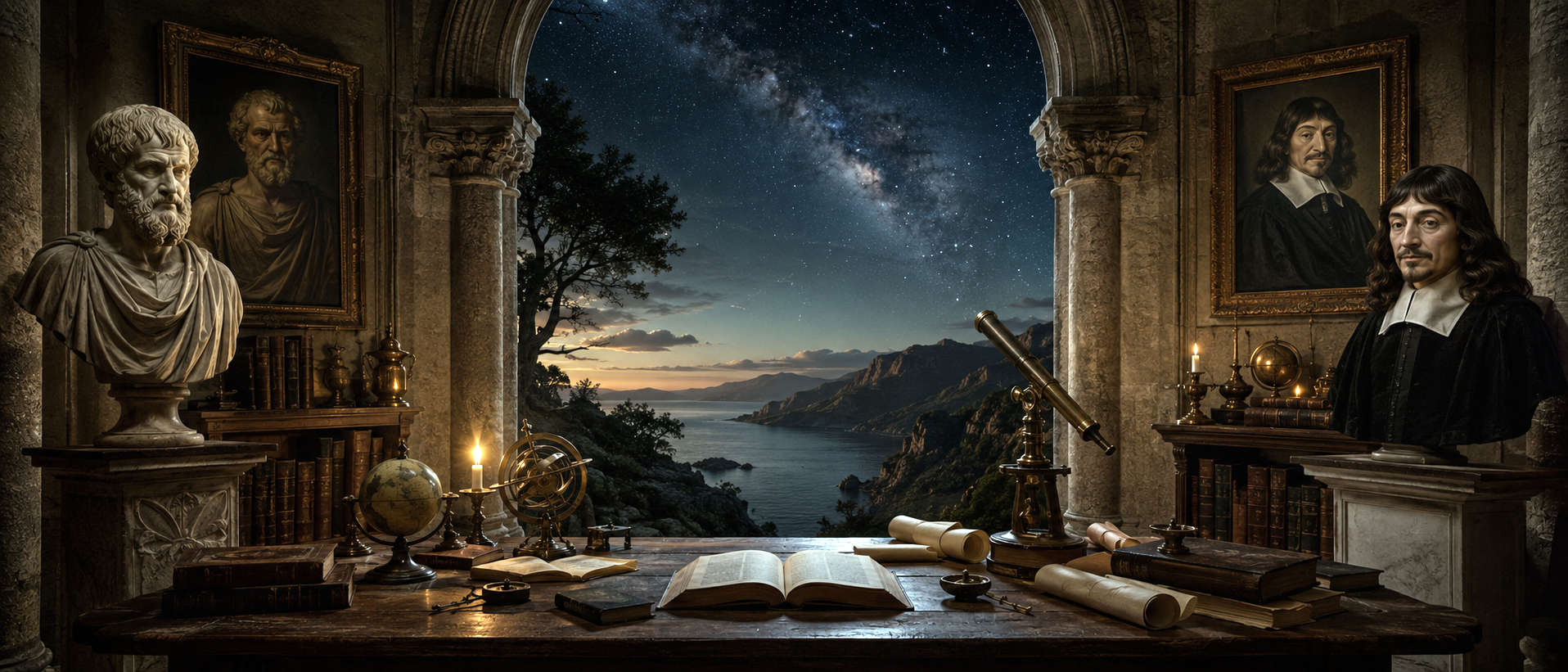
First, this is a reference to Aristotle. His “first philosophy” and “second philosophy” named the most basic areas of inquiry. TST Philosophy does not directly use these. So when we ask this question, we are really comparing TST Philosophy to Aristotle’s ordering, and to later attempts to organize the architecture of philosophy.
In most cases, First Philosophy refers to metaphysics: the study of what is ultimately real. In TST, that maps to the Two Layers, sometimes called Step 2: the split between the material world and our ideas about it. This is the classic “realms” question. Spinoza argued for one substance: nature, or God-as-nature. Descartes argued for two substances: mind and body. Christianity usually works with at least three realms: Heaven, the material world, and Hell. Hindu traditions often allow even wider metaphysical exploration. TST Philosophy limits itself to the shared material world and our ideas about it with allowances for personal exploration of it all.
Second Philosophy, for Aristotle, was the study of nature. In modern terms, this points toward science. This is where TST becomes science-first. In natural philosophy, science goes first as a method: let reality push back.
Aristotle treated first philosophy and second philosophy as covering the deepest structure of inquiry. Some later thinkers expanded or rearranged the architecture, adding more formal attention to ethics, logic, theology, etc.
What we are talking about here is the ordering or taxonomy of philosophical traditions. “First philosophy” and “second philosophy” are Aristotle-rooted terms. TST Philosophy can be compared to them, but it does not use them. TST’s own ordering is clear: one goal, two layers, three truth hammers, four mind traps, and five thought tools.