
Explore Science-first Philosophy

STORY

Bilaterian Split: Ur-Bilaterian

By Michael Alan Prestwood

Fri 3 Apr 2026
Published 2 hours ago.
Updated 2 hours ago.
Animal Evolution
Related Stories
Toothed Birds Go Extinct
Styracosaurus
Sauropodomorph Line Diverges Within Dinosaria (from Saurischia)
Apatosaurus
Pterosaurs Diverge From Dinosaur Ancestors (within Ornithodira)
Cenozoic Era: Age of Mammals & Birds
Share :
The significant idea of the bilaterian body plan is directionality. By moving from a radial (circle) to a bilateral (line) symmetry, life transitioned from a passive state of "being" to an active state of "doing."

Bilaterian Split: Ur-Bilaterian

590 Million Years Ago (± 10 million)
Movement toward goals.

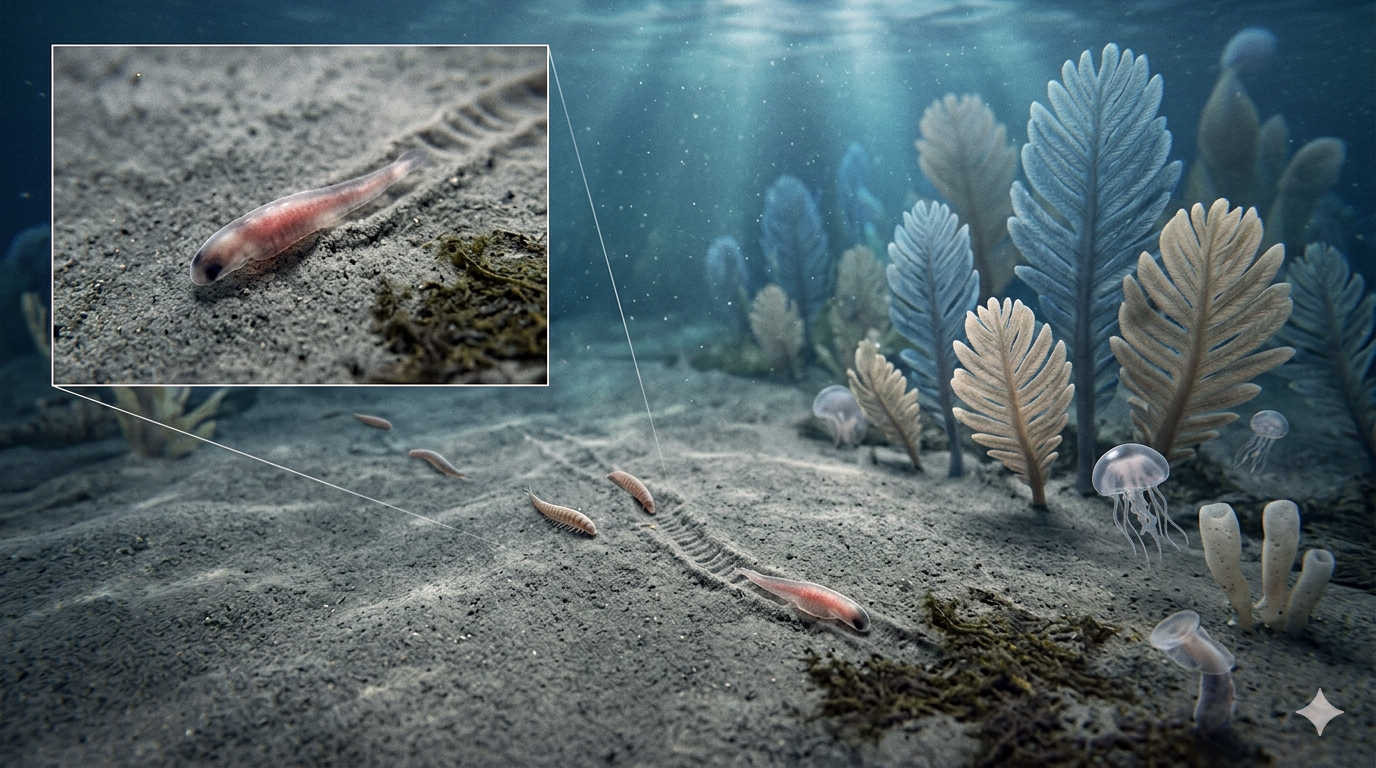
The Bilaterian Split represents the most significant “hardware upgrade” in the history of animal life. It marks the evolutionary divergence where organisms moved away from radial symmetry (like jellyfish or sponges) and developed bilateral symmetry—a distinct front, back, left, and right side. This structural shift was the “Idea” that made complex life possible; it allowed for cephalization (the concentration of nerve cells into a head/brain) and a through-gut (a mouth-to-anus digestive tract), transforming animals from passive drifters into active, goal-oriented hunters and foragers. The Bilaterian Split is considered the “Origin of the Brain” because directional movement requires a “command center.”

The fundamental difference between Radial and Bilateral symmetry is that radial symmetry, like jellyfish, has no defined front or back. They interact with the environment from all sides equally. Bilateral symmetry creates a head and tail, allowing for directional movement and the concentration of sense organs (eyes/mouth) in the front.

The Ur-Bilaterian is the common ancestor of almost all complex animals alive today, from the tiniest tardigrade to the human being. In 2020, scientists identified a tiny, worm-like fossil in Australia named Ikaria wariootia that fits this description perfectly. About the size of a grain of rice, it lacked legs or eyes but possessed the fundamental bilateral blueprint: it could burrow through the seafloor with intent, using muscles to move toward organic matter. It represents the “Source Code” for every creature that possesses a head and a tail.

From a philosophy perspective, the Bilaterian Split is the biological origin of agency. Before this split, life reacted to its environment; after this split, life began to navigate it. This divergence created the two great “kingdoms” of complex movement: the Protostomes (which led to cephalopods, insects, and tardigrades) and the Deuterostomes (which led to the vertebrates). If the history of life is a book, the Ur-Bilaterian is the first sentence of the chapter on “Will.”

— map / TST —

Michael Alan Prestwood
Author & Natural Philosopher
Prestwood writes on science-first philosophy, with particular attention to the convergence of disciplines. Drawing on his TST Framework, his work emphasizes rational inquiry grounded in empirical observation while engaging questions at the edges of established knowledge. With TouchstoneTruth positioned as a living touchstone, this work aims to contribute reliable, evolving analysis in an emerging AI era where the credibility of information is increasingly contested.
Email
Print
This Week @ TST
April 1, 2026
»Column Archive
WWB Research….
1. Story of the Week
The Dawn of Empirical Spirituality
2. Quote of the Week
“It is wrong always, everywhere, and for anyone, to believe anything upon insufficient evidence.”
3. Science FAQ »
Is science tainted by bias?
4. Philosophy FAQ »
How do knowledge frameworks help transform information into wisdom?
5. Critical Thinking FAQ »
Are personal spiritual experiences believable?
6. History FAQ!
Did the Buddha believe in Mount Meru and the six realms of existence?
Bonus Deep-Dive Article
TST Theory of Justification: What to Believe
Scroll to Top