
Explore Natural Philosophy

Science • Phil • Cr. Think • Hist •

STORY

First Cynodonts

By Michael Alan Prestwood

Sat 23 May 2026
Published 4 weeks ago.
Updated 4 weeks ago.
Related Stories
Emergence of the Great Apes (Great Apes LCA)
XX/XY Sex System Emerges: A Tale of Mammalian Evolution
Mammals: First Live Births
First Mammaliaforms: Morganucodon
Early Intelligence Emerges: Aegyptopithecus zeuxis
The K-Pg Extinction
Share :
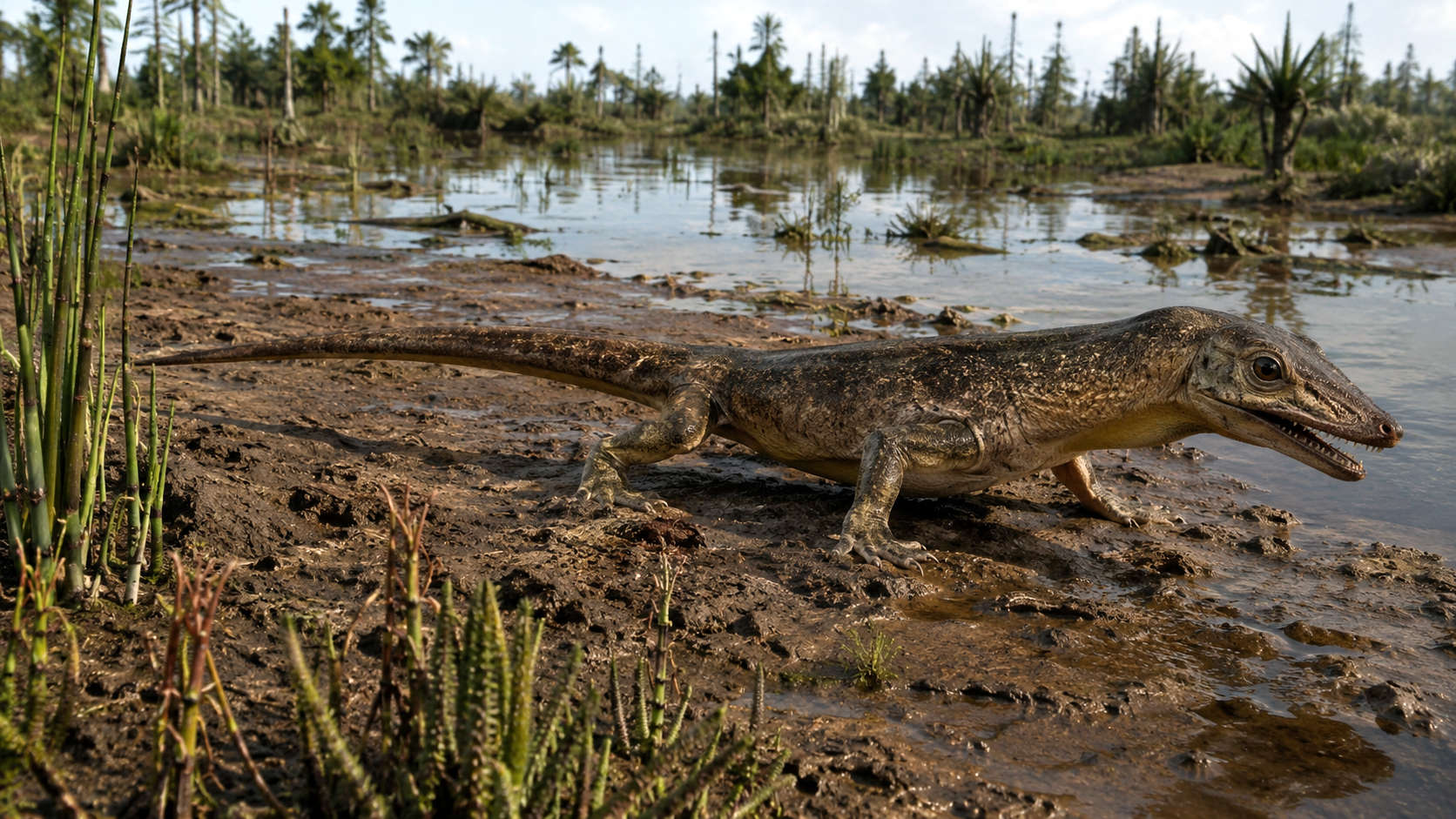
Around 260 million years ago, early cynodonts such as Procynosuchus marked a major tightening of the mammal-side branch. They were still non-mammalian therapsids, low-bodied and primitive in outward form, but their jaws, teeth, skull, and secondary palate were beginning to shift toward better chewing and breathing. This was not yet the mammal line in full bloom, but the roots were getting stronger.

First Cynodonts

~260 Million years ago
Mammal-like jaw and breathing.

This is where the mammal story stops being merely “mammal-side” and starts becoming recognizably mammal-bound.

The first cynodonts evolved in the Late Permian, roughly 260 million years ago, probably first known from southern African ecosystems, with related early forms spreading more widely before the end-Permian crisis. Strictly speaking, cynodonts were therapsids — a more derived branch within Therapsida — so the distinction is not “cynodonts instead of therapsids,” but cynodonts as a new kind of therapsid. What made them different was the tightening of the mammal-side package: more complex teeth, stronger jaw muscles, a larger dentary bone in the lower jaw, and a developing secondary palate that helped separate breathing from chewing. This is where the mammal story starts to feel less like a broad synapsid experiment and more like a focused line moving toward mammals.

Procynosuchus is one of the best early examples of this transition. It lived near the end of the Permian and still looked low, long-bodied, and not very mammal-like to modern eyes. But inside the skull, the mammal-bound direction was already underway. Its teeth and jaws show the early cynodont shift toward more precise food processing, while its palate and skull structure point toward better breathing and a more active lifestyle. Procynosuchus was not a mammal, and not even close in appearance, but it is a strong marker for the branch that would eventually lead through later cynodonts to mammaliaforms and, much later, true mammals.

— map / TST —

Michael Alan Prestwood
Author & Natural Philosopher
Prestwood writes on science-first philosophy, with particular attention to the convergence of disciplines. Drawing on his TST Framework, his work emphasizes rational inquiry grounded in empirical observation while engaging questions at the edges of established knowledge. With TouchstoneTruth positioned as a living touchstone, this work aims to contribute reliable, evolving analysis in an emerging AI era where the credibility of information is increasingly contested.
Email
Print
This month @ TST
Column Menu
June 2026
»COLUMN ARCHIVE
Column Research….
1. Timeline Story
Secular Spirituality Settles
2. Linked Quote
“Extraordinary claims require extraordinary evidence.”
3. Science FAQ »
What is the difference between a spiritual and empirical belief?
4. Philosophy FAQ »
What is secular spirituality?
5. Critical Thinking FAQ »
How does spirituality relate to public belief?
6. History FAQ!
Is secular spirituality supported in history and science?
Bonus Deep-Dive Article
The Material-Spiritual Framework: A Philosophy of Spirituality

Comments

Join the Conversation! Currently logged out.

Leave a Reply

NEW BOOK! NOW AVAILABLE!!

30 Philosophers: A New Look at Timeless Ideas

by Michael Alan Prestwood
The story of the history of our best ideas!
Scroll to Top