

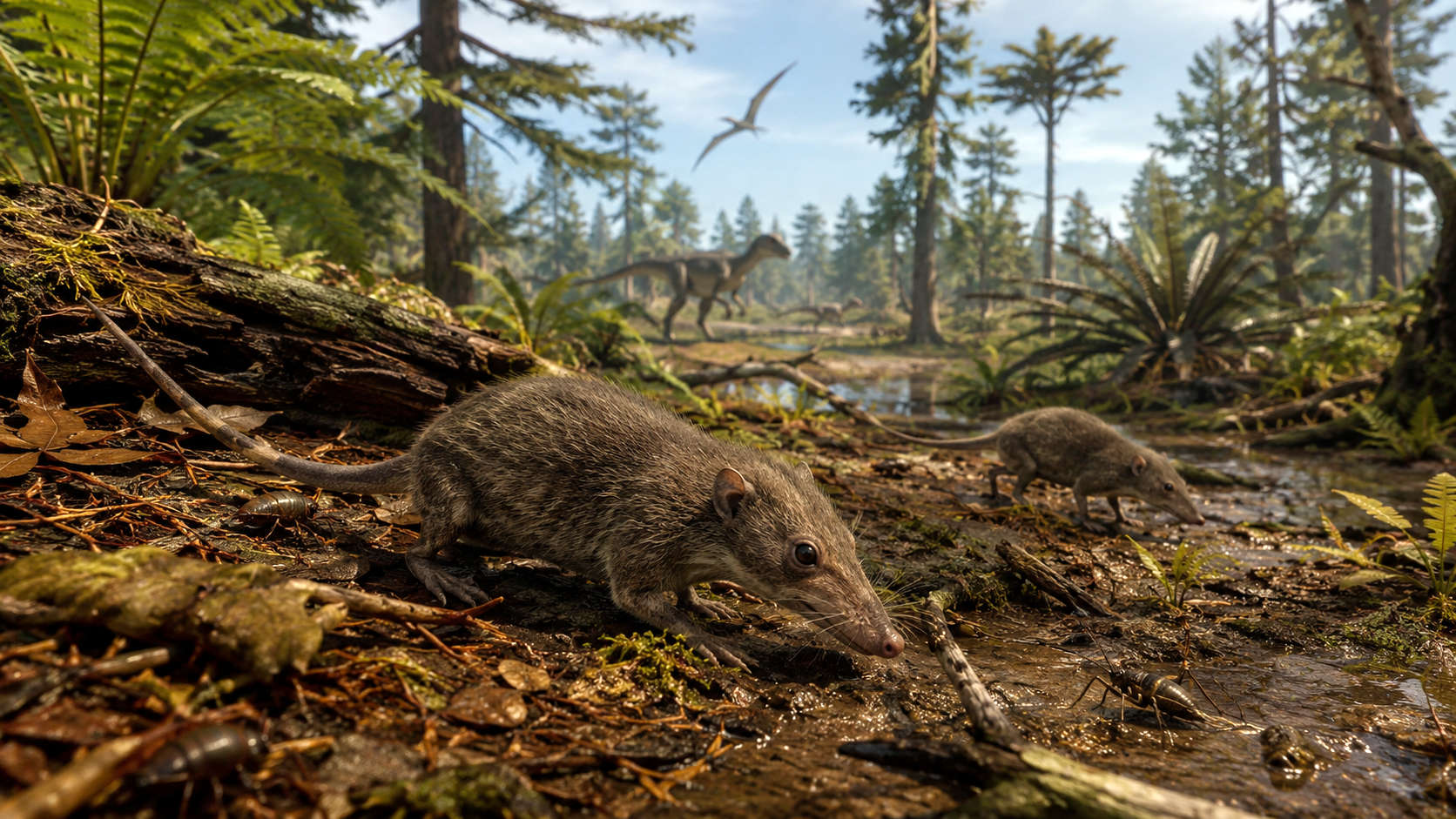
The small Jurassic ancestor shared by all living mammals.
Crown mammals first evolved by the Middle Jurassic, roughly 170–160 million years ago, as small mammal-line animals living in dinosaur-dominated ecosystems. The “first crown mammal” was not a known named fossil but is the last common ancestor of living monotremes and therians. This is the ancestor of monotremes, marsupials, and placentals. It lived in a warm Jurassic world of forests, floodplains, and lakeshores. Common plants were conifers, cycads, and ferns. Common animals were small reptiles, amphibians, and larger pterosaurs overhead. These early crown mammals were likely small, secretive, and mostly nocturnal or crepuscular, surviving in the shadows while their anatomy quietly crossed the threshold into the living mammal branch.
A useful early fossil anchor is Ambondro mahabo, from the Middle Jurassic of Madagascar, about 167 million years ago. It is known only from a fragmentary lower jaw with teeth, so it should not be presented as “the first crown mammal” with certainty. But it is important because it shows complex tribosphenic-style molars — teeth with cutting and crushing surfaces, a key feature associated with later marsupials and placentals, though its exact placement is debated. Britannica describes Ambondro as a shrewlike extinct mammal from Middle Jurassic Madagascar and the oldest known mammal with complex tribosphenic dentition.

