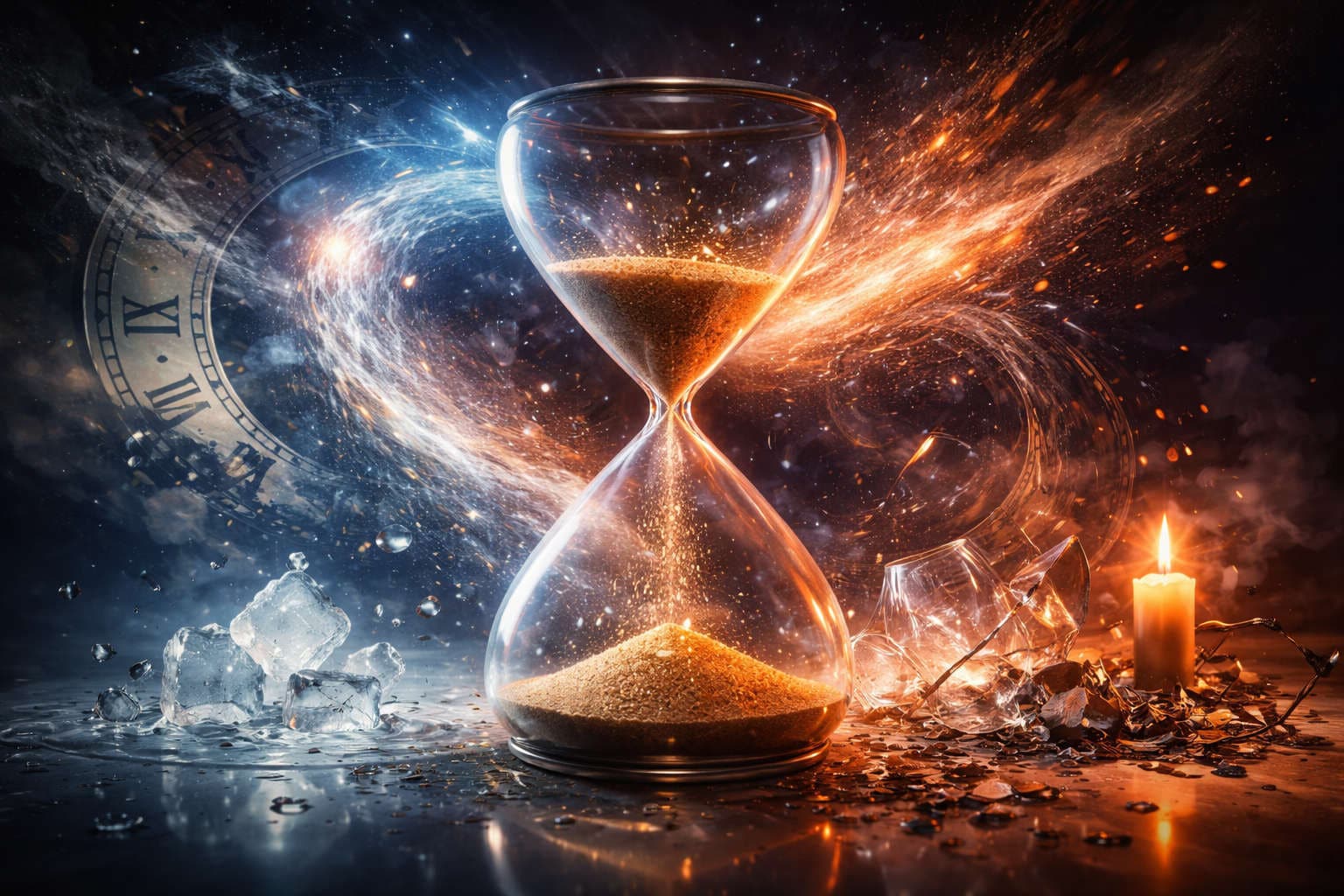
For most of human history, time was not understood as a physical property of the universe. It was understood as counted change. Days followed nights. Seasons followed seasons. Life was measured in harvests, heartbeats, and celestial cycles. Time was what happened between events, not something that existed on its own.
Entropy is irreversibility—the idea that time only moves forward. Time itself does exist, but it’s not a ticking metronome; it’s a ledger of causation—a record of what has happened and what can no longer be undone. This insight is relatively modern. It only emerged once science began asking why change has a direction, not just how fast it occurs.
As physics matured, especially in the 19th and 20th centuries, scientists realized that clocks don’t define time—they merely measure regular processes. Strip the universe of change, and there is nothing left to count. Time, as we experience it, is inseparable from events.
The breakthrough came with thermodynamics. When something happens, energy spreads, information disperses, and traces are left behind—heat, motion, light, memory. These traces don’t naturally reconverge. A shattered glass doesn’t reassemble. A spoken word can’t be unsaid. The universe keeps records, and those records accumulate.
Historically speaking, this is how the arrow of time entered science—not as a philosophical assumption, but as a physical discovery. Time moves forward because causes pile up and cannot be erased. The past is fixed because it’s written. The future is open because it isn’t.
Seen this way, time entropy isn’t about disorder. It’s about history itself—why yesterday leaves evidence and tomorrow does not. The universe tells its story one irreversible page at a time.