

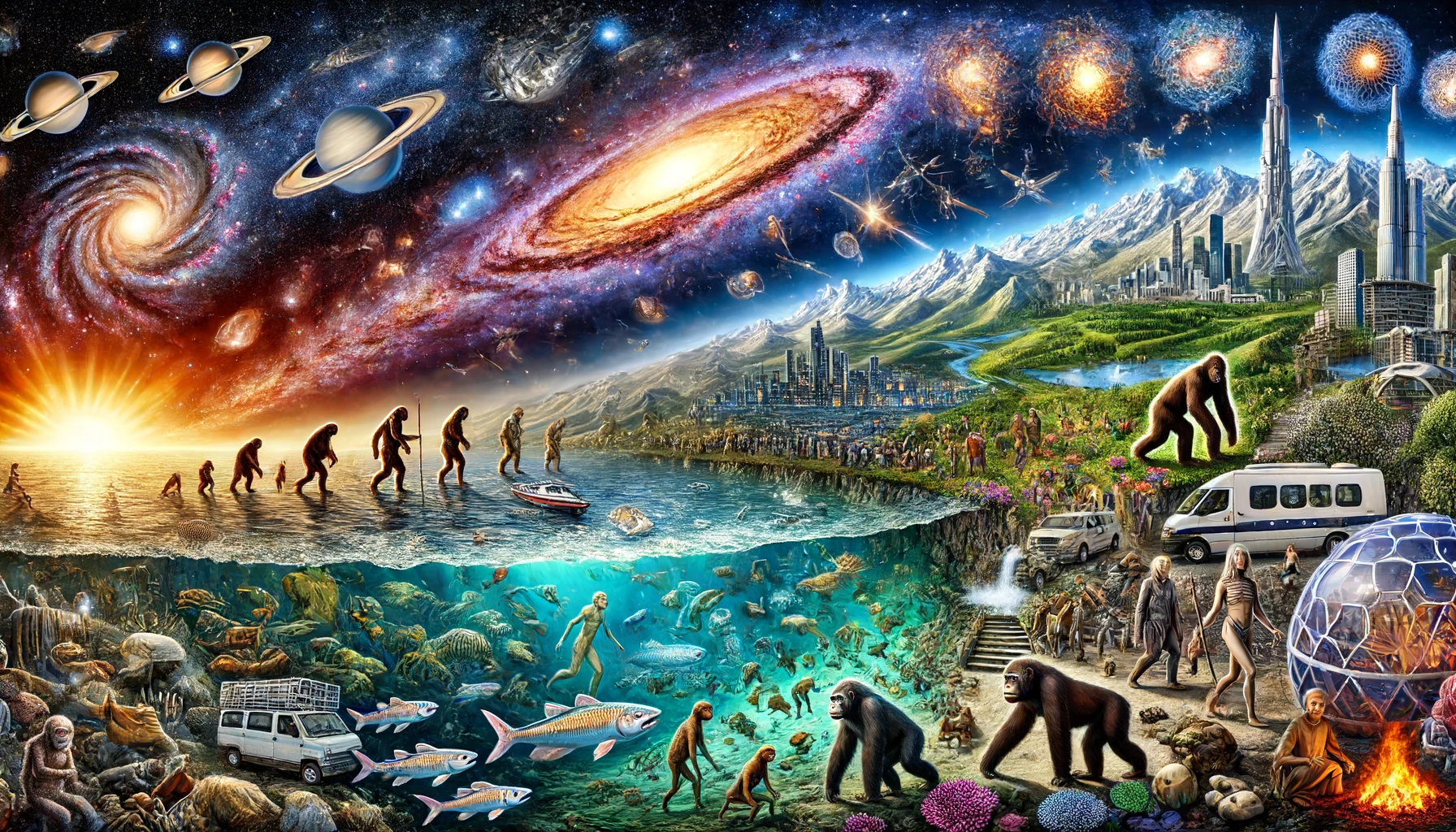
From Atoms to Human: This timeline tells the complete story from the Big Bang to modern civilization. The epic tale from space dust to inorganic molecules to the first DNA life all the way to modern civilization.
Human Evolution
Big Bang Expansion
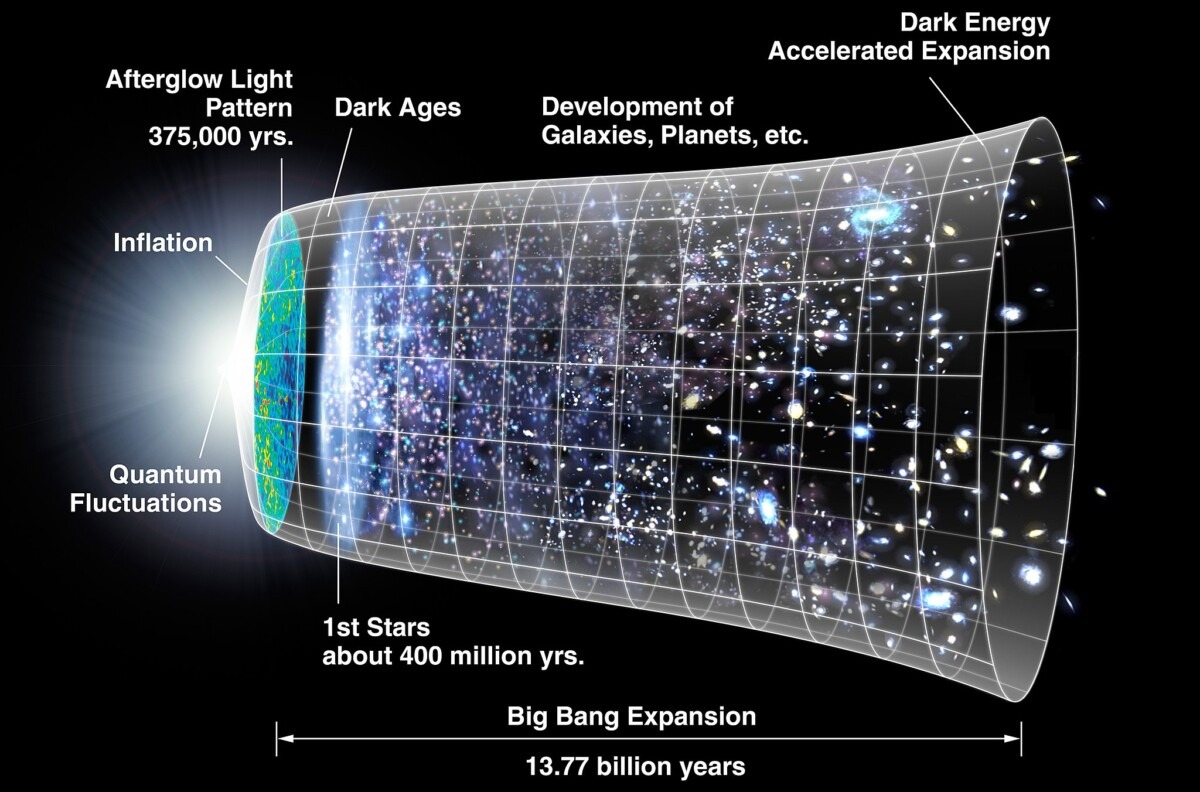
13.8 billion years ago, space itself began expanding and cooling, setting the stage for particles, atoms, stars, galaxies, planets, life, and us.
13.8 Billion Years Ago
Verified. Empirically supported and rationally deduced.
First Atoms

Molecules or atom isolated on blue background
13.7 Billion Years Ago
Verified. Empirically supported and rationally deduced.
Population III Stars: Heavier Elements

NOIRLab/NSF/AURA/J. da Silva/Spaceengine, CC BY 4.0 <https://creativecommons.org/licenses/by/4.0>, via Wikimedia Commons
13.6 Billion Years Ago
Verified. Empirically supported and rationally deduced.
Population II Stars: Heavy Element Synthesis

Cosmos Stars Cluster Structure Stunning Astrophotography Dramatic Celestial Wallpaper. Bright blue n
13.59 Billion Years Ago
Verified. Empirically supported and rationally deduced.
Galaxies are Born
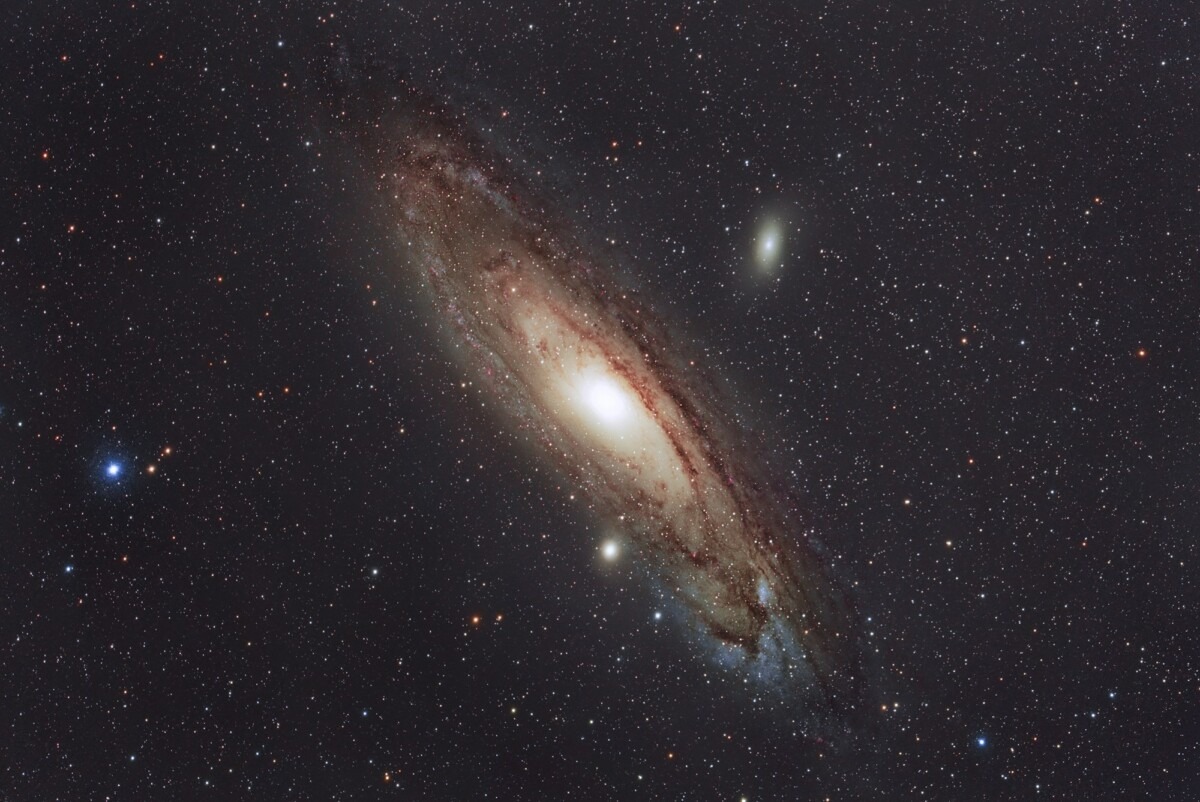
Galaxies emerged quickly from an initially simple universe. They started within a few hundred million years of the Big Bang. Observations confirm that gravity wasted little time turning primordial gas into organized systems, even before features we now consider typical. Such as central supermassive black holes commonly found in galaxies.
13.4 Billion Years Ago
Verified. Empirically supported and rationally deduced.
Birth of the Milky Way

milky way forest
About 13.39 Billion Years Ago
Verified. Empirically supported and rationally deduced.
Population I Stars: Like our Sun
Stars in observatory
10 Billion Years Ago
Verified. Empirically supported and rationally deduced.
Interstellar Clouds: Organic Molecules

debris of a stellar explosion, 3d illustration
10 Billion Years Ago
Verified: 10 to 7 Billion Years Ago
Birth of the Sun

Epic sun surface flare prominence solar system
4.6 Billion Years Ago
Verified. Empirically supported and rationally deduced.
Earth is Born
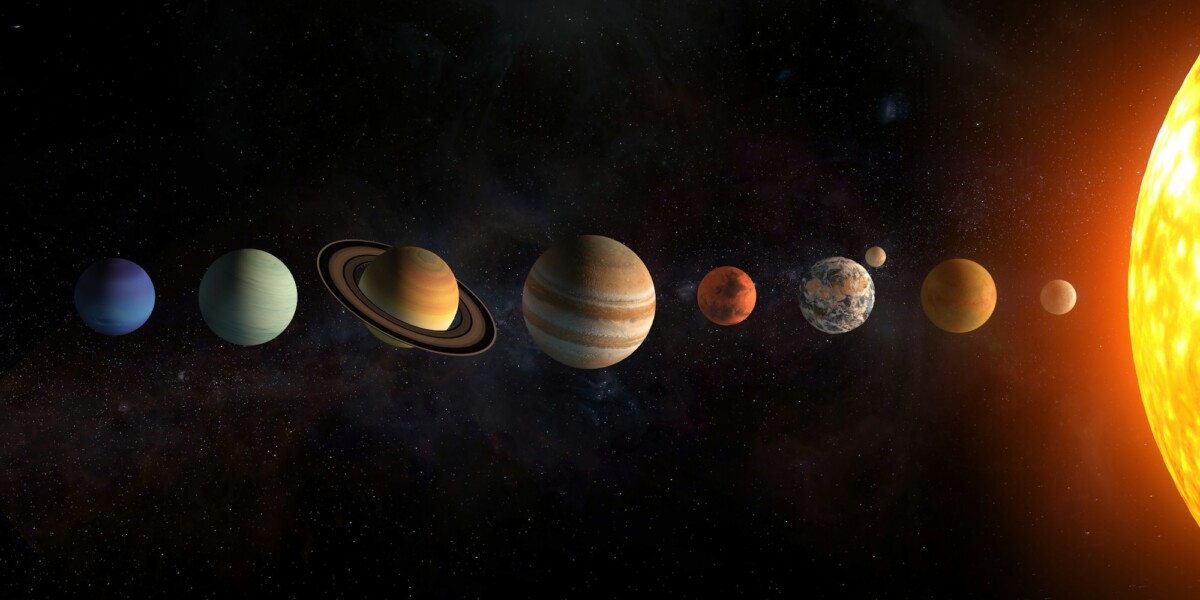
Solar system planets set. The Sun and planets in a row on univer
4.5 Billion Years Ago
Verified. Empirically supported and rationally deduced.
First Atmosphere: Hydrogen & Helium

4.48 Billion Years Ago
4.49 to 4.6 Billion Years Ago
Inorganic Precursors to Organic Molecules
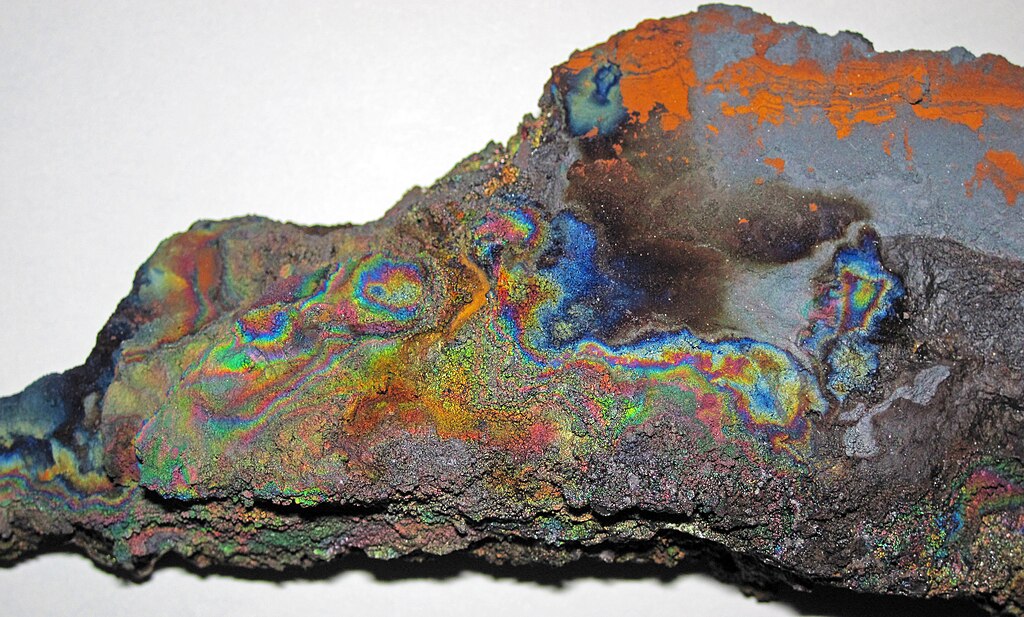
4.45 Billion Years Ago
Spedulative guess: 4.2 to 4.4 Billion Years Ago
Second Atmosphere: Carbon Dioxide & Nitrogen

4.3 Billion Years Ago
4.5 to 4 Billion Years Ago
First Life: Self-Replicating Molecules
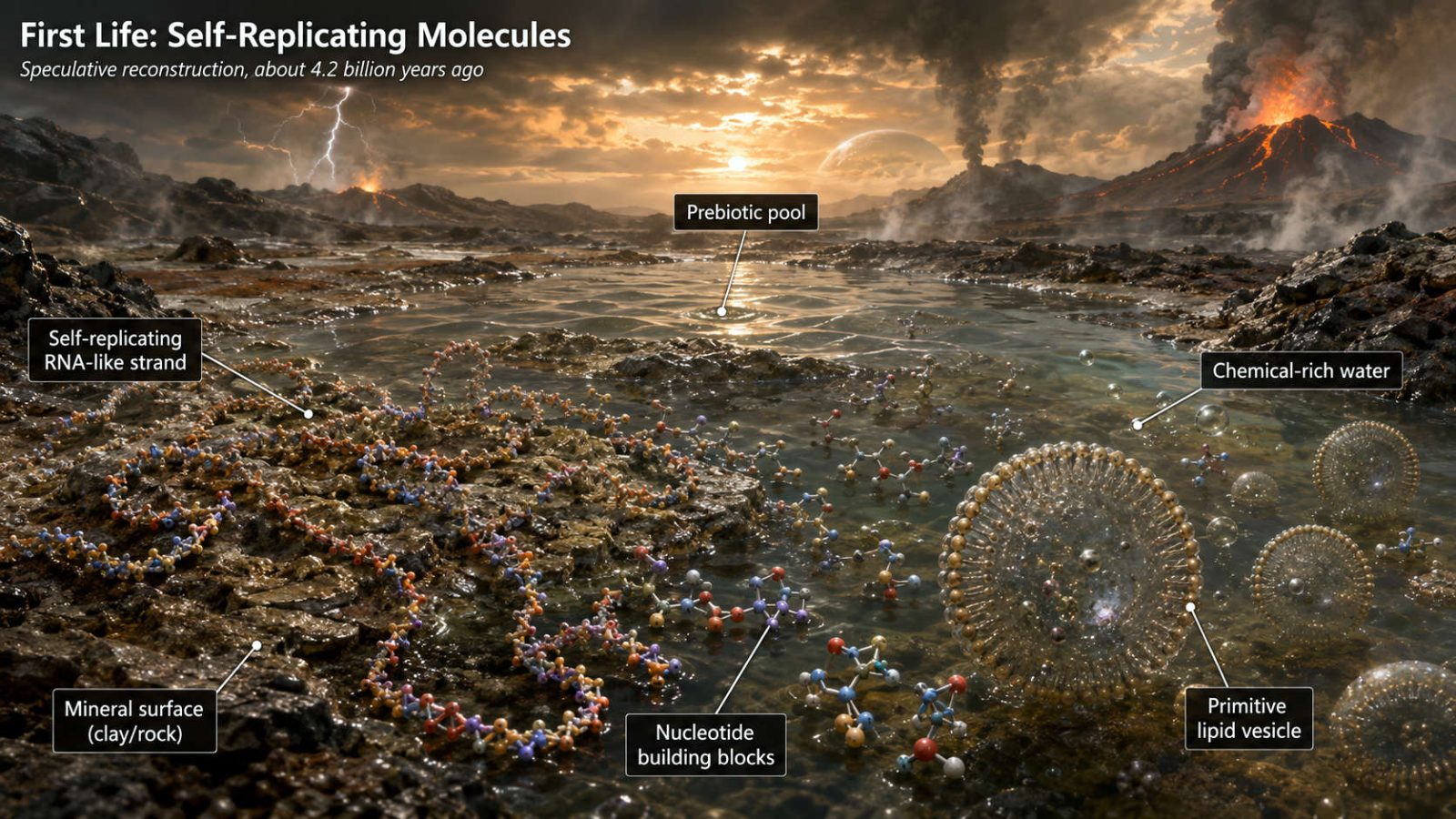
None of those first self-replicators survive today, at least not in their original form. But modern biology still carries echoes of that ancient autonomy. Viruses, plasmids, and transposons all remind us that life is full of genetic passengers, copy-makers, and molecular hitchhikers—some alive only inside cells, some not considered alive at all, but all strangely resonant with that first age of replication.
4.2 Billion years ago (+/- 200 million)
Self-replication emerges
First Oceans: Fresh Water

sunset north sea sea 2191645
4.2 Billion Years Ago
4 to 4.4 Billion Years Ago
Metabolic Pathways
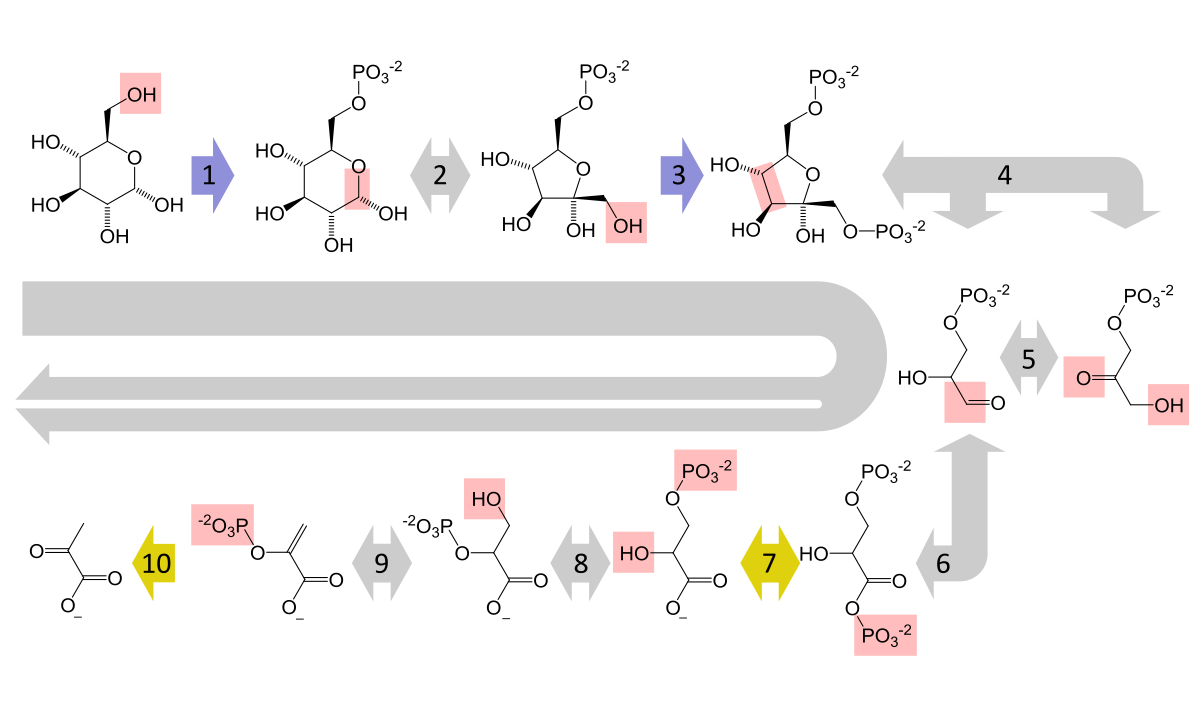
"<a href="https://commons.wikimedia.org/w/index.php?curid=39236376" target="_blank" rel="noopener noreferrer">Glycolysis metabolic pathway 3</a>" by <a href="https://commons.wikimedia.org/wiki/User:Evolution_and_evolvability" target="_blank" rel="noopener noreferrer">Thomas Shafee</a> is licensed under <a href="https://creativecommons.org/licenses/by/4.0/" target="_blank" rel="noopener noreferrer">CC BY 4.0</a>
4.1 Billion Years Ago (+/- 200 milion)
Self-sustaining chemical reactions
Chemical Evolution of Organic Molecules

3d illustration. Model of serotonin molecule, Hormone of Happiness
4.1 Billion Years Ago
Spedulative guess: 4 to 4.4 Billion Years Ago
Formation of Prebiotic Microenvironments

Geyser in Yellowstone National Park
4 Billion Years Ago
Spedulative guess: 3.9 to 4.1 Billion Years Ago
Cellular Membranes
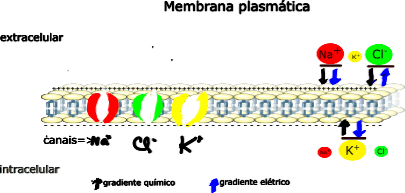
"<a href="https://commons.wikimedia.org/w/index.php?curid=97444339" target="_blank" rel="noopener noreferrer">Cell membrane - Cellular biology - adapted for ions gradient and membrane channels</a>" by <a href="https://smart.servier.com" target="_blank" rel="noopener noreferrer">Servier Medical Art by Servier, adapted for Alexandro Rocha https://smart.servier.com/</a> is licensed under <a href="https://creativecommons.org/licenses/by/3.0/" target="_blank" rel="noopener noreferrer">CC BY 3.0</a>
3.9 Billion Years Ago
Spedulative guess: 3.8 to 4.1 Billion Years Ago
Assembly of Protocells
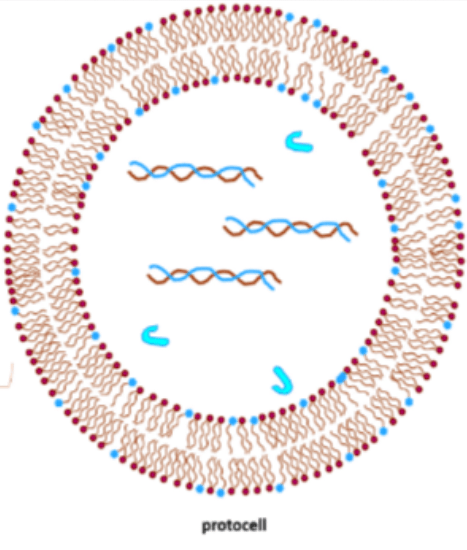
"<a href="https://commons.wikimedia.org/w/index.php?curid=99962760" target="_blank" rel="noopener noreferrer">Protocell</a>" by <a href="https://commons.wikimedia.org/wiki/User:148LENIN" target="_blank" rel="noopener noreferrer">148LENIN</a> is licensed under <a href="https://creativecommons.org/publicdomain/zero/1.0/deed.en" target="_blank" rel="noopener noreferrer">CC CC0 1.0</a>
3.9 Billion years ago (+/- 100 million)
The engine gets wrapped in a bubble.
RNA World
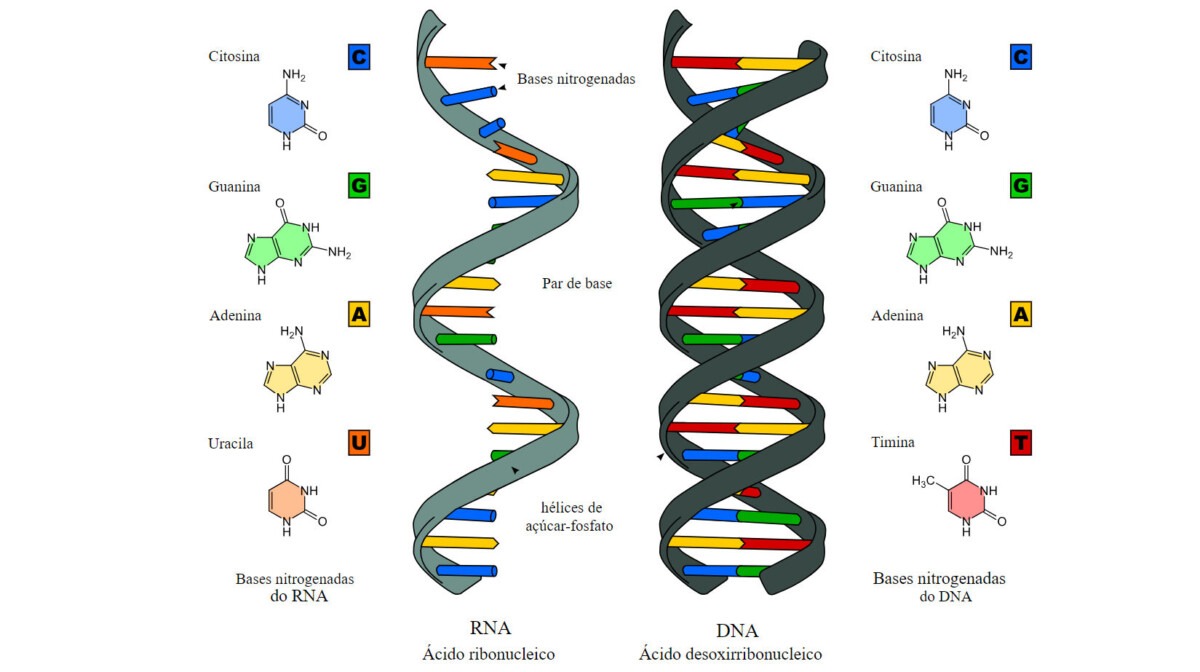
3.85 Billion Years Ago (before LUCA)
Leading Hypothesis: Molecules drifted; Chemistry binds.
LUCA: Last Universal Common Ancestor
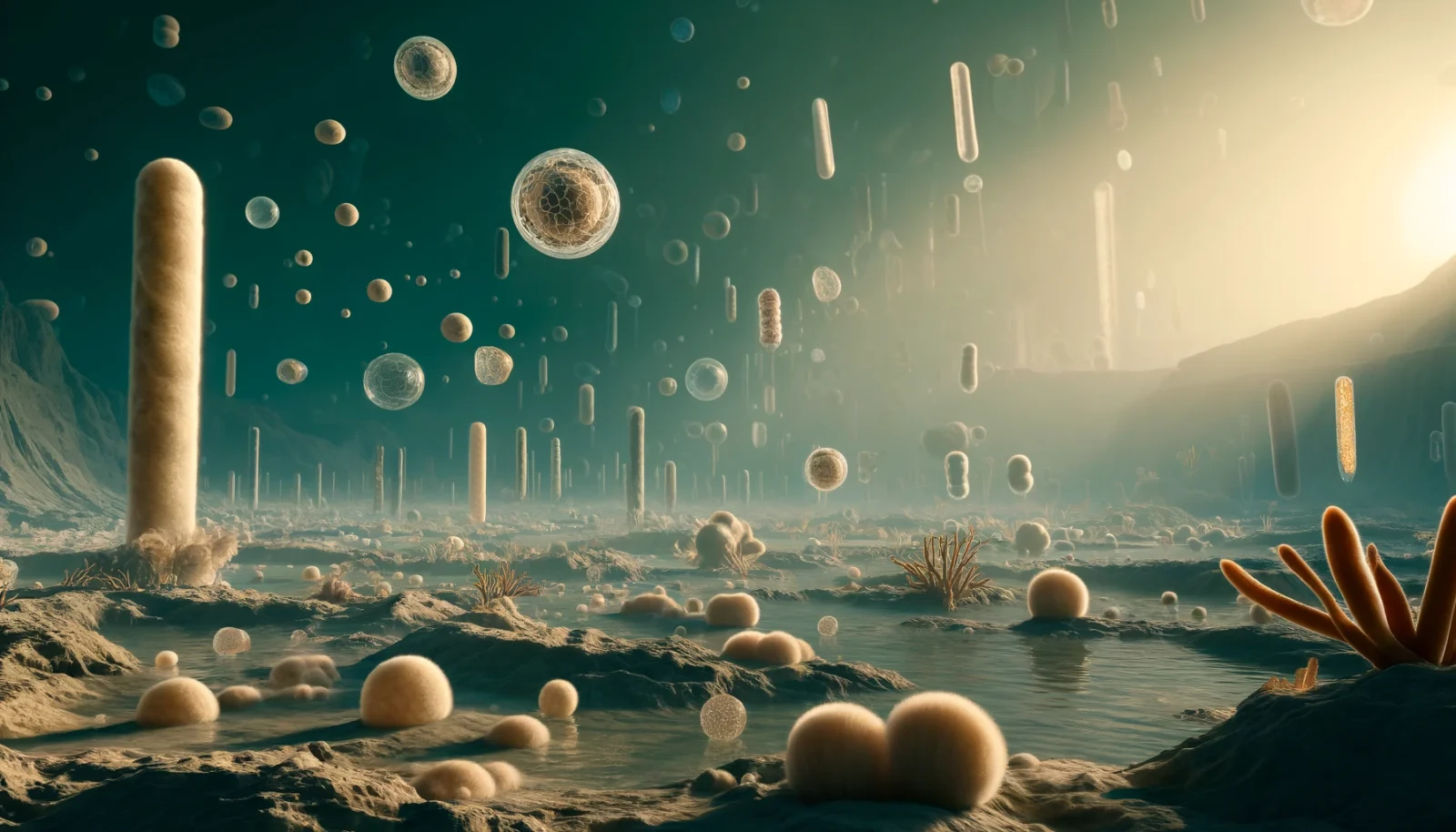
LUCA's form is unknown. Imagined image of various LUCA shapes.
3.75 Billion years ago (+/- 100 million)
DNA, Ribosomes, and ATP
Prokaryotic Life
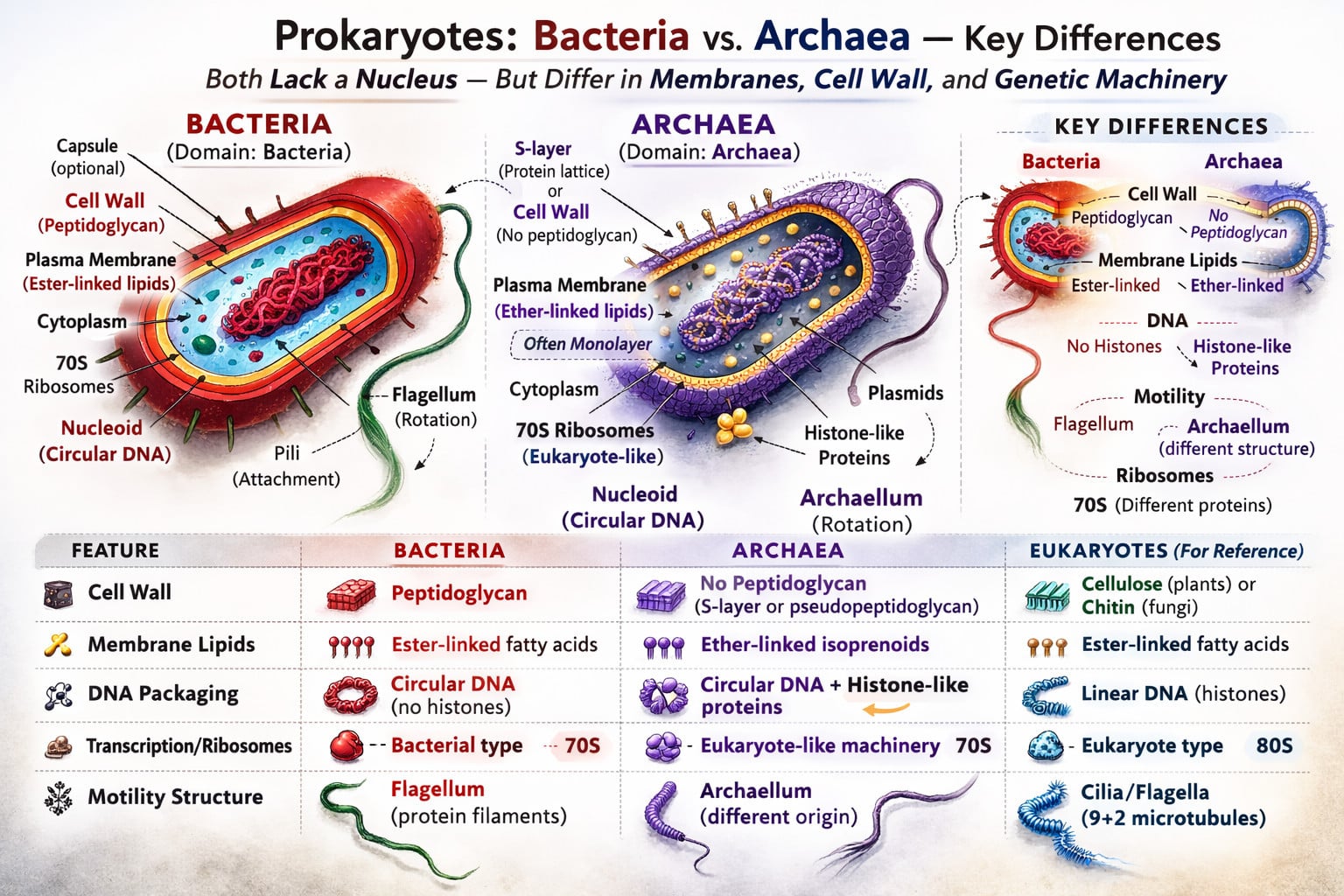
Archaea look like bacteria at first glance — small, simple, and lacking a nucleus. But they are fundamentally different.
3.73 Billion Years Ago (after LUCA)
Membrane and metabolic diversity.
Touch: Life Learns to Feel Force
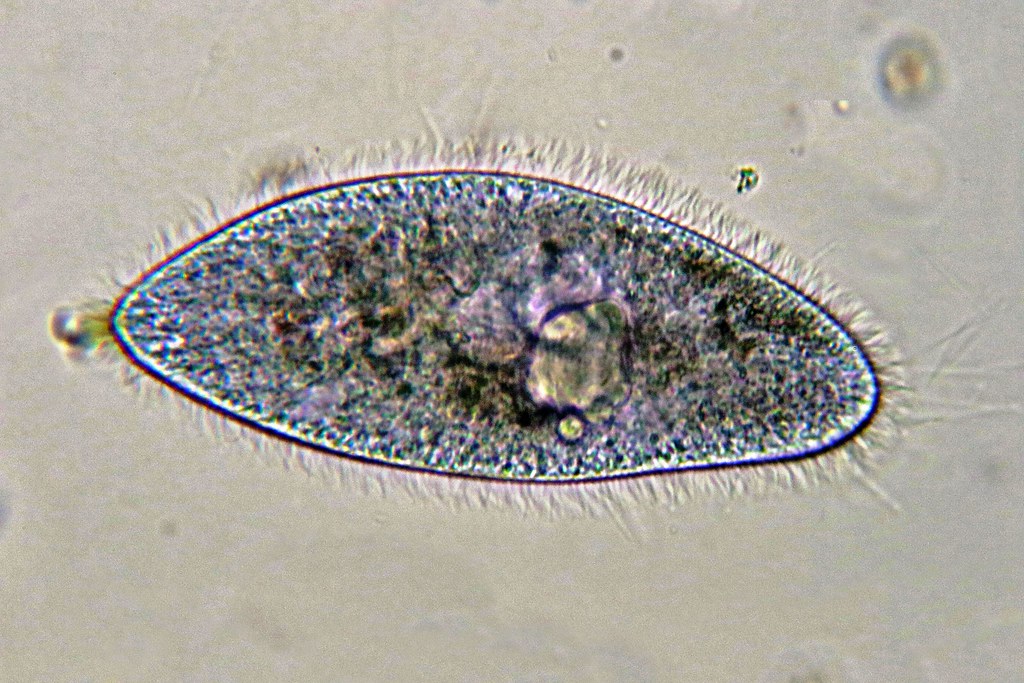
About 3.72 billion years ago, right after LUCA, when cells emerged, touch became the most ancient form of biological sensing: required to physically navigate reality.
~3.72 Billion Years Ago (after prokaryotes)
Mechanical sensitivity to pressure and membrane stretch
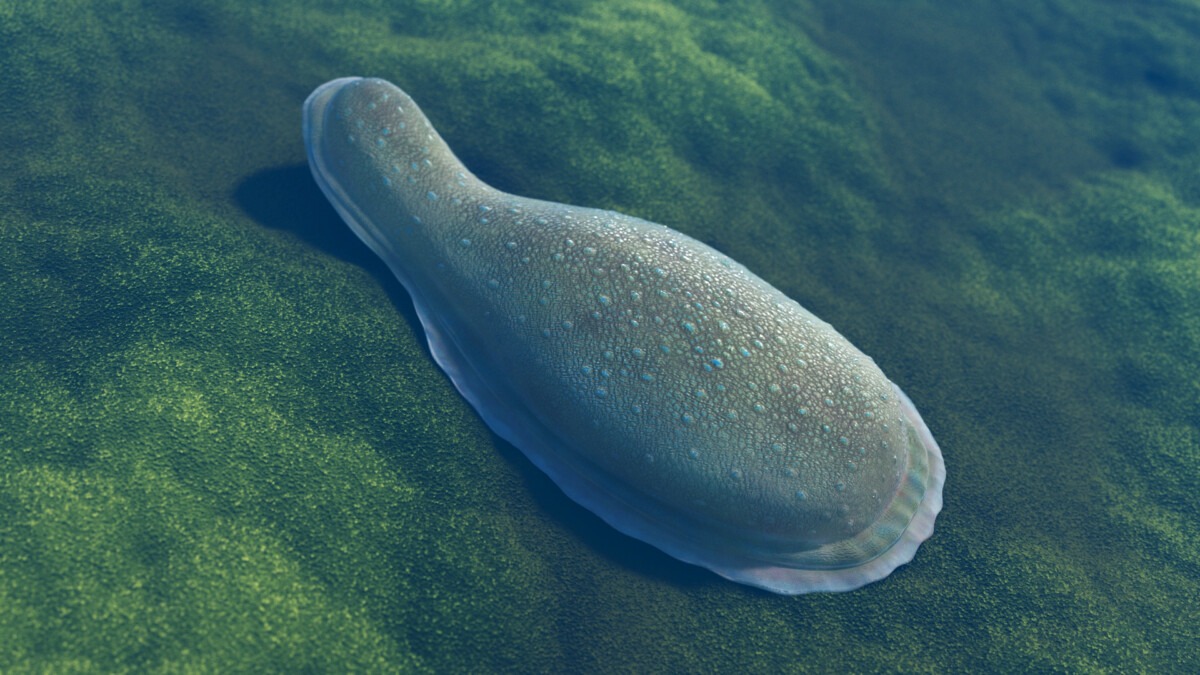
Presentient Animals Emerge: The Ediacaran Prelude

Before the Cambrian Explosion, early animal body shapes were already experimenting. Some evolved into larger, more complex forms, from frond-like patterns to disks and tubes. In this strange world, nerve nets and proto-nervous systems were beginning to appear.
635 to 590 Million Years Ago
Proto-brain; Pre-brain memory; Presentient.
Animal Chemoreception: Proto-Taste and Smell Emerge
Chemoreception is older than animals. Found across bacteria, fungi, and plants, it later became the foundation for animal taste and smell as early nerve nets and proto-nervous systems gave rise to brains.
600 Mya
Bilaterian Split: The Origin of Agency
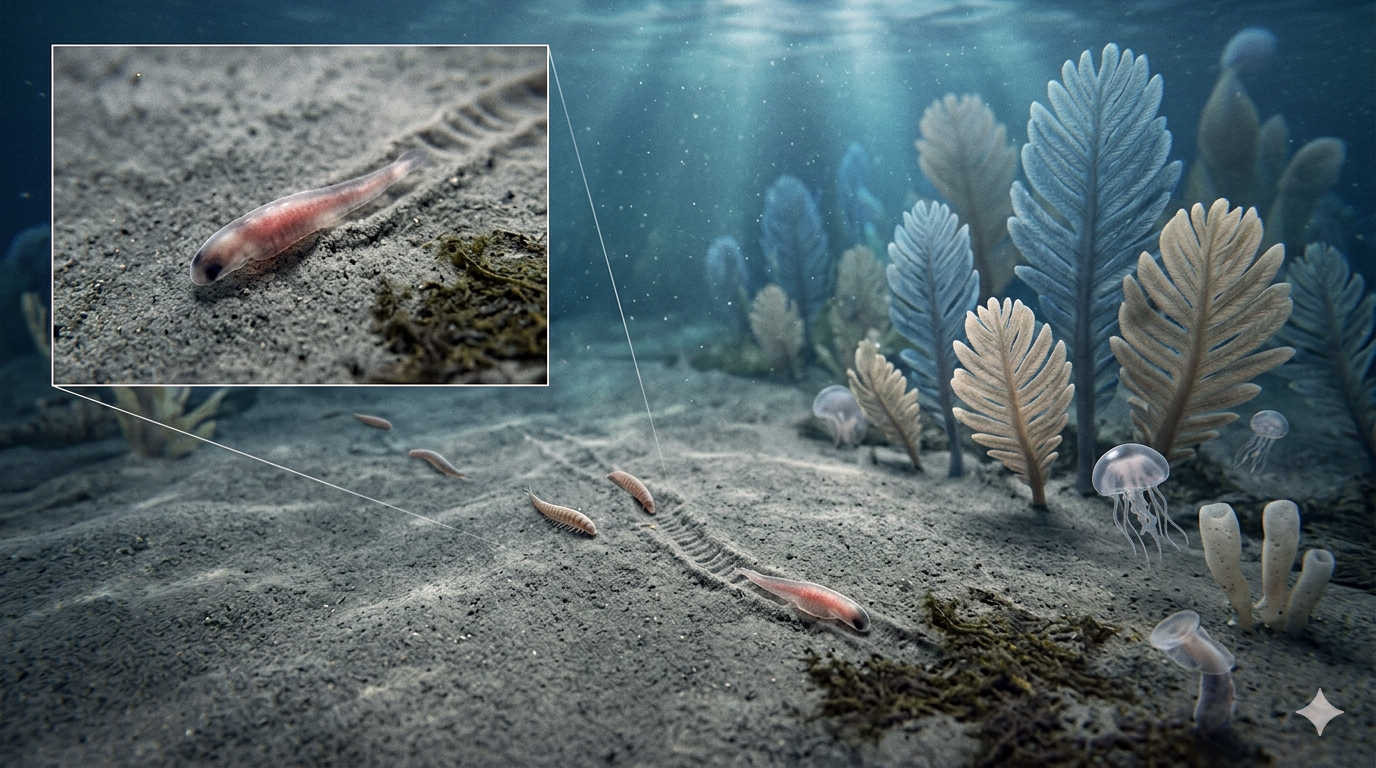
The bilaterian branch gave rise to today's arthropods, mollusks, fish, amphibians, reptiles, birds, and mammals. The significant idea is directionality. From a radial (circle) to a bilateral (line) symmetry, life transitioned from a passive "being" to an active "doing."
590 Million Years Ago (± 10 million)
Agency and directional action with intent.
True Circulatory Systems: Blood Veins

545 Million Years Ago (after through-gut digestion: mouth/anus)
Circulatory fluid transport (veins)
Vision Emerges: The Pre-fish Chordates
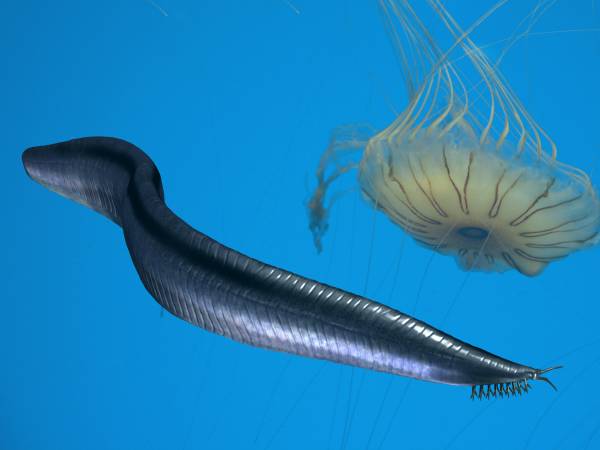
540 Mya
Vision Emerges; Proto-Simple Brains; Pre-vertebrate Cord.
Paleozoic Era: The Age of Synapsids
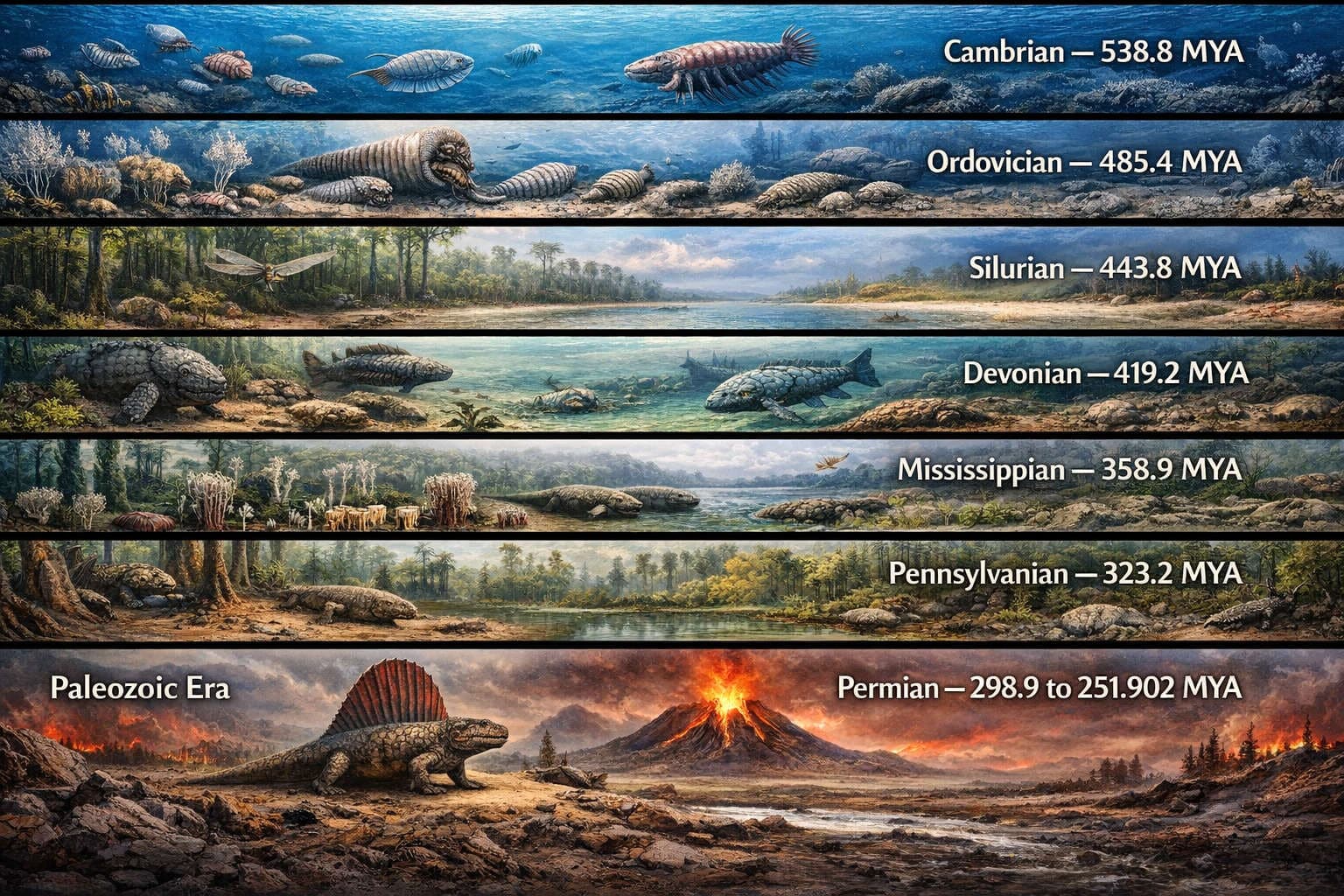
The Paleozoic era is marked by the rise of complex animal life 538.8 million years ago. It ends with the end-Permian mass extinction 252 million years ago. A volcanic cascade global warming event.
From 538.8 to 251.902 million years ago.
287 Million years: From burrowing to extinction.
Simple Sentience Settles: Haikouichthys
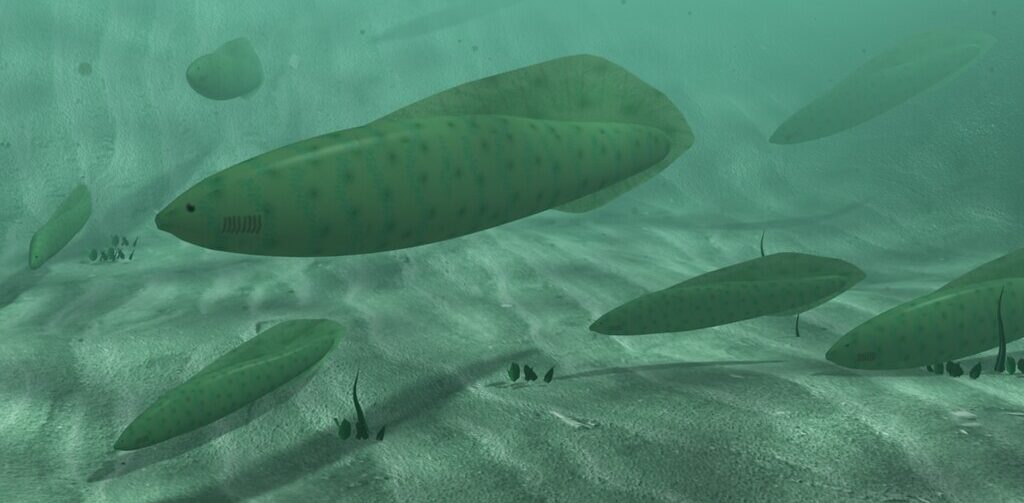
520 Million BCE
Simple Brains; Proto-Short-Term Memory; Simple Sentience.
First Animal Teeth
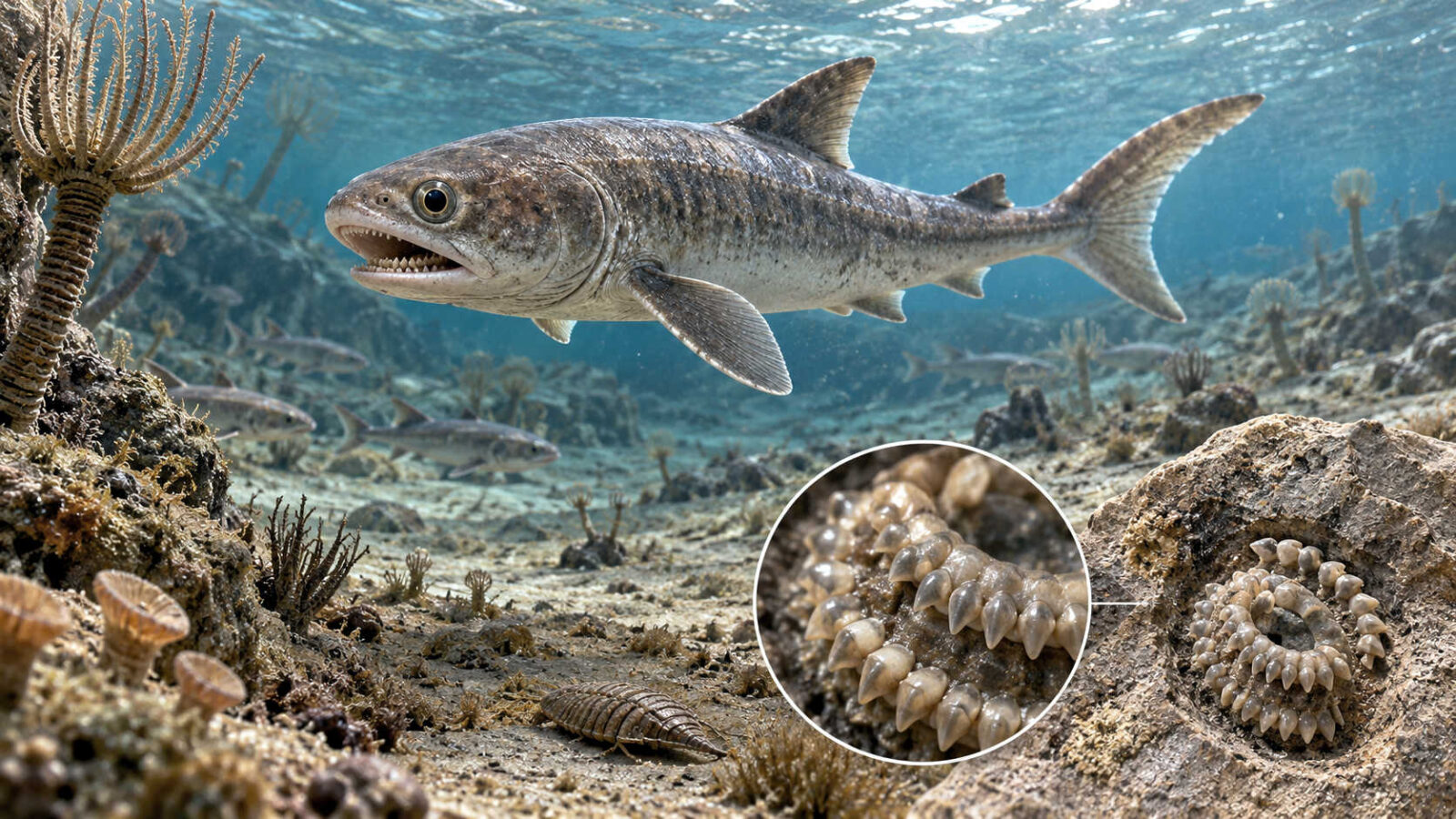
Teeth first evolved in a common fish ancestor to reptiles, dinosaurs, and mammals. The earliest direct evidence we currently have for true teeth comes from a tiny jawed fish called Qianodus duplicis, which lived about 439 million years ago during the Silurian Period. We don’t have a nice complete fish fossil smiling back at us. What we have are tiny fossilized tooth whorls from China, with rows of teeth added as the animal grew. These structures show features recognizable in later jawed vertebrates, making Qianodus our current oldest solid evidence for a toothed animal.
439 Million years ago (+/- 1 million)
Long-Term Memory Evolves: Tiktaalik
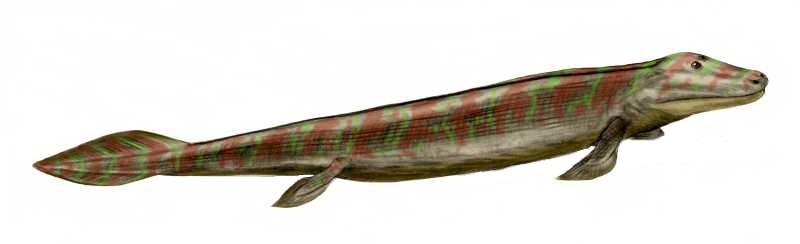
375 Mya
Complex Brains; Long-Term Memory; Simple Sentience.
Land Hearing Emerges: Amphibians
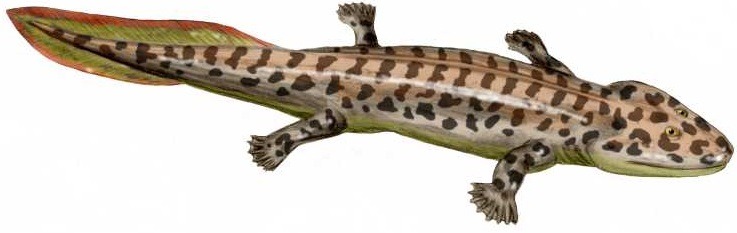
370 Mya
Land Hearing Emerges; Yet Larger Brains.
First Synapsids
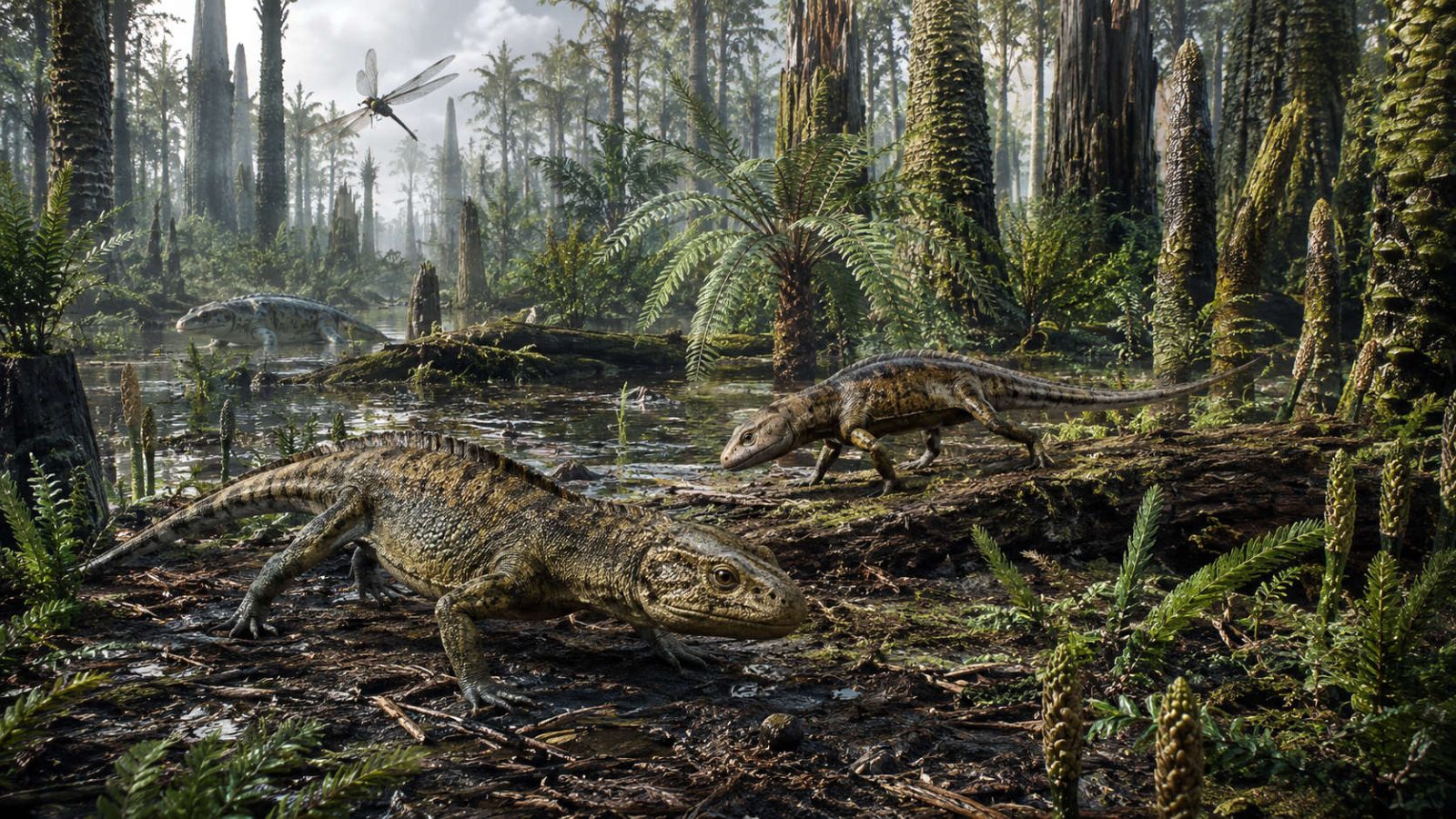
Before mammals, there were synapsids. Echinerpeton and Archaeothyris lived around 300 million years ago in humid Carboniferous coal forests. To the eye, they looked reptile-like, but their skulls carried the first clear sign of the mammal-side branch: one temporal opening behind each eye.
~308 Million years ago
Single temporal opening behind the eye.
Early Complex Sentience Emerges: Dimetrodon
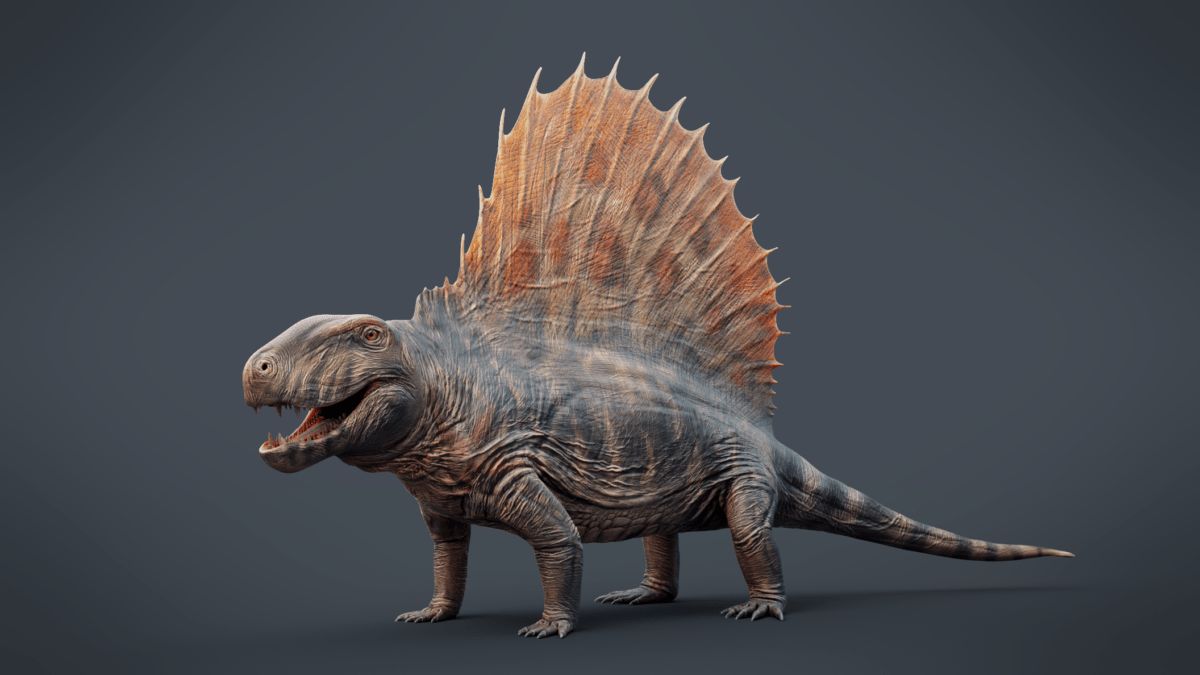
By about 280 million years ago, Dimetrodon was one of the best-known predators of the Early Permian. It stalked rivers and floodplains alongside caseid synapsids, large amphibians like Eryops, and a landscape of Calamites, Sigillaria, ferns, and early seed plants.
295 Million BCE
Complex Brains; Long-Term Memory; Early Complex Sentience.
First Therapsids
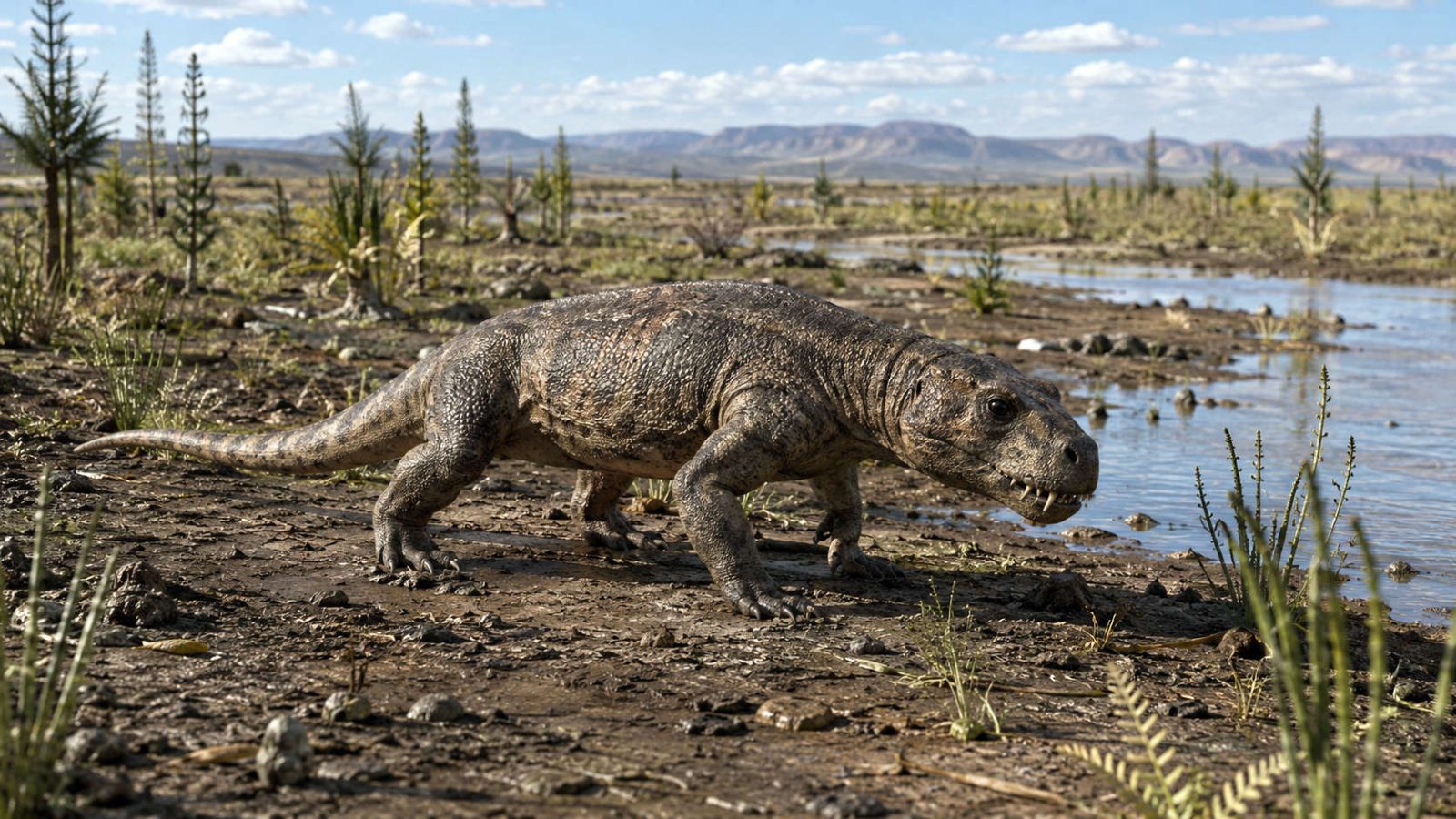
Around 272 million years ago, early therapsids such as Raranimus dashankouensis began shifting the mammal-side branch away from the older sprawling synapsid body plan. Its posture was still low and reptile-like, but the limbs were moving slightly farther under the body, while the skull and teeth show the first clear signs of a sharper, more active therapsid predator.
~272 Million years ago
A more upright posture.
First Cynodonts
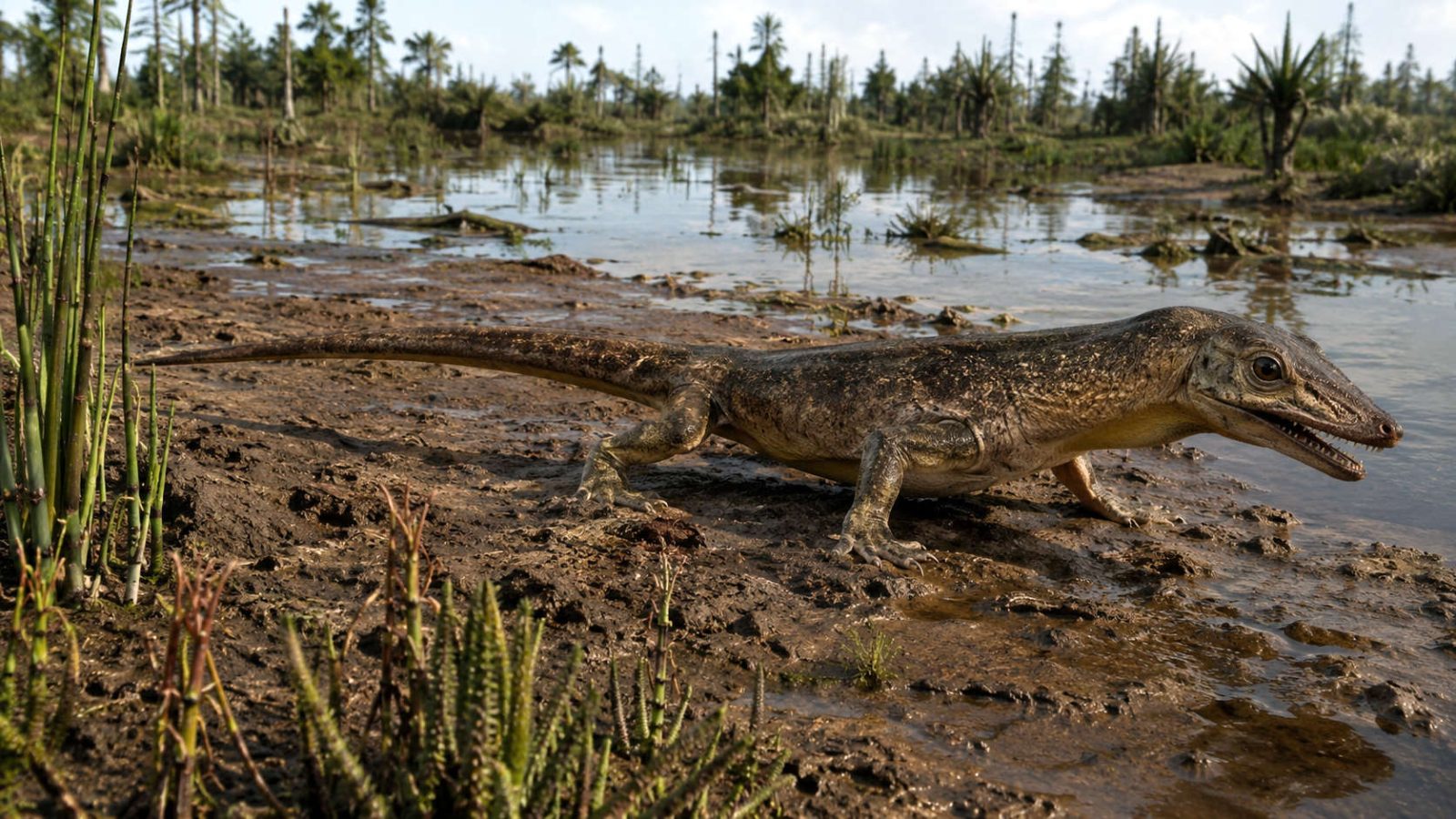
Around 260 million years ago, early cynodonts such as Procynosuchus marked a major tightening of the mammal-side branch. They were still non-mammalian therapsids, low-bodied and primitive in outward form, but their jaws, teeth, skull, and secondary palate were beginning to shift toward better chewing and breathing. This was not yet the mammal line in full bloom, but the roots were getting stronger.
~260 Million years ago
Mammal-like jaw and breathing.
The Synapsid World of the Late Permian
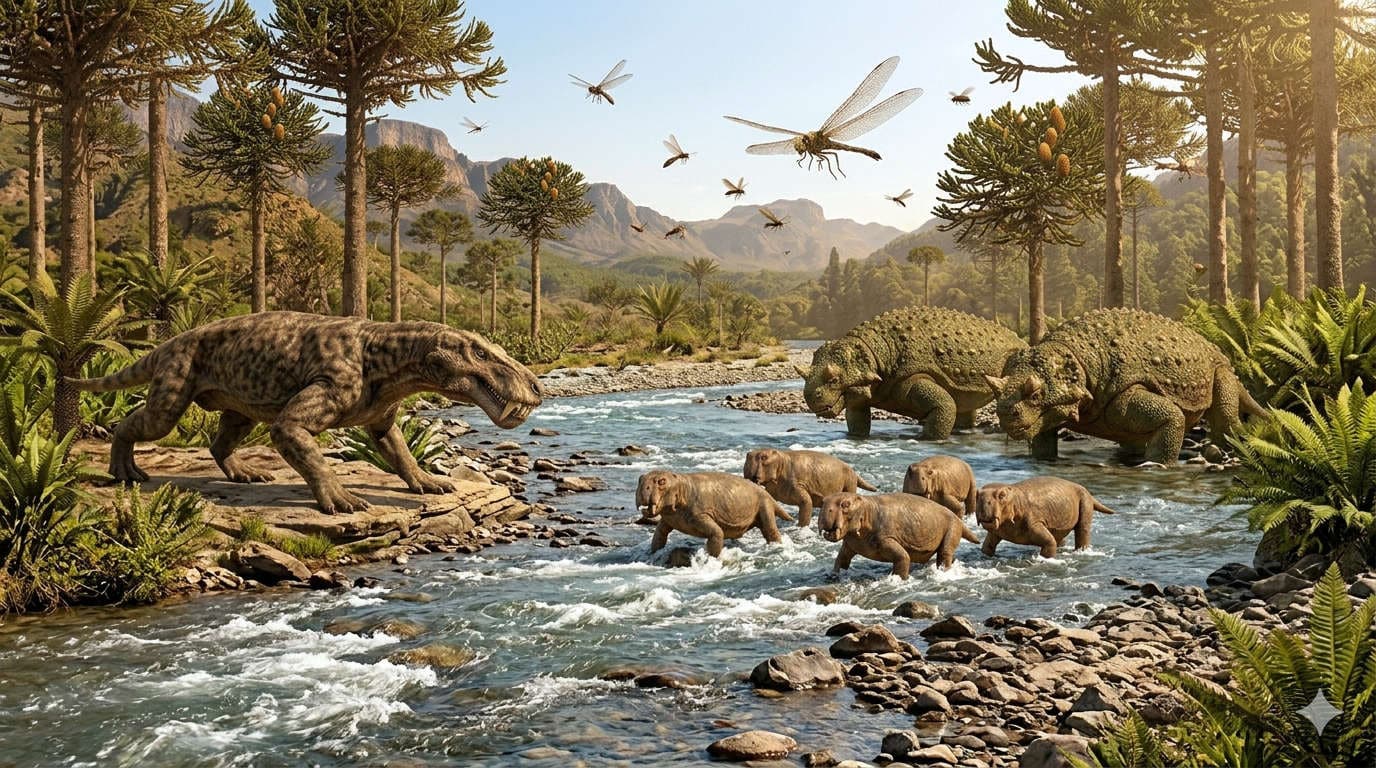
A Late Permian river world about 255 million years ago, where synapsids still ruled the land. A gorgonopsid stalks near the water while dicynodonts gather at the river’s edge and pareiasaurs move through the floodplain, alongside amphibians, large insects, and hardy pre-flowering plants.
255 Million years ago.
The P-T Extinction
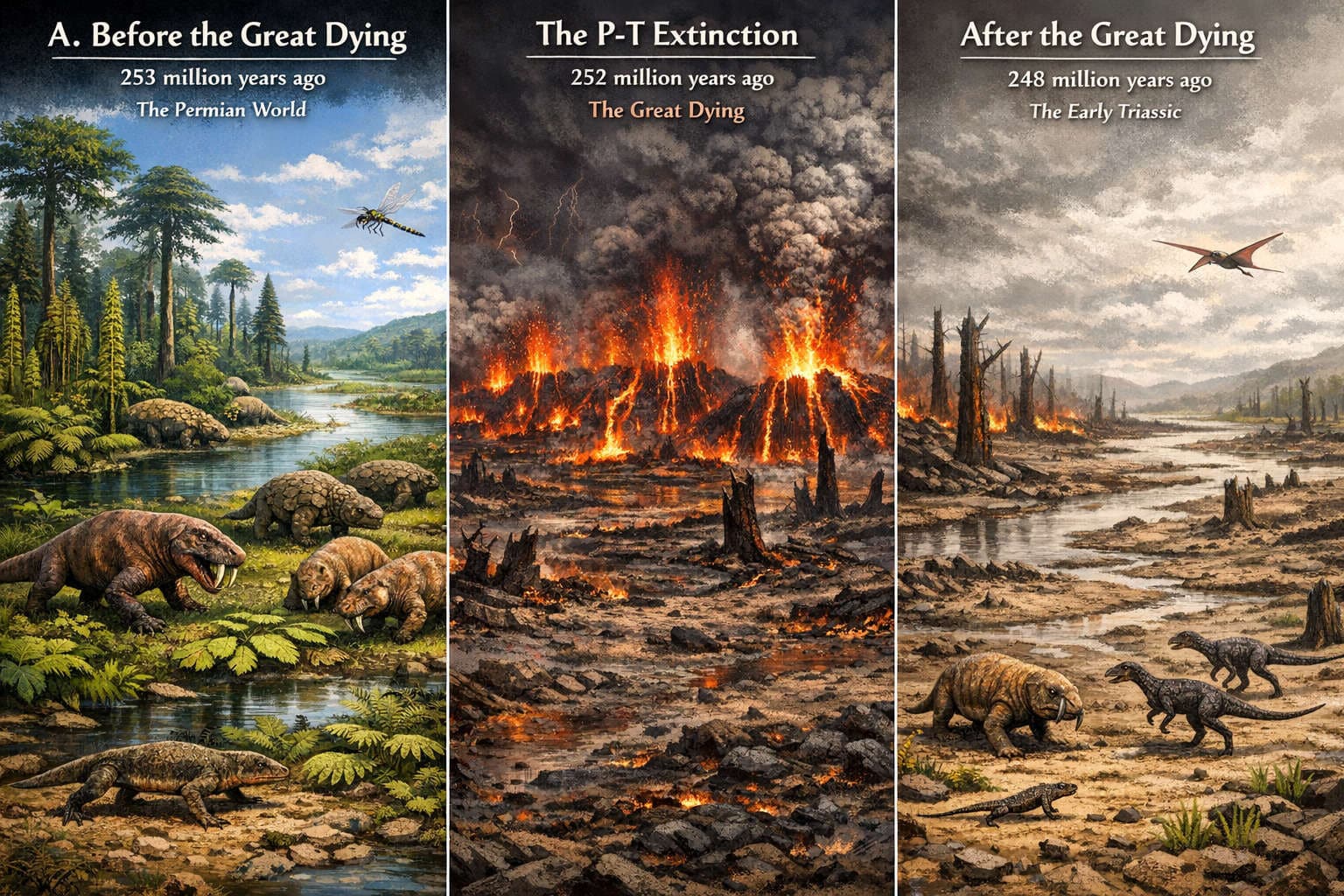
The Permian-Triassic extinction was not just the end of many species. It was a planetary reset that destroyed the old synapsid-dominated world and opened the door for the archosaur line that would later give rise to dinosaurs.
251,902,000 years ago (+/- 900 years).
Cause: Massive Volcanic Eruptions in Siberia
Mesozoic Era: Age of Dinosaurs
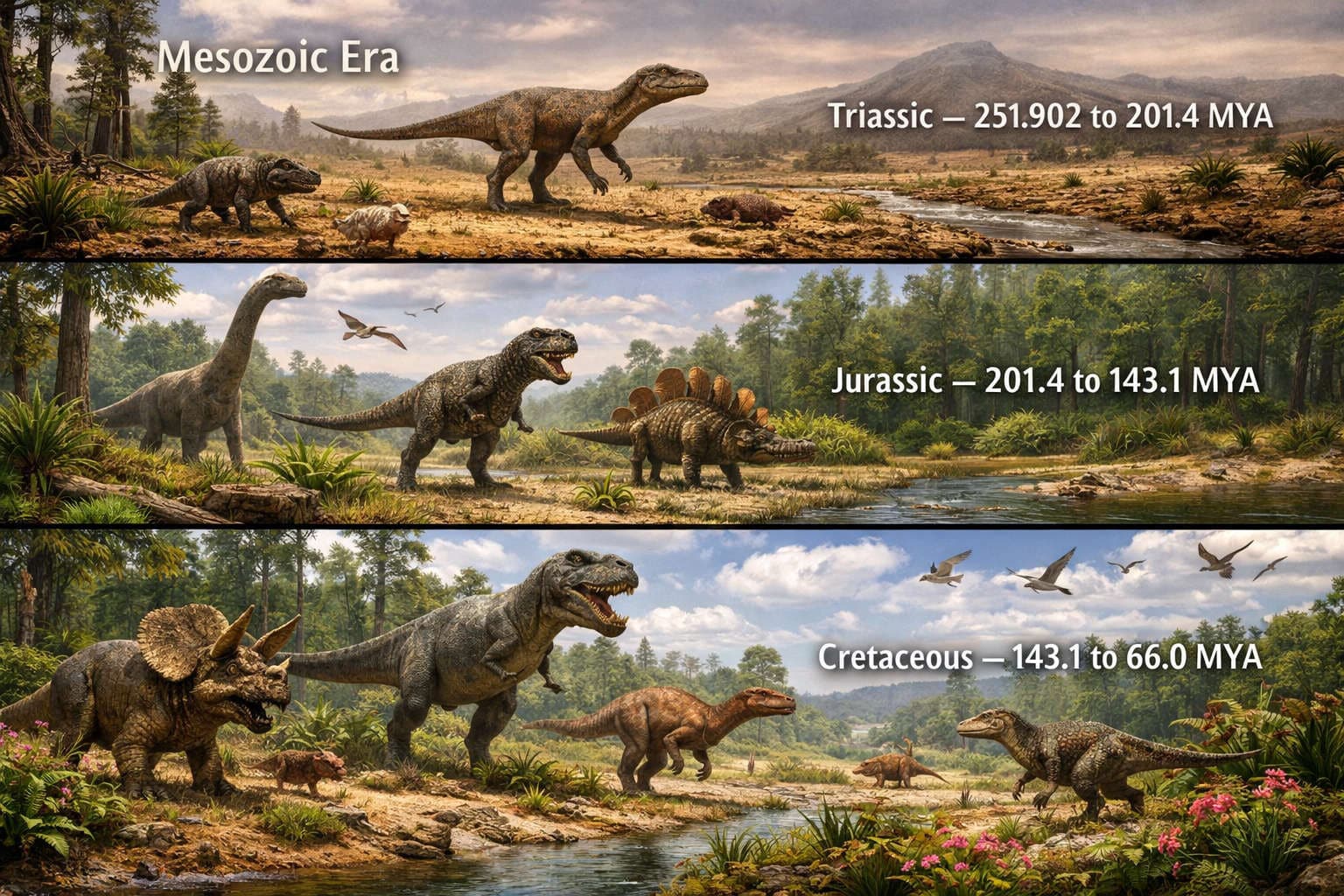
The Mesozoic era starts with the end-Permian mass extinction 252 million years ago. It ends the reign of dinosaurs with the K–Pg extinction 66 million years ago.
From 251.902 to 66.0 million years ago.
186 Million years: Dinosauria reigned from extinction to extinction.
XX/XY Sex System Emerges: A Tale of Mammalian Evolution

Around 240 million years ago, during the late Triassic period, a crucial evolutionary development unfolded within the lineage that would give rise to mammals. It is believed that the XX/XY sex-determination system emerged in a common ancestor of mammals, possibly within the genus Therapsida, a group of synapsids that exhibited both reptilian and mammalian traits.
240 Million Years Ago
First Mammaliaforms: Morganucodon
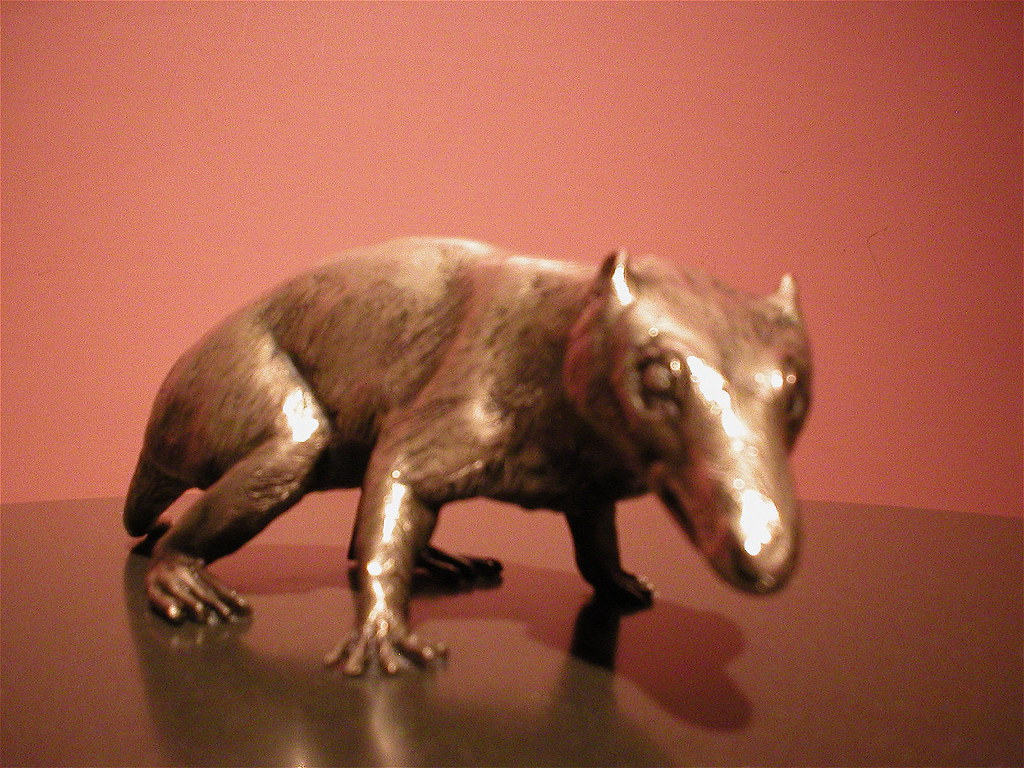
By the time of early mammaliaforms like Morganucodon, the body plan was already starting to feel familiar: small, furry, warm-blooded, long-tailed, and likely active at night. It was not a modern mammal, but it may have looked less like a “reptile” and more like a shrew-like or mouse-like creature from the deep past.
203 Million years ago (+/- 3 million)
Differentiated teeth and true mammalian jaw
Early Play Evolves in Mammals

Play evolved as one of the group survival traits. Lower play abilities evolved in mammals like rodents about 190 million years ago. Higer play abilities evolved in mammals like cats about 80 million years ago.
190 Million Years Ago (+/- 10 million years)
Parental care, brain plasticity, extended juvenile period
First Crown Mammals
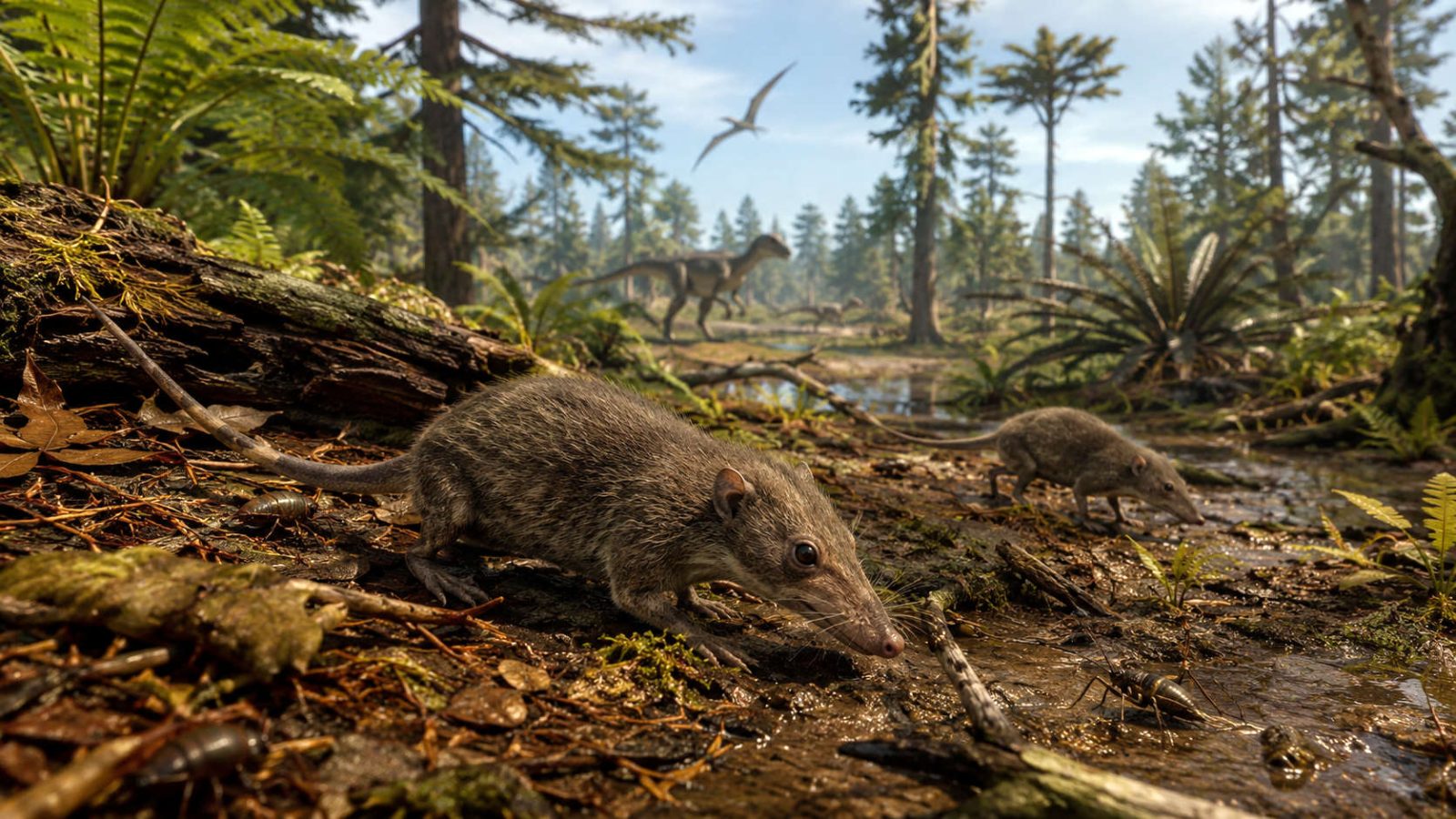
Around 170 million years ago, crown mammals began with the shared ancestor of all living mammal branches: monotremes, marsupials, and placentals. These early mammals were likely small, fur-covered, alert, and mostly hidden in the dinosaur-dominated world. They were not impressive by size, but they carried the living mammal story forward.
~165 Million years ago (+/- 5 million)
Complex Sentience Settles: Eomaia scansoria
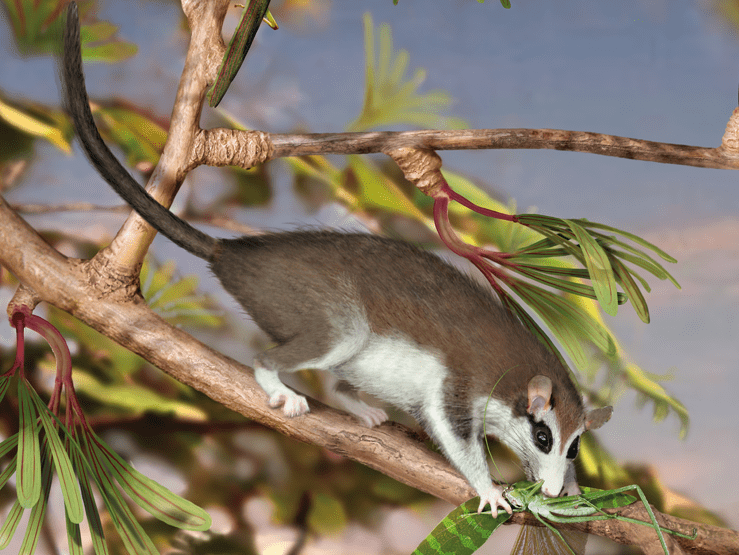
The rise of Eomaia scansoria, an early placental mammal, marks a definitive leap towards "Complex Sentience" in the evolutionary saga leading to humans. It's also plausible that it possessed a foundational level of self-awareness, or what can be termed as Proto Self-awareness. A rudimentary sense of self.
circa 125 Million BCE
Complex Brains; Long-Term Memory; Complex Sentience; Likely Proto Self-aware.
Appendix
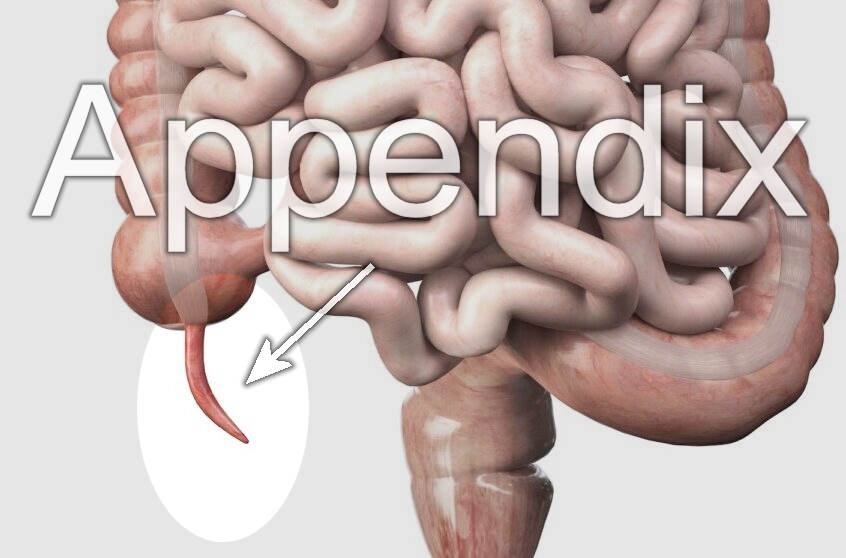
The appendix is an example of a Phenotype Variation -- a trait that varies among individuals. In fact, something like 1 in 100,000 people are born without an appendix.
80 Million BCE
Higher Play Evolves in Social Mammals

Play evolved as one of the group survival traits. Lower play abilities evolved in mammals like rodents about 190 million years ago. Higer play abilities evolved in mammals like cats about 80 million years ago.
80 Million Years Ago (+/- 10 million years)
Enlarged neocortex
Cenozoic Era: Age of Mammals & Birds
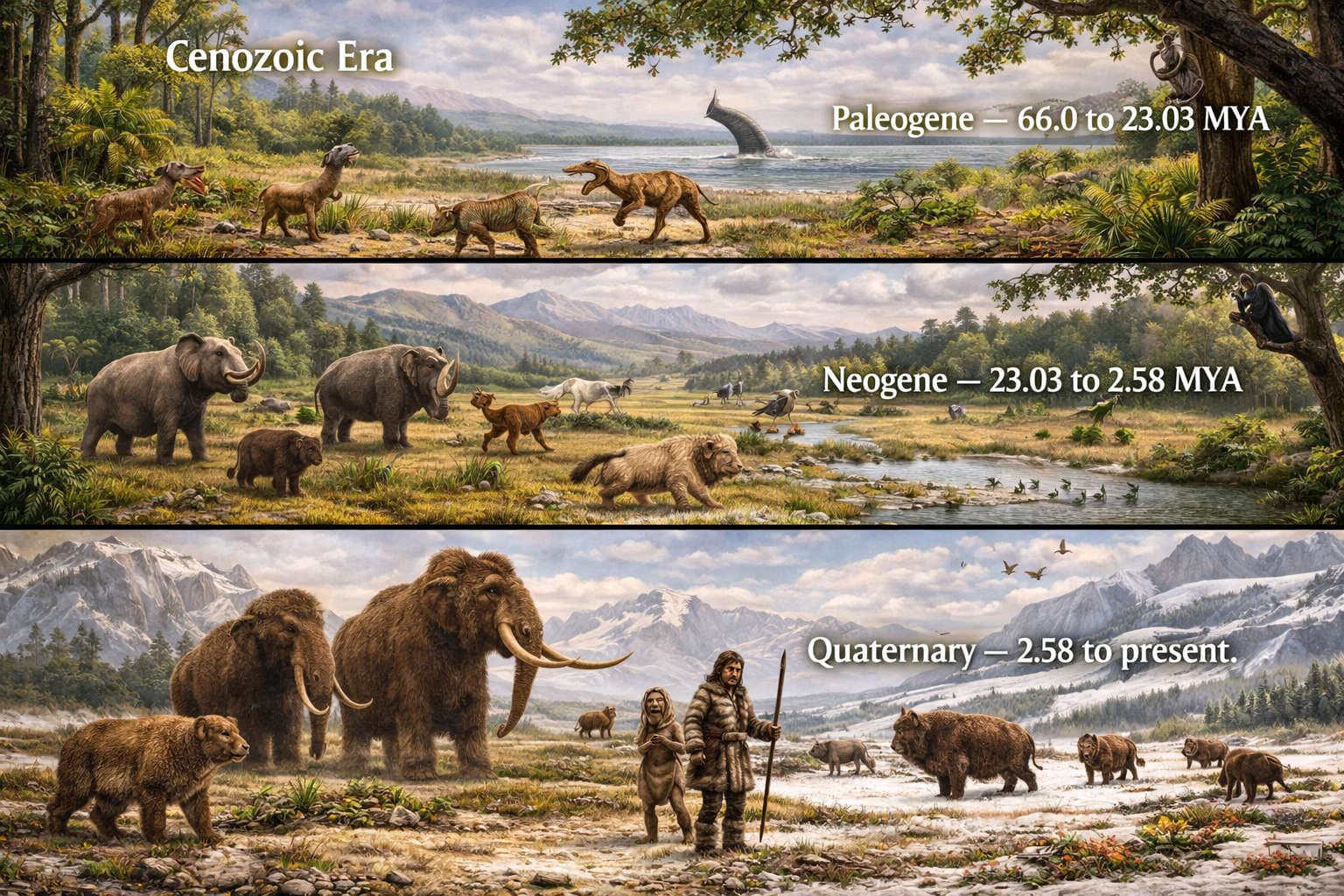
The Cenozoic era starts with the K–Pg extinction 66 million years ago. That event marks the sudden end of the reign of dinosaurs and the rise of mammals and birds.
66.04 million years ago to the present.
66 Million years: From extinction to society.
Purgatorius — Earliest known proto-primate.
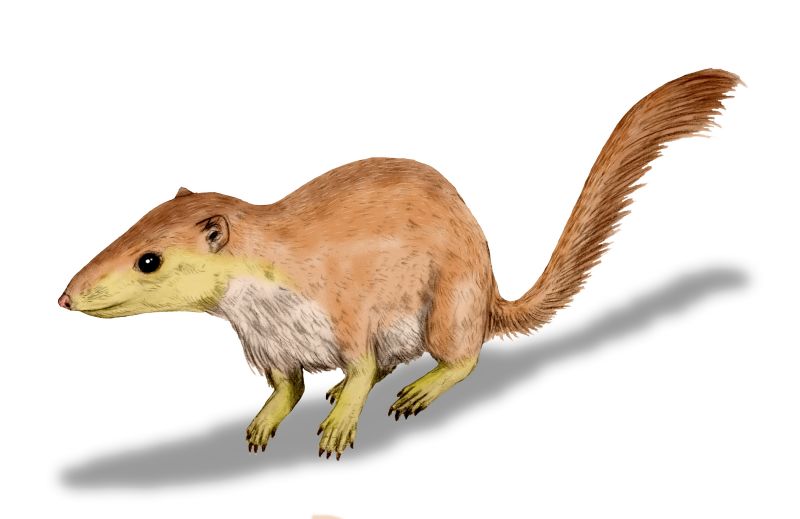
Purgatorius unio, from the Late Paleocene of North America, believed to be the earliest primate, pencil drawing, digital coloring. © N. Tamura (CC BY-SA)
66 Million BCE
Grasping hand and flexible ankles
Opposable Thumb Emerges

Around 60 million years ago, the early ancestors of primates began to develop a crucial adaptation: the opposable thumb. This evolutionary milestone marked the beginning of increased dexterity.
60 Million Years Ago
Plesiadapis: First fruit-insect eaters.
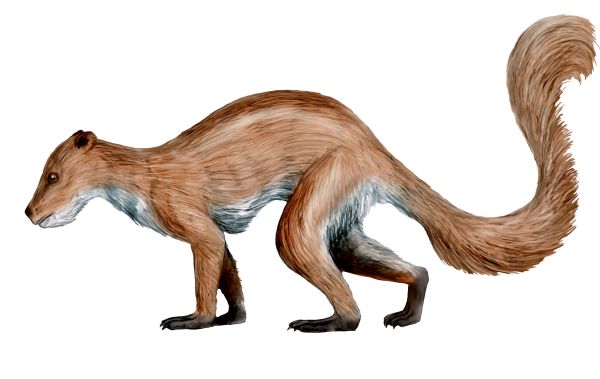
Plesiadapis, a proto-primate, is an example of a fruit-insect eater likely similar to our direct-line ancestors around this time.
56 Million BCE (+/- 2 million)
Enhanced color perception, Diet-driven brain growth
Early Self-Awareness: Miacis
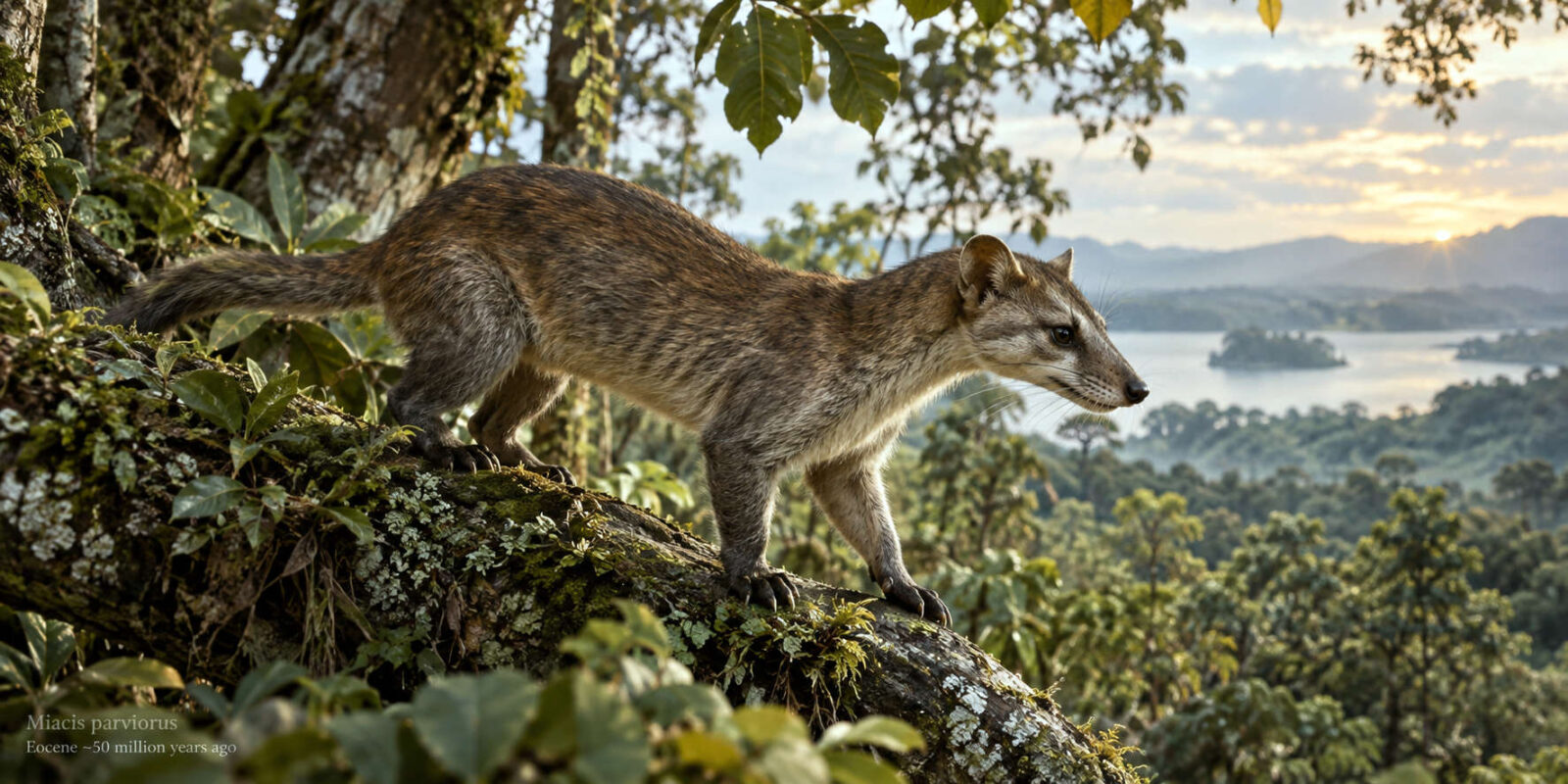
Emerging in the lush forests of the Eocene, Miacis signifies an experimental moment in the evolution of cognitive abilities among mammals. As a basal member of the Carnivora, this small, tree-dwelling creature exhibited behaviors and social dynamics suggesting the early stages of self-awareness.
50 Million Years Ago
Territory memory, where things are, hippocampus development
Ape Thumb Evolves
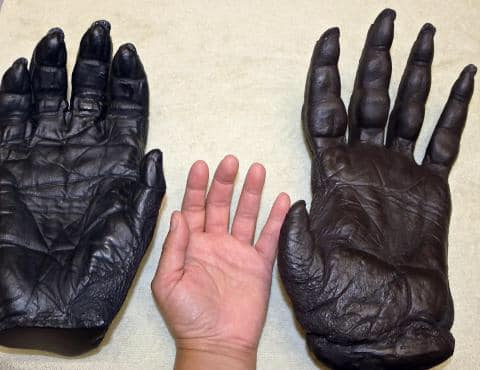
Gorilla on right, human, then orangutan. Orangutan-like hands evolved about 30 mya, gorilla-like hands evolved about 12 mya, and human-like hands evolved about 3 mya.
32 Million Years Ago (+/- 2 million)
Early Intelligence Emerges: Aegyptopithecus zeuxis
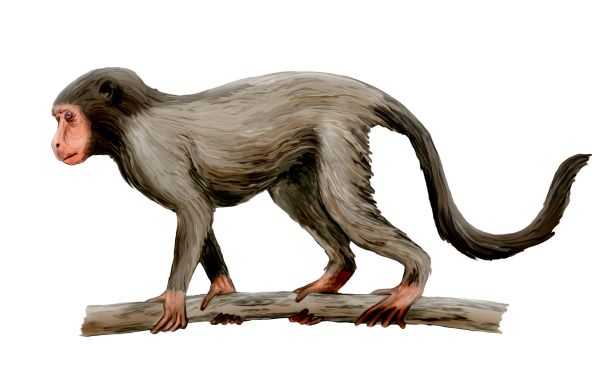
True Primate: Within mammals, only primates have binocular vision, grasping hands, and flat nails--instead of claws.
30 Million BCE
Complex Brains; Long-Term Memory; Complex Sentience; Semi Self-awareness settles in.
Baboons Branch Off: Old World Monkeys

Our last tails! The last common ancestor with humans and old-world monkeys lived around 29 million years ago.
27 Million Years Ago (+/- 2 million)
Large neocortex, Coalition politics emerge
Panamacebus transitus: Earliest Known Monkey in the Americas
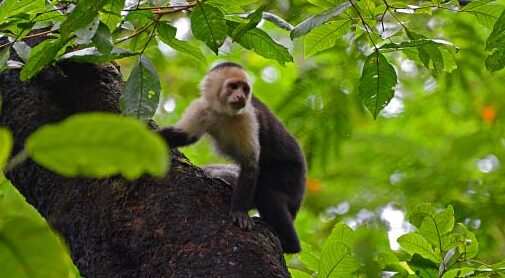
circa 21 Million Years Ago
Emergence of Blood Type Variability in Primates
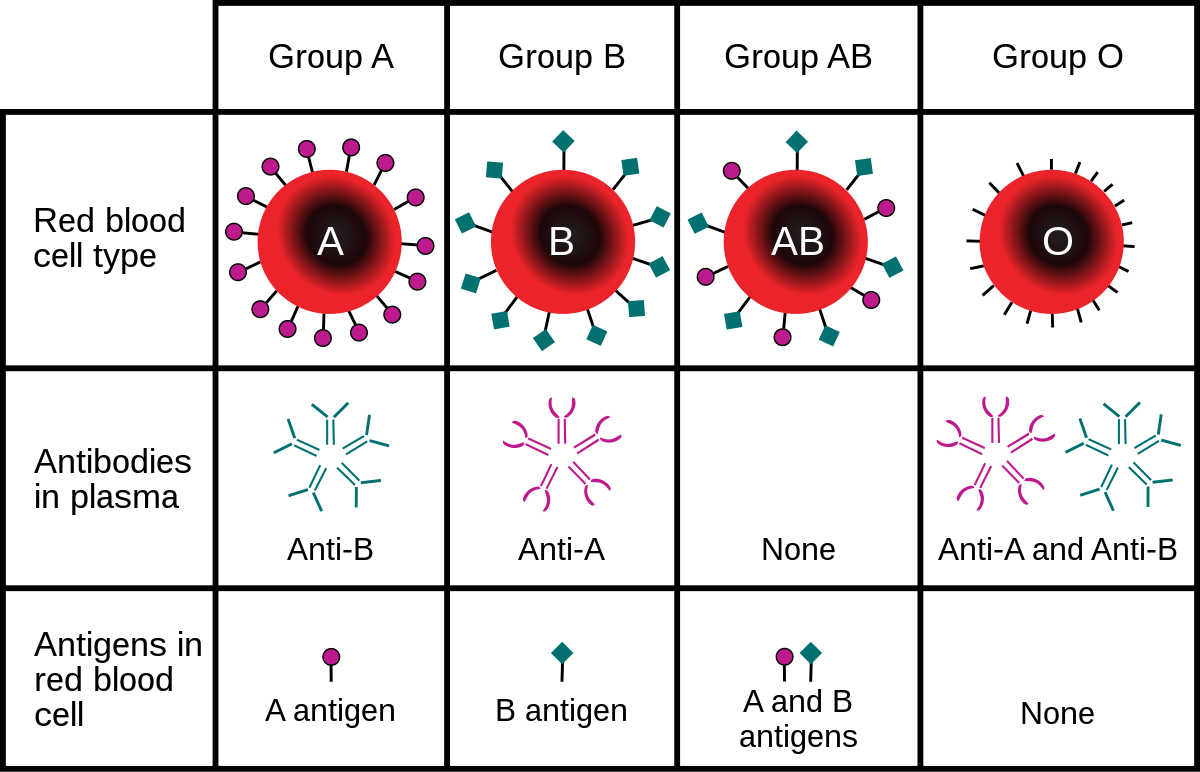
circa 20 million years ago
Phenotype Variations
Genus Proconsul (Self-Awareness Settles)
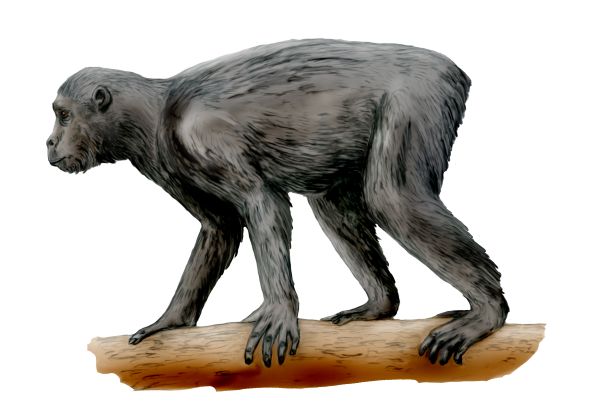
Great Apes LCA candidate: Proconsul, an inhabitant of the Miocene forests in East Africa, stands as a landmark in the evolutionary journey toward self-awareness.
20 Million Year Ago (+/- 2 Million Years)
Complex Brains; Long-Term Memory; Complex Sentience; Maybe Self-aware; Likely Simple EI.
Great Apes: Medicine Emerges
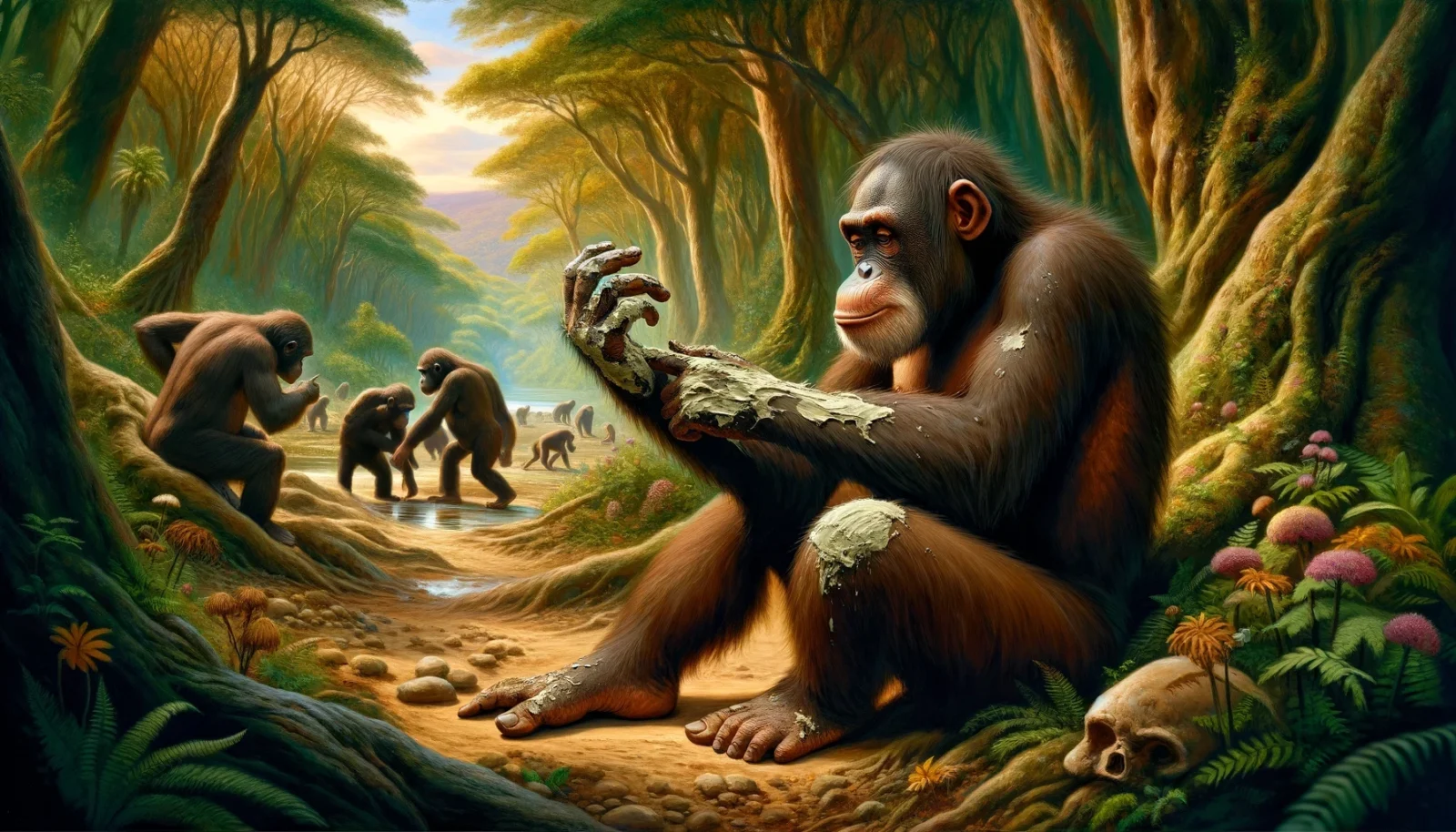
By about 18 million years ago, the great apes could experience time the way we do. They remember the past while living in the present and anticipating the future. In this case, an early great ape is applying mud to a wound he just experienced while anticipating the mud will soothe the pain and help him feel better in the future.
18 Million Years Ago, ± 3 million years
Causal reasoning, Early prefrontal integration
Gibbons Branch Off: Genus Hylobates

Today, there are about 20 species of gibbons which belong to the family Hylobatidae, which is further divided into four genera: Hylobates (the largest group, including the white-handed gibbon), Hoolock (hoolock gibbons), Nomascus (crested gibbons), and Symphalangus (the siamang).
17 Million Years Ago, ± 1 million
Long-distance pair bonding, Fine motor control
Emergence of the Great Apes (Great Apes LCA)
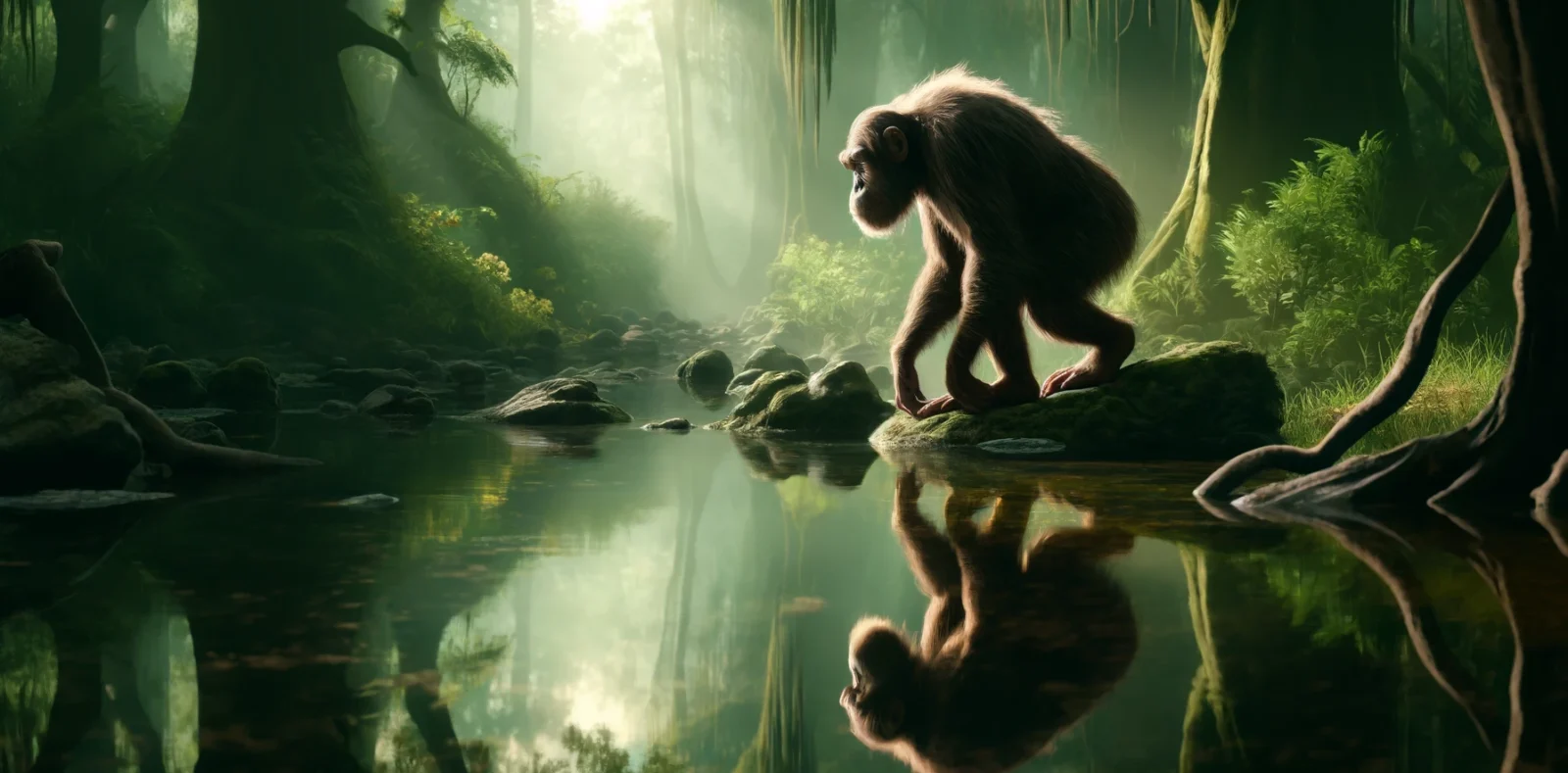
Circa 18 million years ago, the Proconsul, an inhabitant of the Miocene forests, stands as a landmark in the evolutionary journey toward self-awareness. Here a Proconsul ponders his image in a local watering hole.
16.5 Million Years Ago (+/- 2 Million Years)
Tool potential begins, Neocortical expansion
Genus Kenyapithecus: EI Emerges
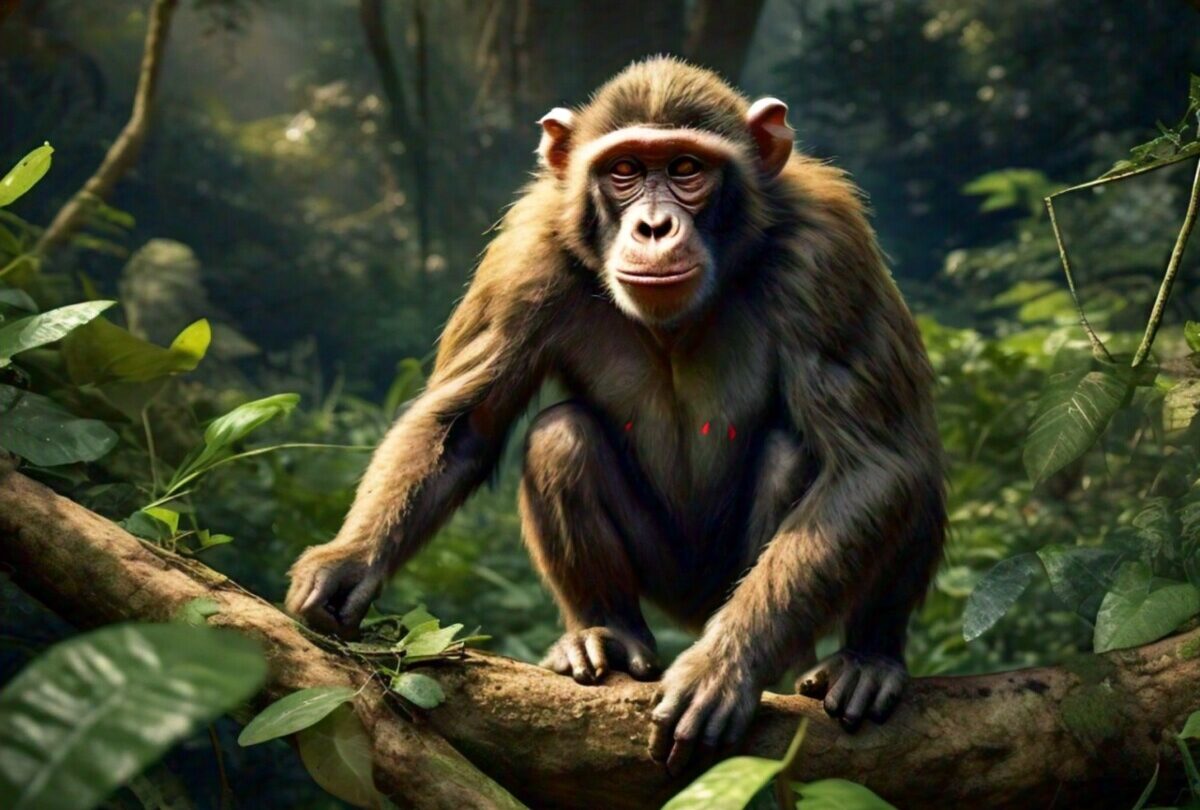
Emotional intelligence did not begin with humans. Its roots reach deep into the great ape line, where survival depended not only on strength or instinct, but on noticing others, managing reactions, and living inside social relationships. In Kenyapithecus, we may be looking near the dawn of that deeper emotional world.
Lived 16 to 14 Million Years Ago
Prefrontal–limbic integration, Reading others, Modulating reaction
Laughter Emerges

The roots of laughter can be traced back to our common ancestors with other great apes, living around 10 to 15 million years ago. Before this time, the time when emotional intelligence evolved, laughter as we know it did not exist.
14.5 Million Years Ago (+/- 2 million)
Limbic vocalization pathways, Breath control
Skin Color Diversity Across and within Primate Species
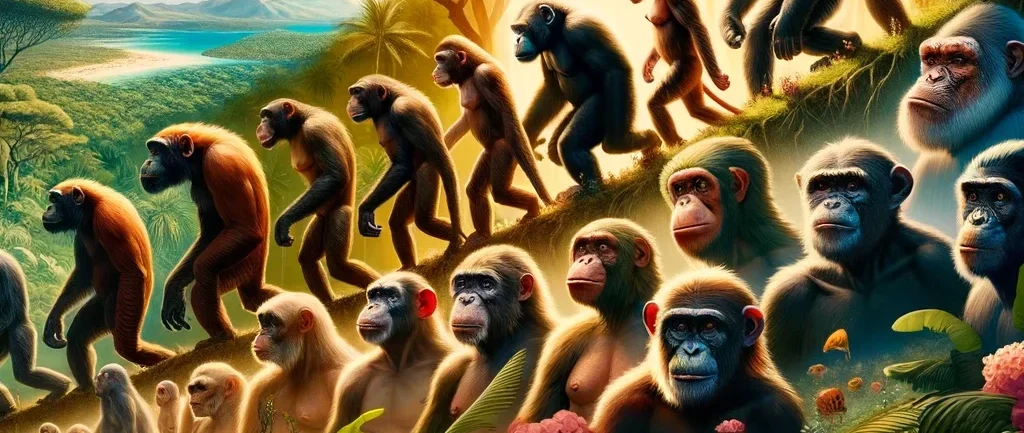
Long before humans existed, primates already displayed visible variation in skin, hair, and exposed body color. Color was not a ranking system. It was biology responding to sunlight, climate, ancestry, signaling, and time.
By 14 Million Years Ago
Phenotype Variations
Genus Dryopithecus: Cultural Transmission Emerges
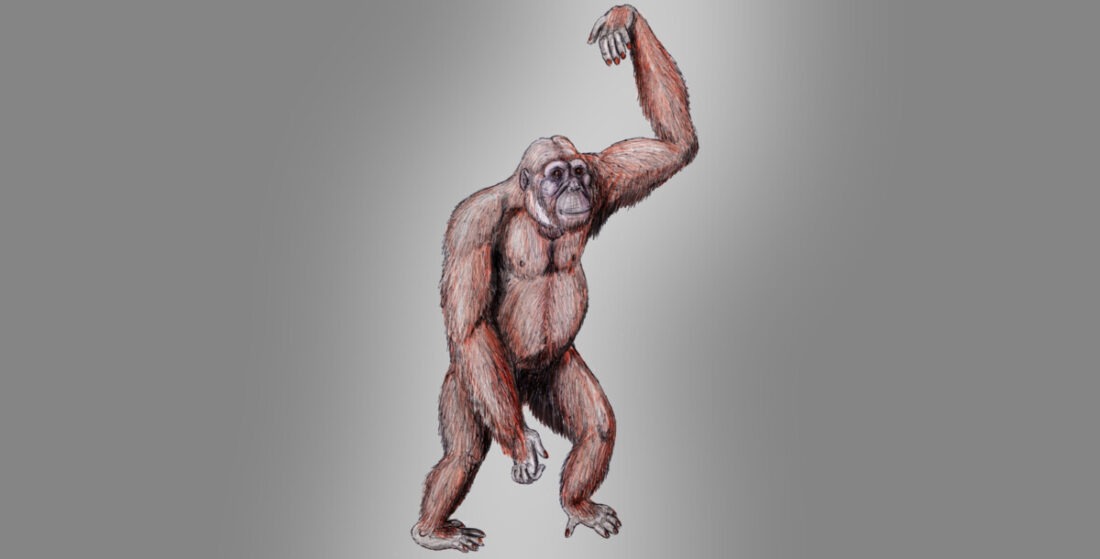
Around 13 million years ago, Dryopithecus lived among the branches of Miocene forests. Young apes learned by watching adults: what to eat, where to climb, who to trust, and how to survive.
Emerged 13 mya, extinct 9 to 7 mya
Cultural Transmission
Gorillas Branch Off: Genus Nakalipithecus
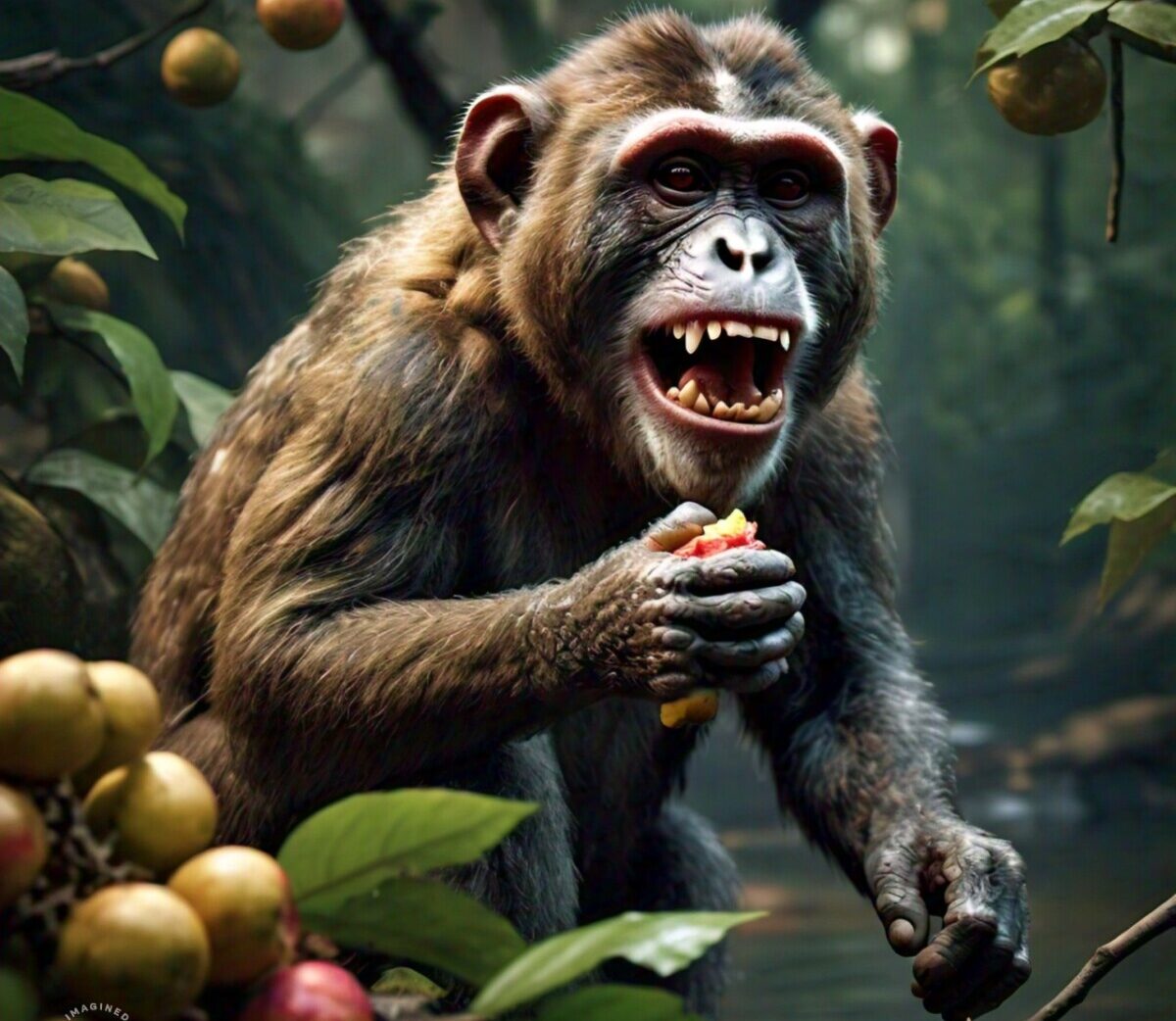
Last Gorilla-Chimp-Human ancestor: The last common ancestor of gorillas, chimpanzees, and humans likely lived about 8 to 10 million years ago.
Emerged 10 mya, extinct 9.8 to 9 mya.
Ancestral Hominids (us, pre-split)
Transition from Trees to Savannah Begins
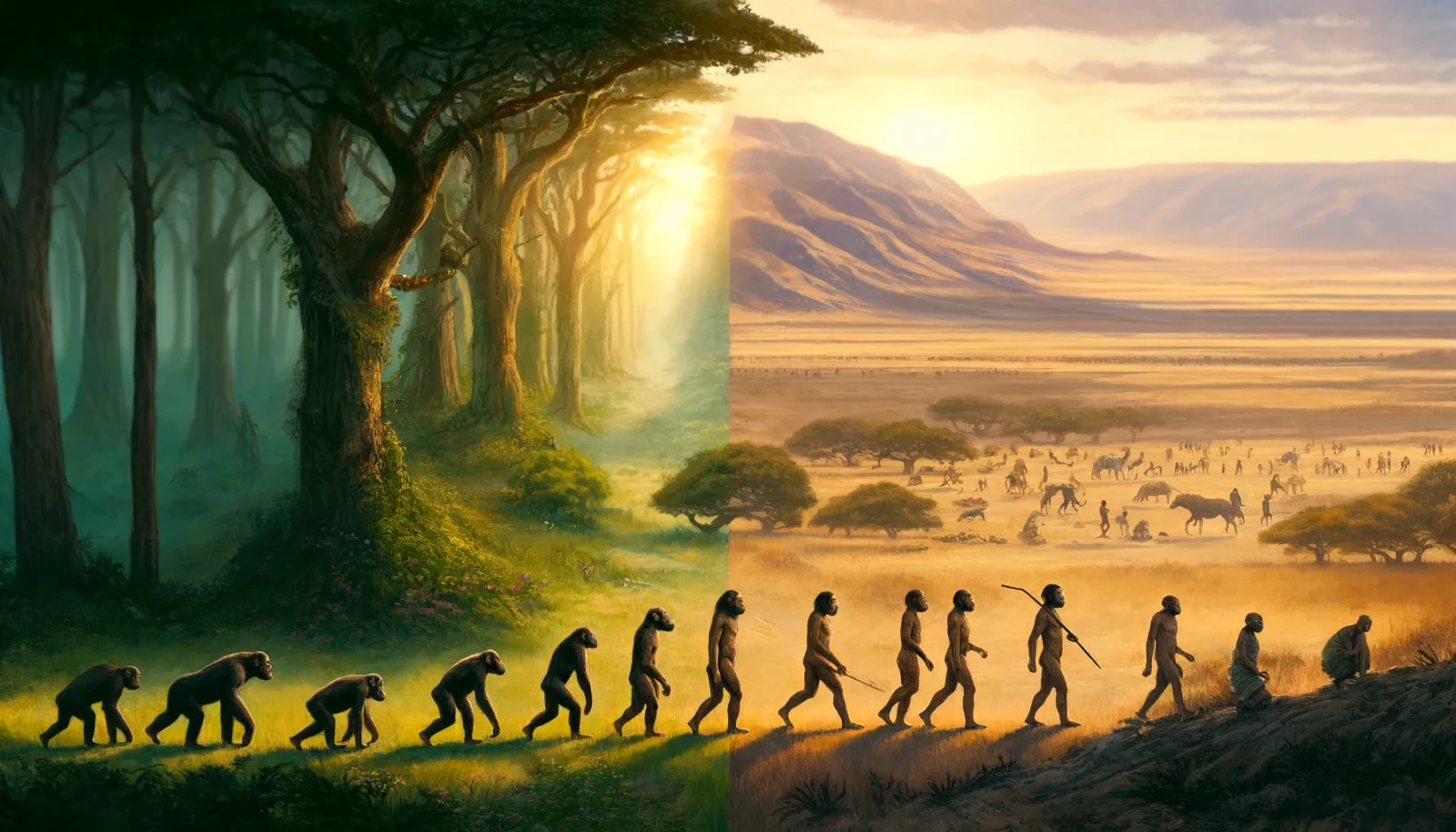
Beginning about 9 million years ago, our ancestors began evolving from forests to savannahs over about 7 million years. By about 2 mya, our ancestors were fully bipedal carrying things like stone axes and sticks for hunting and fighting off animals.
9 Million Years Ago
Enhanced spatial mapping and endurance planning
Chimpanzees Branch Off (CHLCA)
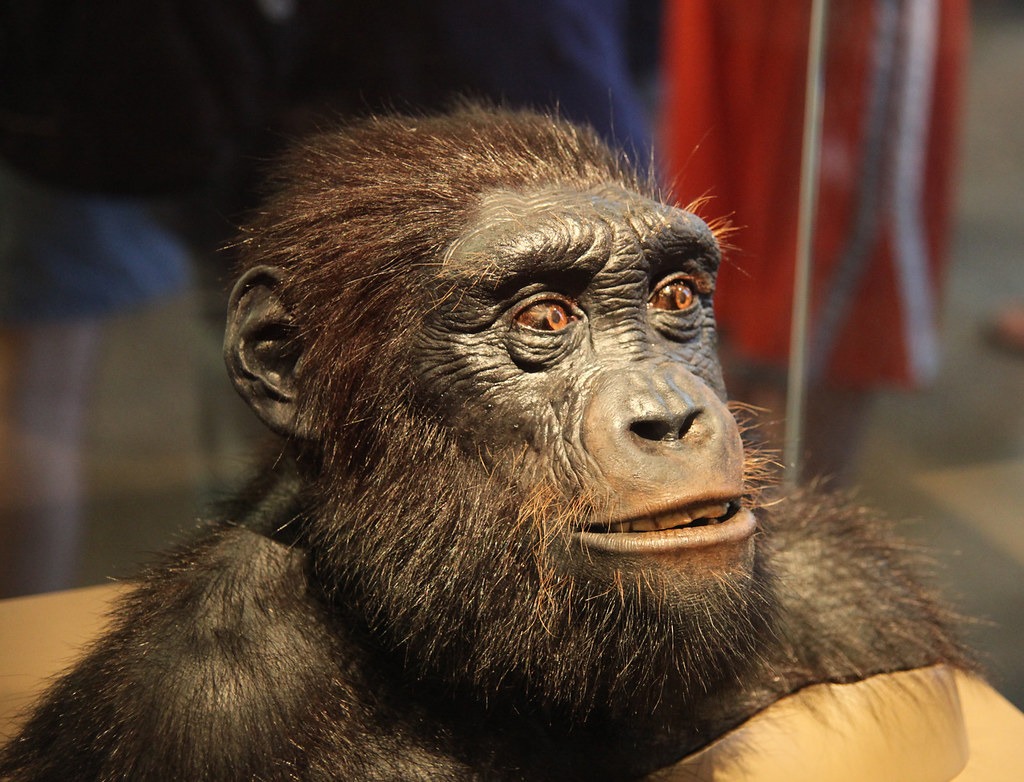
"<a href="https://www.flickr.com/photos/23165290@N00/7283201268" target="_blank" rel="noopener noreferrer">Sahelanthropus tchadensis adult male - head model - Smithsonian Museum of Natural History - 2012-05-17</a>" by <a href="https://www.flickr.com/photos/23165290@N00" target="_blank" rel="noopener noreferrer">Tim Evanson</a> is licensed under <a href="https://creativecommons.org/licenses/by-sa/2.0/" target="_blank" rel="noopener noreferrer">CC BY-SA 2.0</a>
7.5 Million Years Ago
Advanced coalition politics and tool precursors
Genus: Sahelanthropus (Walking Upright)
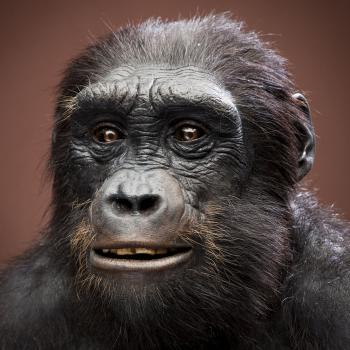
7 Million BCE
Partial bipedal posture + visual reorientation
Genus: Orrorin
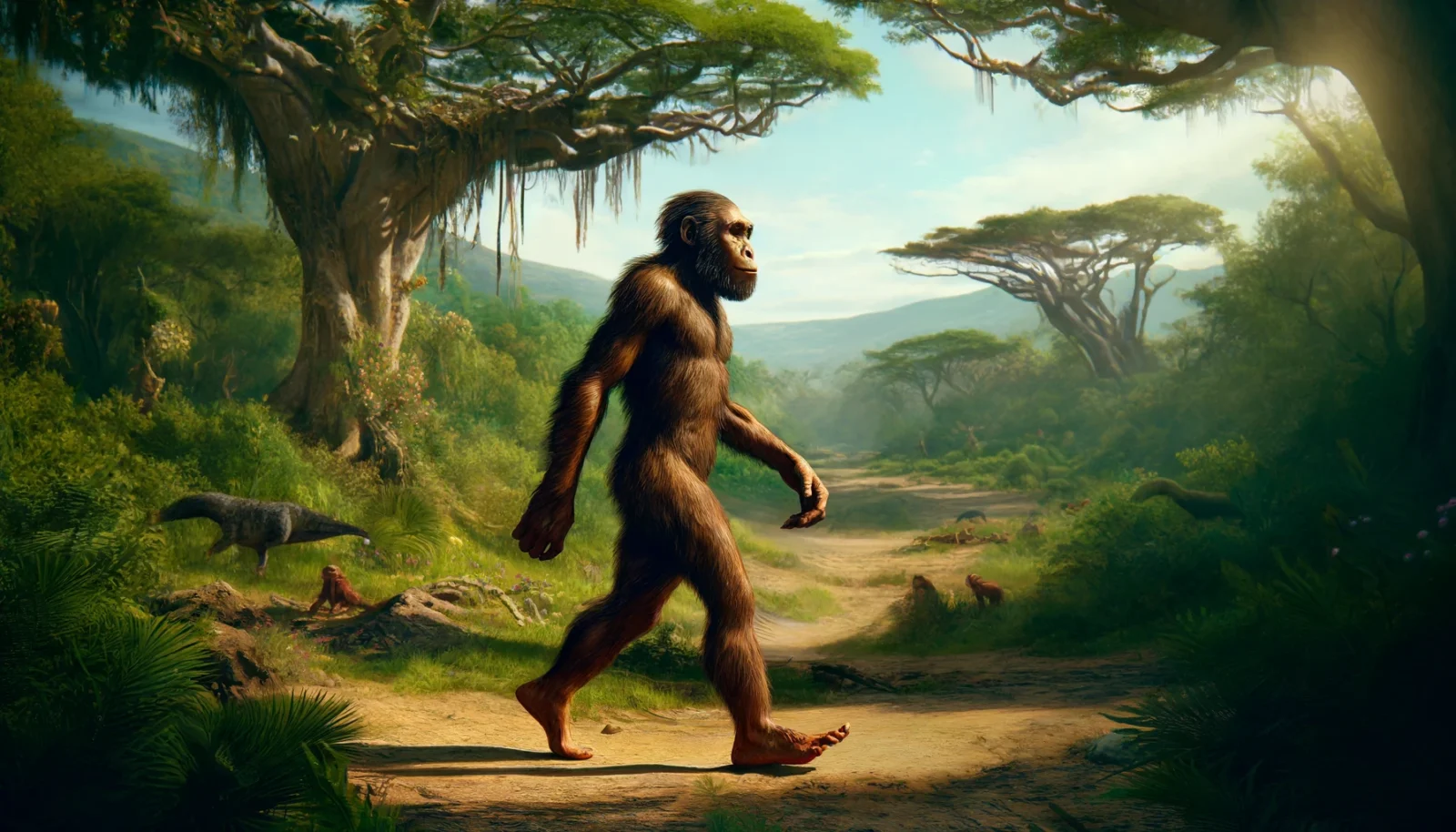
Imagined image of Orrorin tugenensis in a natural landscape, approximately 6 million years ago. The scene captures this early human ancestor walking upright, showcasing its bipedal nature in a lush, prehistoric African forest setting.
6 Million Years Ago (Maybe Us)
Femoral adaptation, Motor cortex recalibration
Genus: Ardipithecus
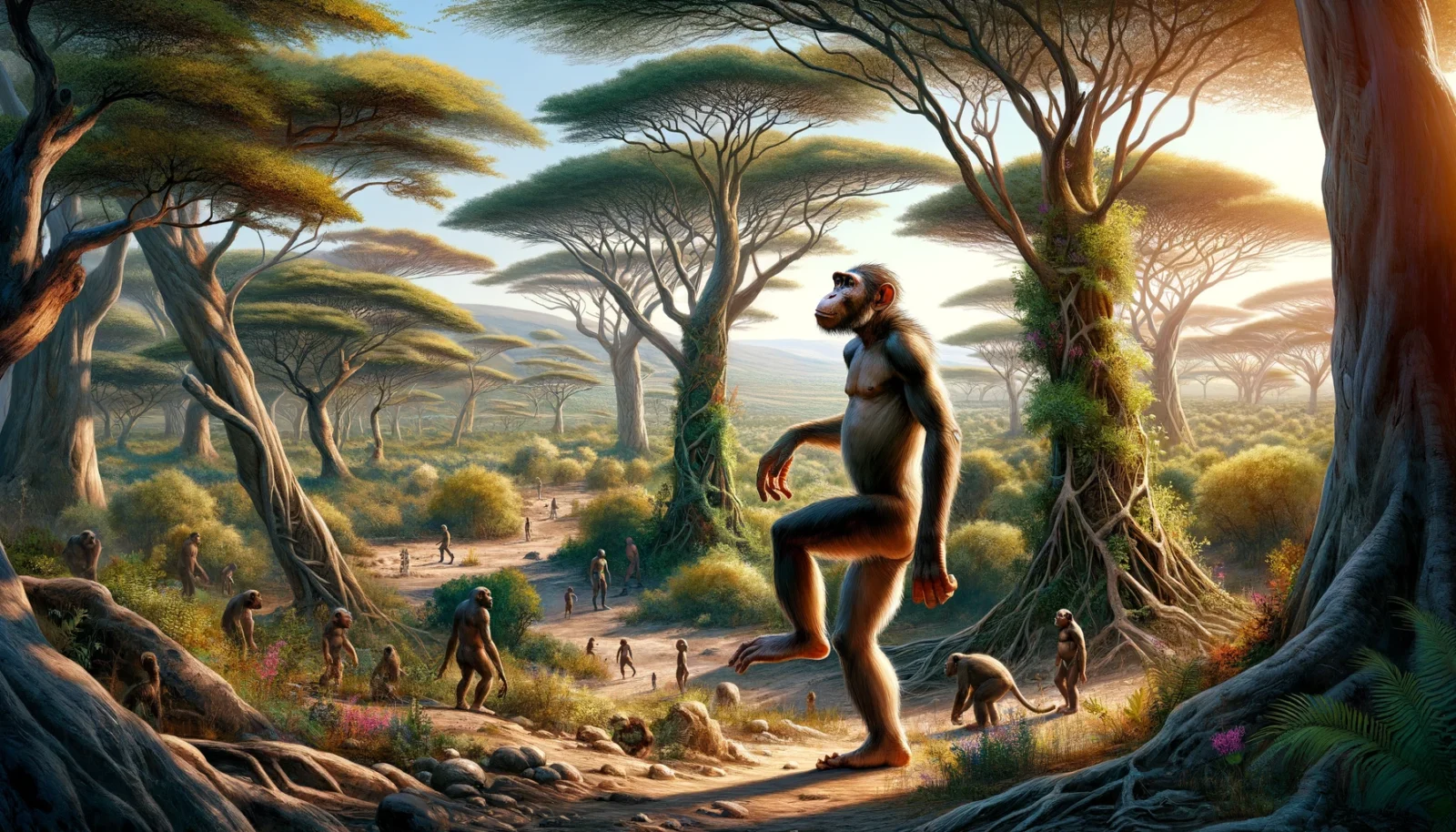
Imagined image depicting the genus Ardipithecus in an ancient African landscape. The scene captures the dual adaptations for upright walking and tree-climbing.
Lived 5.8 to 4.4 Million Years Ago (Maybe Us)
Reduced aggression, Reduced canine dimorphism
Echoes of Early Steps: The Laetoli Footprints

Imagined image: Captured in ancient volcanic ash at Laetoli, Tanzania, these 3.66 million-year-old footprints belong to Australopithecus afarensis, showcasing one of the earliest strides toward bipedalism in our evolutionary history.
3.66 Million Years Ago
Hominin
Early Wood tools
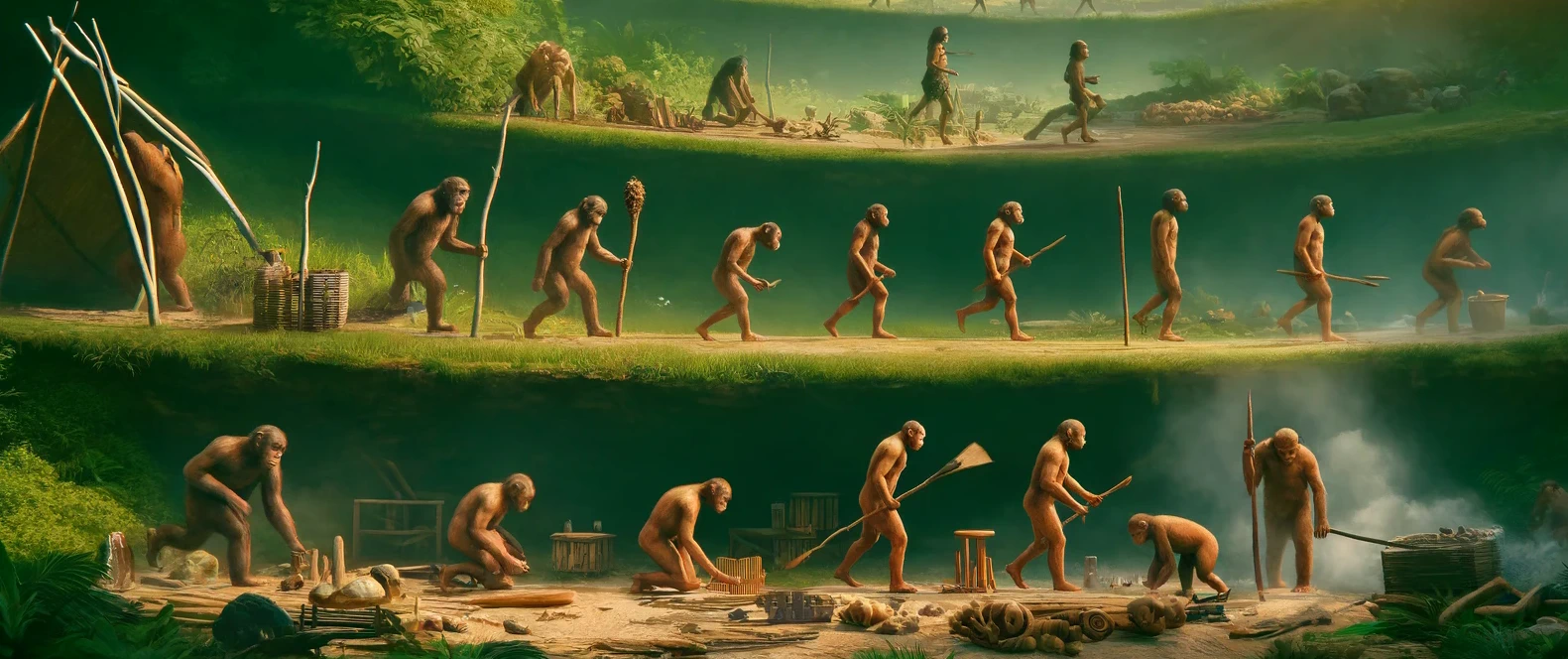
Imagined Image: The evolution of wooden tool use by early hominins. A walking stick around 3.3 million years ago, aiding mobility and providing defense. Small, sharpened sticks used for intricate tasks like termite extraction around 2.6 million years ago. Spears and digging sticks around 1.76 million years ago, vital for hunting and foraging. Advanced wooden constructs such as shelter frames and simple rafts emerge around 500,000 years ago. Hafted tools with stone-tipped spears around 300,000 years ago.
3.4 Million Years Ago
cognitive sequencing + motor precision + future modeling
Collective Learning Emerges
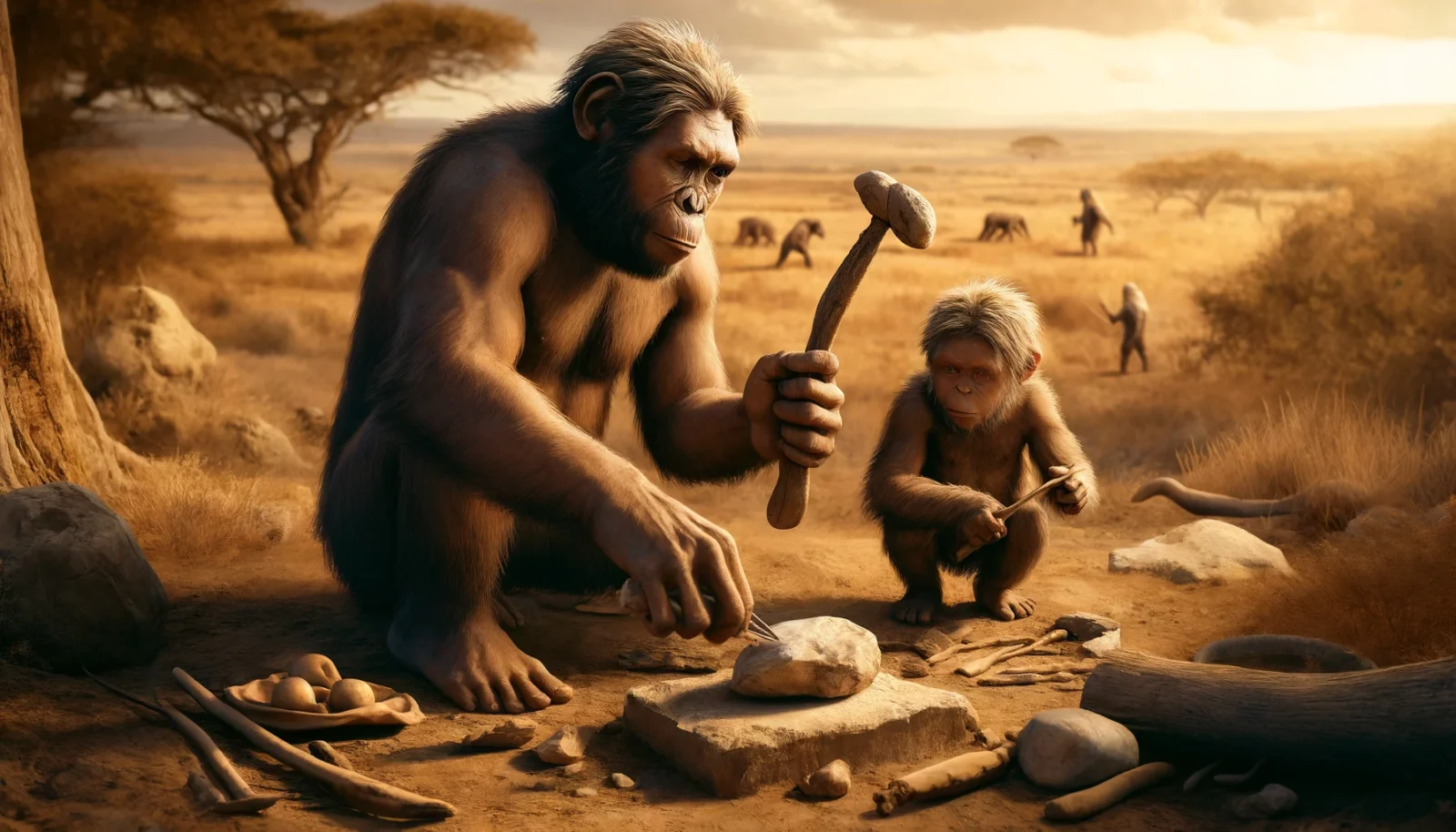
Collective learning, where a parent teaches a child, started long before primates, but something like our modern approach to showing our young how to live likely started about 3 million years ago, perhaps wit a species like australopithecus in a place like Kenya, Africa.
3.3 Million Years Ago
Early Stone Tools
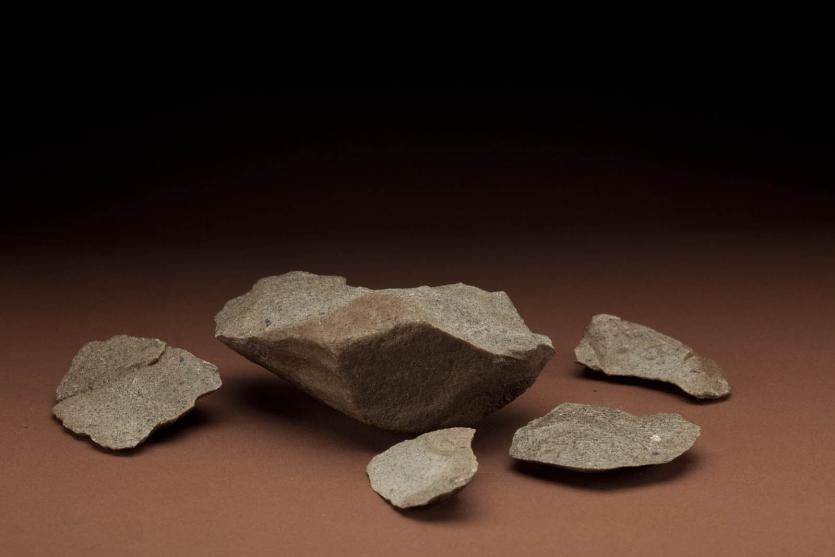
3.3 Million BCE (Hominins)
Prefrontal Cortex Expansion, Internal 3D modeling
Human Laughter Emerges

Cheerful children's laughter
3 Million Years Ago
+/- 1 million years
Human Thumb Evolves
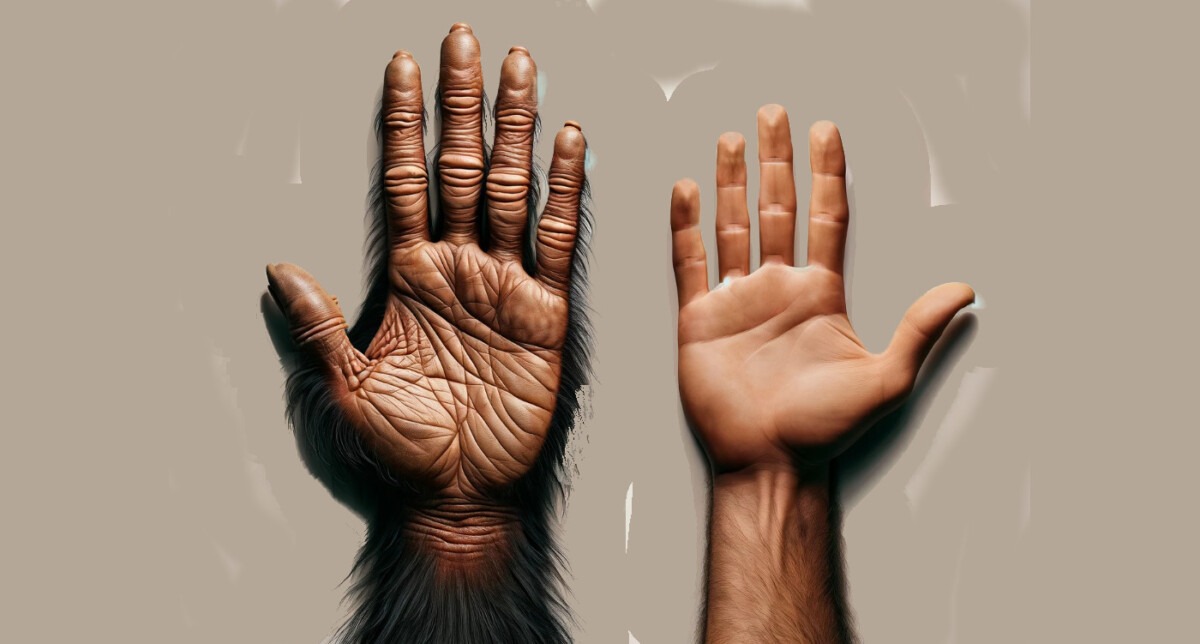
3 Million Years Ago (+/- 400,000 years)
Genus: Australopithecus
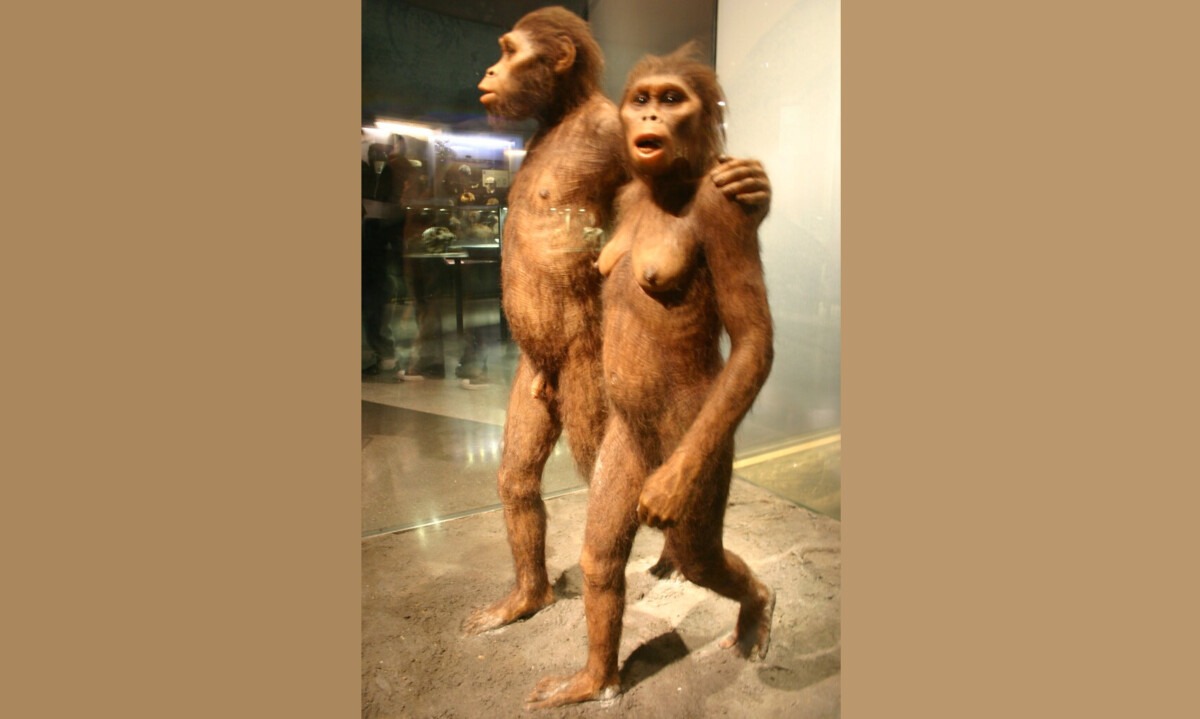
2.9 Million BCI
Hominin, Us, From 4.2 to 2 MYA
Homo habilis: Our Intelligence Settles.
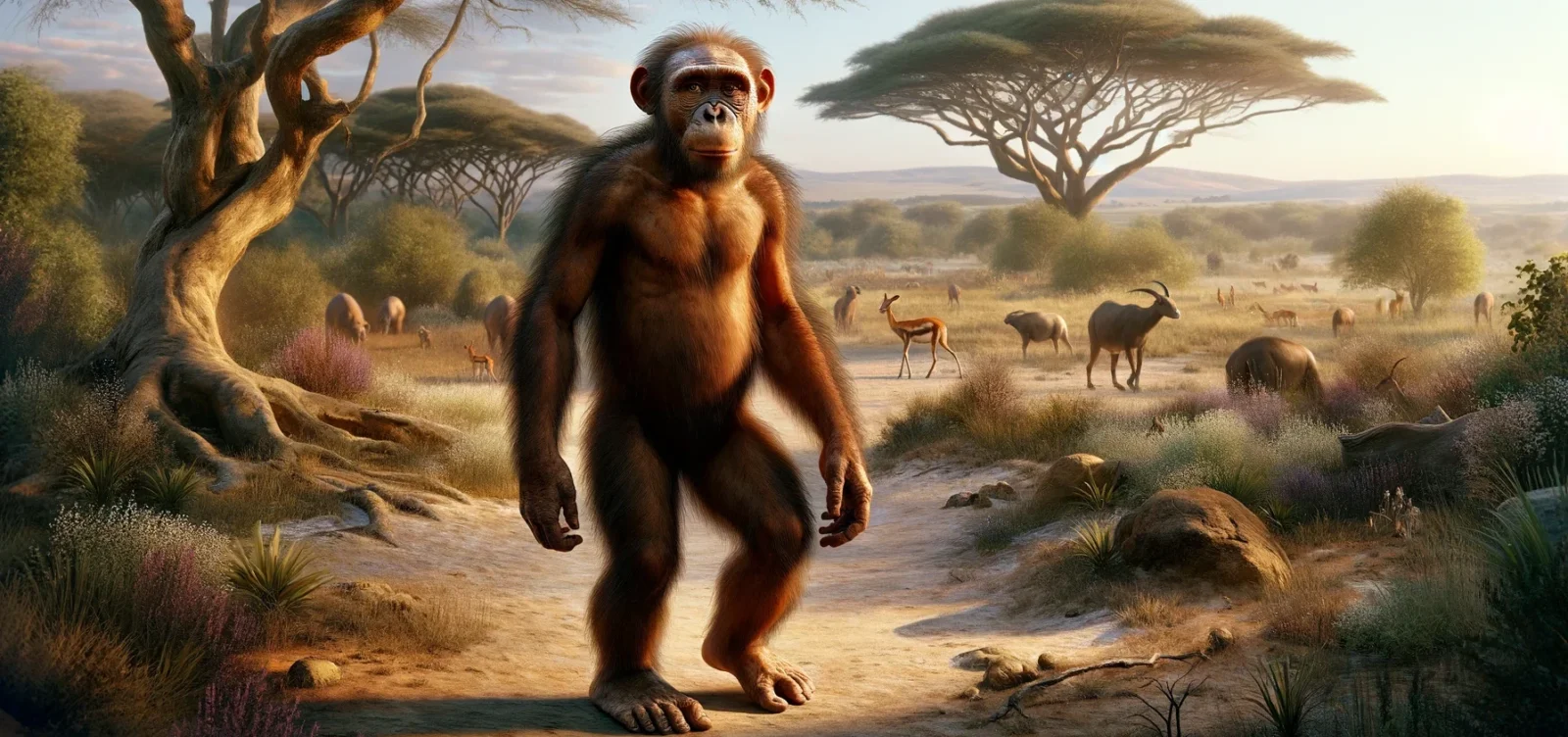
Handy man is the nickname for Homo habilis, based on its association with tool use.
2.3 Million BCE
92,000 Generations Ago
First Proto-Containers
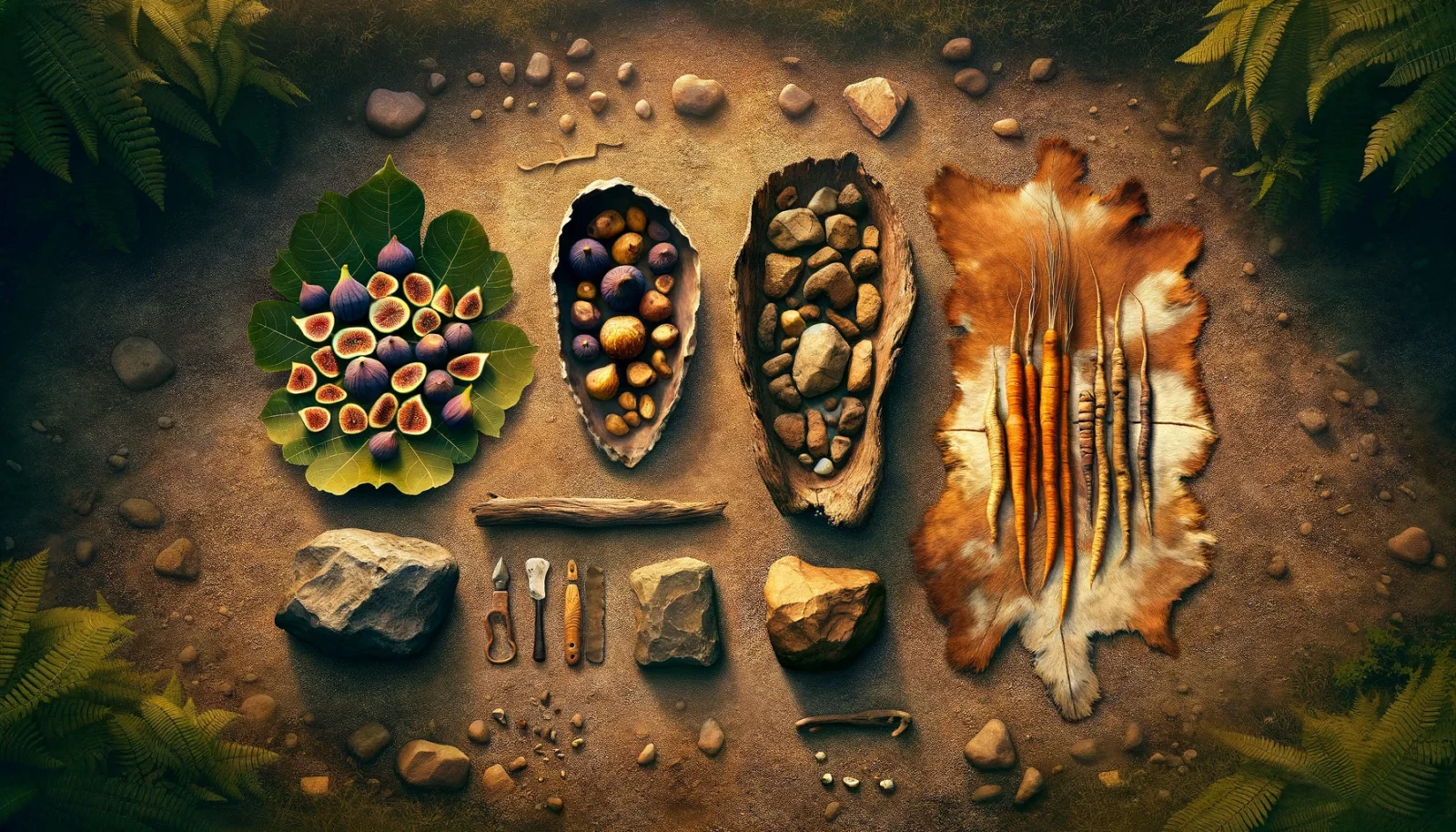
Imagined Image: A collection of early hominin tools and natural containers showing primitive ingenuity. Items like this may have been used as early as 2 million years ago. From left to right: 1) A large leaf used to carry figs, symbolizing the earliest forms of portable storage. 2) A large shell serving as a collector of small items, highlighting the use of found objects for gathering. 3) A naturally hollowed-out piece of wood filled with root vegetables, demonstrating the use of natural formations as functional tools. 4) A piece of animal hide displaying simple tools like flint and a sharpened stick, illustrating the early development of tool-making and preparation skills.
2 Million Years Ago
Homo erectus: A True Omnivore
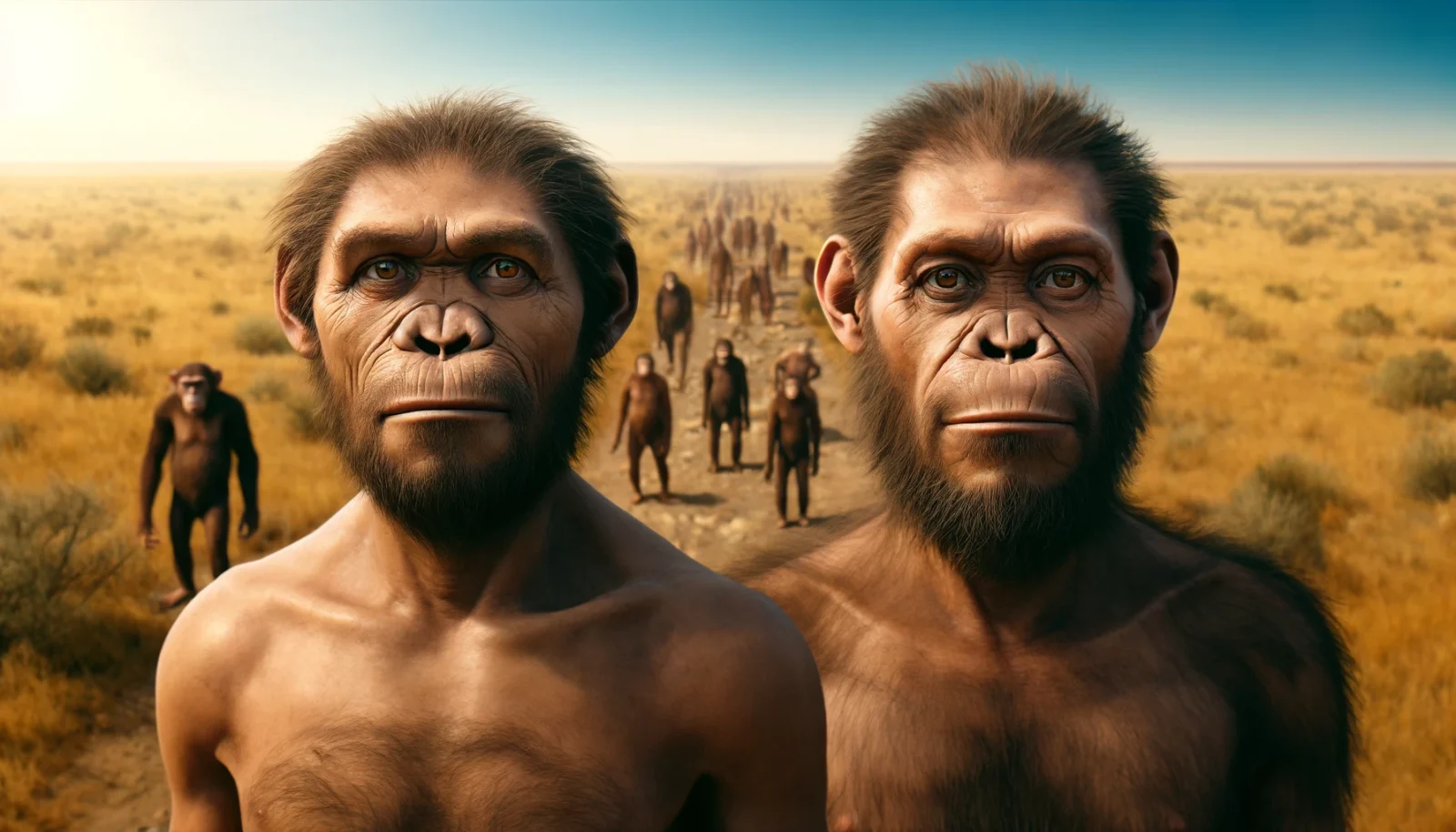
Image depicting two Homo erectus individuals at different stages of their evolutionary timeline. The first individual represents what Homo erectus might have looked like around 1.8 million years ago, and the second shows the species' features around 700,000 years ago, just before the transition towards Homo heidelbergensis.
1.9 Million BCE
Emergence of Early Hominin Shelters
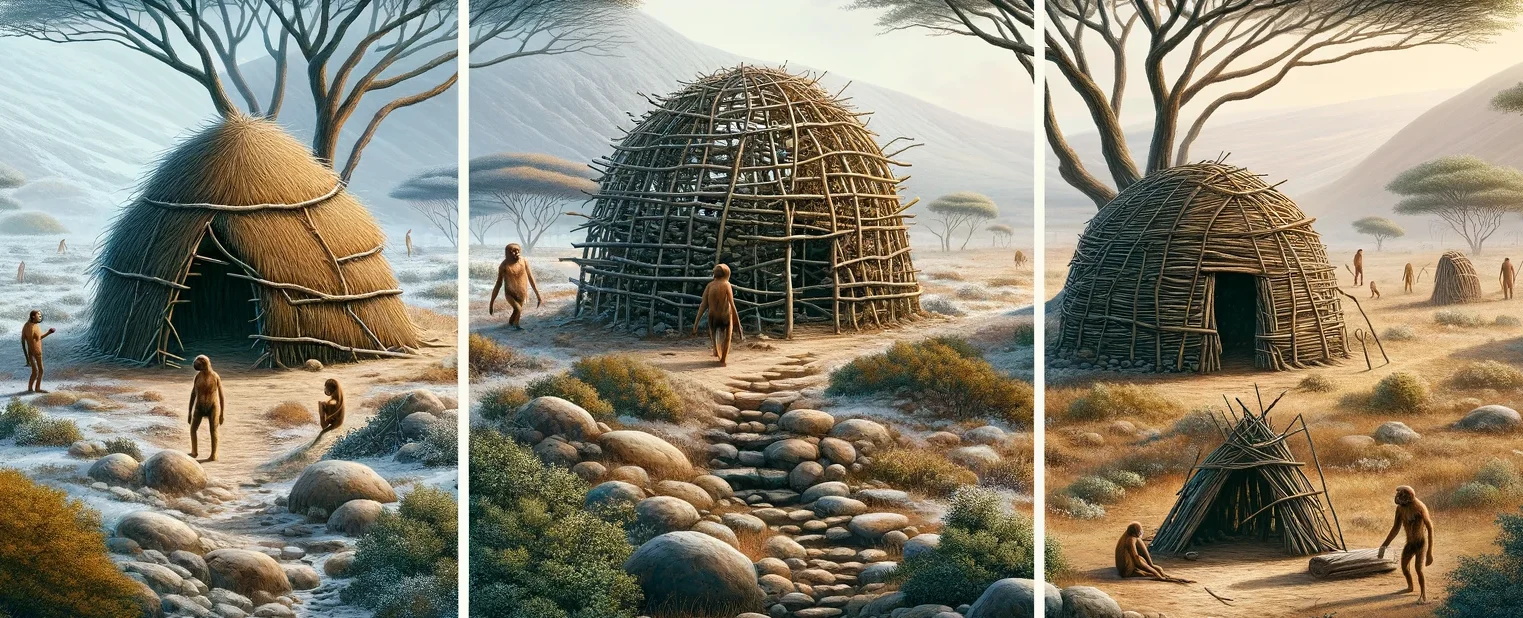
Imagined image: three types of early shelters that Homo erectus might have constructed. 1) Simple Lean-to: Made from branches and large leaves, providing basic protection against elements. 2) Structured Windbreak: Constructed with tightly packed branches and possibly covered with animal hides for better insulation.
3) Rudimentary Hut-like Structure: Using interwoven branches and vines, with a base of large stones to anchor it.
1.8 Million Years Ago (+/- 500,000 years)
Oldest Modern Human-like Footprints
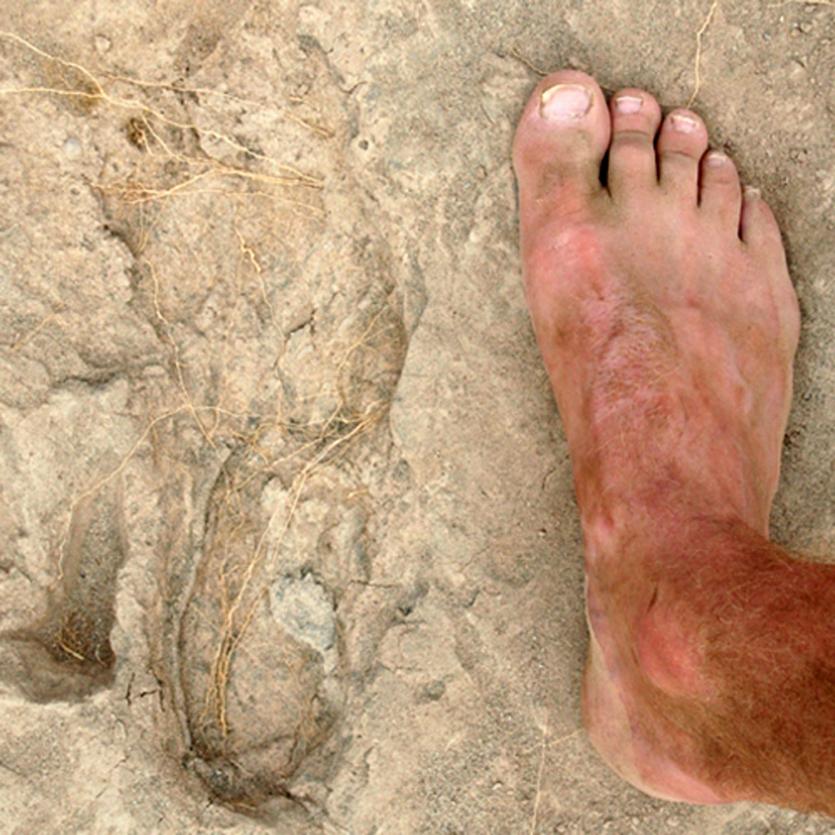
1.52 Million BCE
1.53 to 1.51 Million BCE
Homo antecessor: Earlier Modern Looks
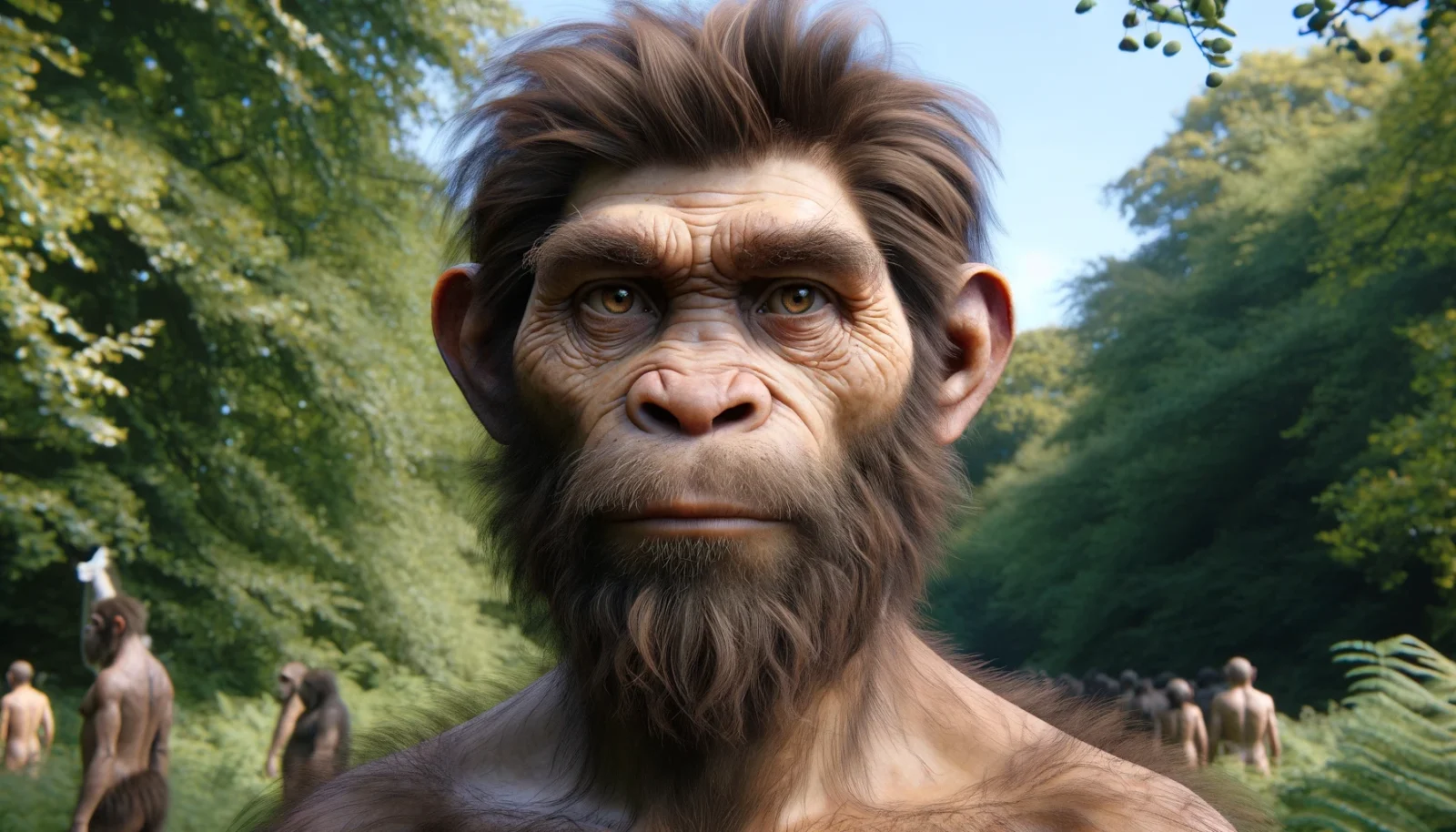
1.2 Million BCE
Less Body Hair Emerges in Homo erectus
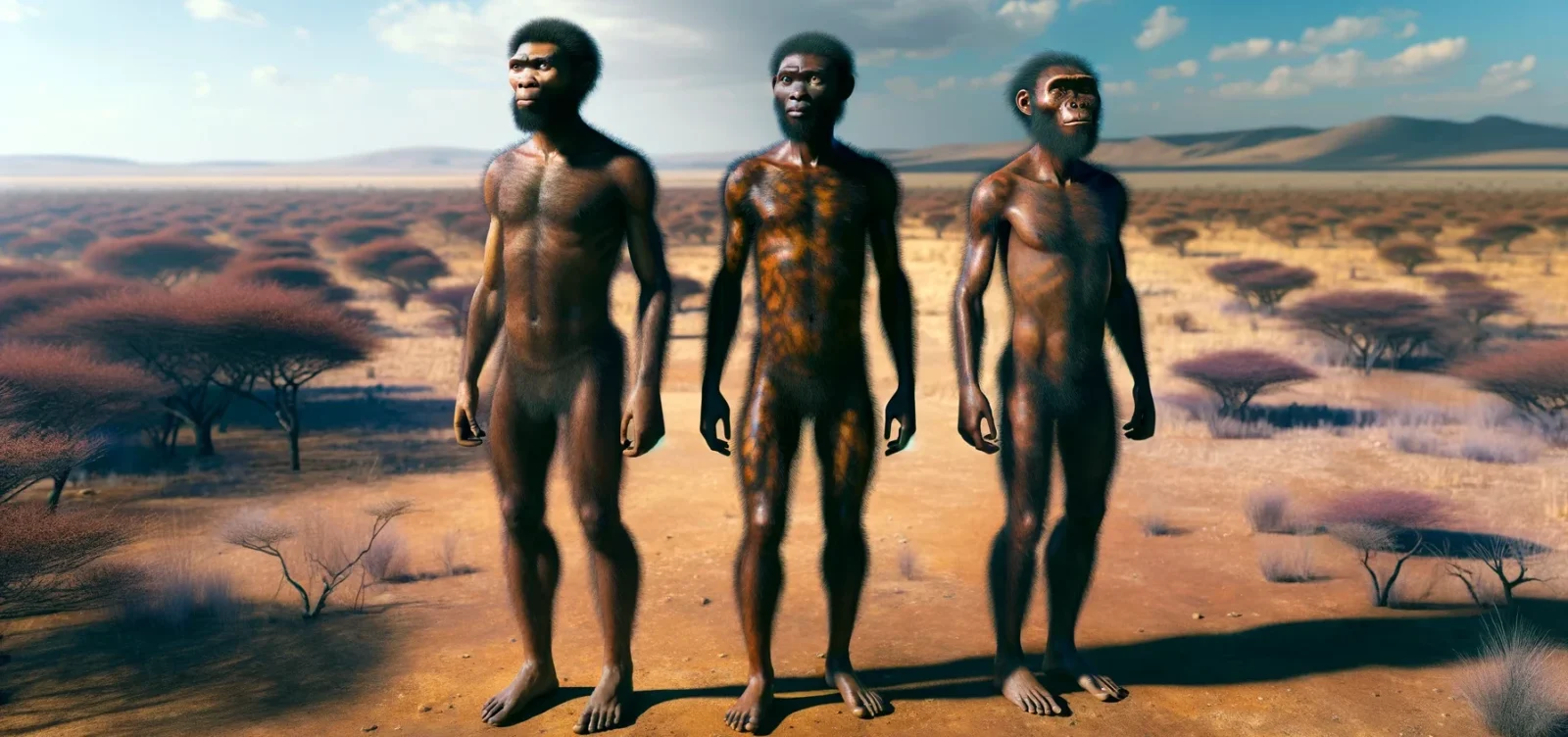
Imagined image of Homo erectus about 1 million years ago shortly after evolving to have less hair.
1.2 Million BCE
Supported by DNA evidence.
Rapid Brain Growth

800,000 BCE
800,000 to 200,000 BCE
Fire-Altered Stone Tools
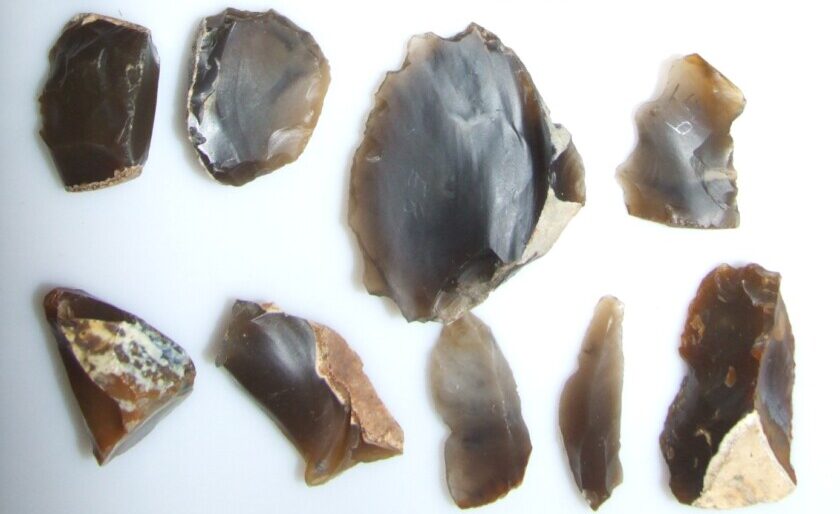
"<a href="https://commons.wikimedia.org/w/index.php?curid=55942692" target="_blank" rel="noopener noreferrer">File:Flint tools, Numbers 41-64 (Top left to bottom right) (FindID 132815).jpg</a>" by The Portable Antiquities Scheme, Adam Daubney, 2006-05-17 10:54:28 is licensed under <a href="https://creativecommons.org/licenses/by-sa/2.0/" target="_blank" rel="noopener noreferrer">CC BY-SA 2.0</a>
790,000 BCE
Genus Homo
Hyoid Bone: Speach Emerges
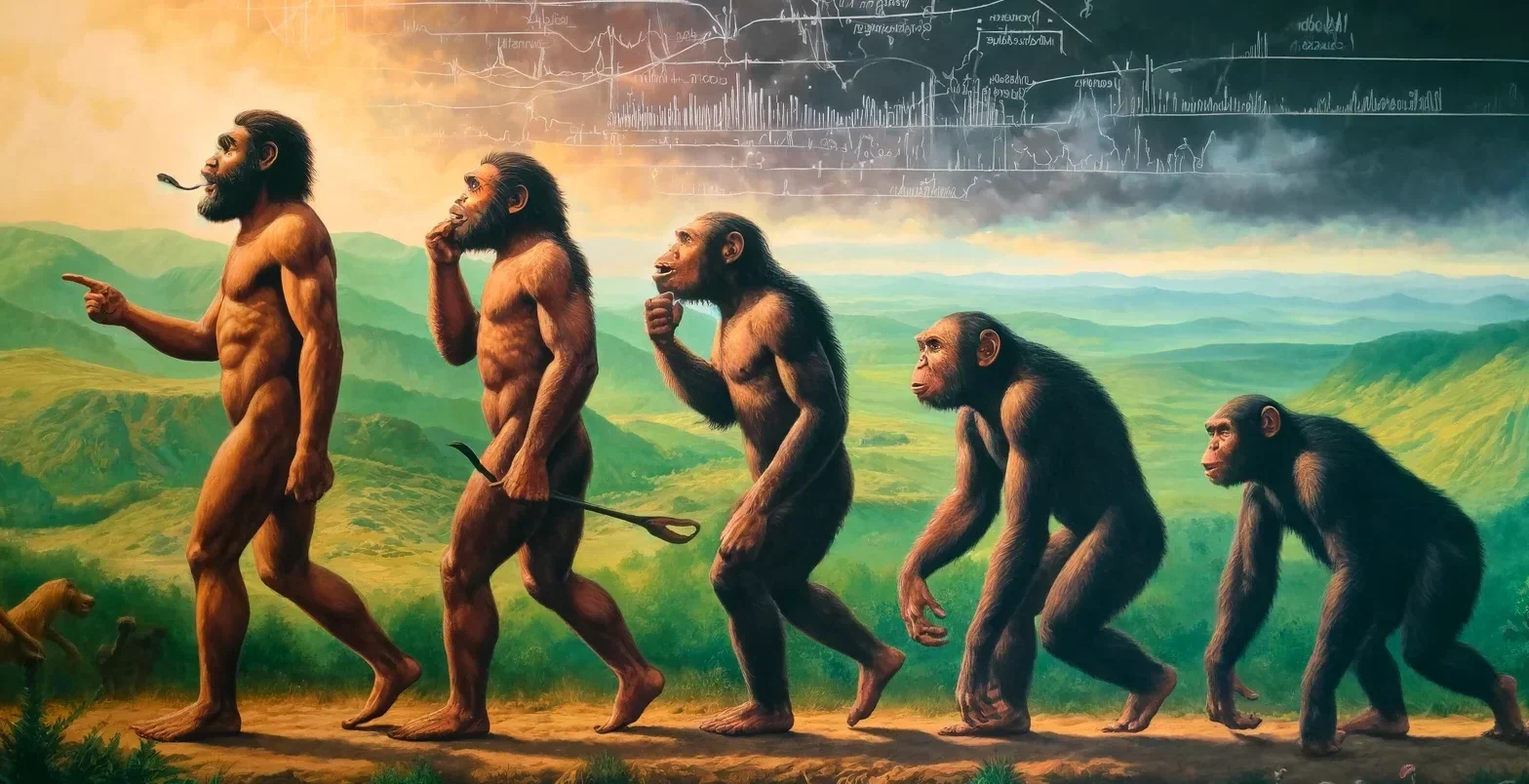
Imagined image depicting the evolution of vocalization and early speech in hominins. The illustration features Homo habilis, Homo erectus, and Homo heidelbergensis, each represented in a context that corresponds to their stage of communication development. This visual captures the progression from simple vocal sounds to more structured speech-like communications as these species evolved.
700,000 BCE
Full Emotional Intelligence Emerges
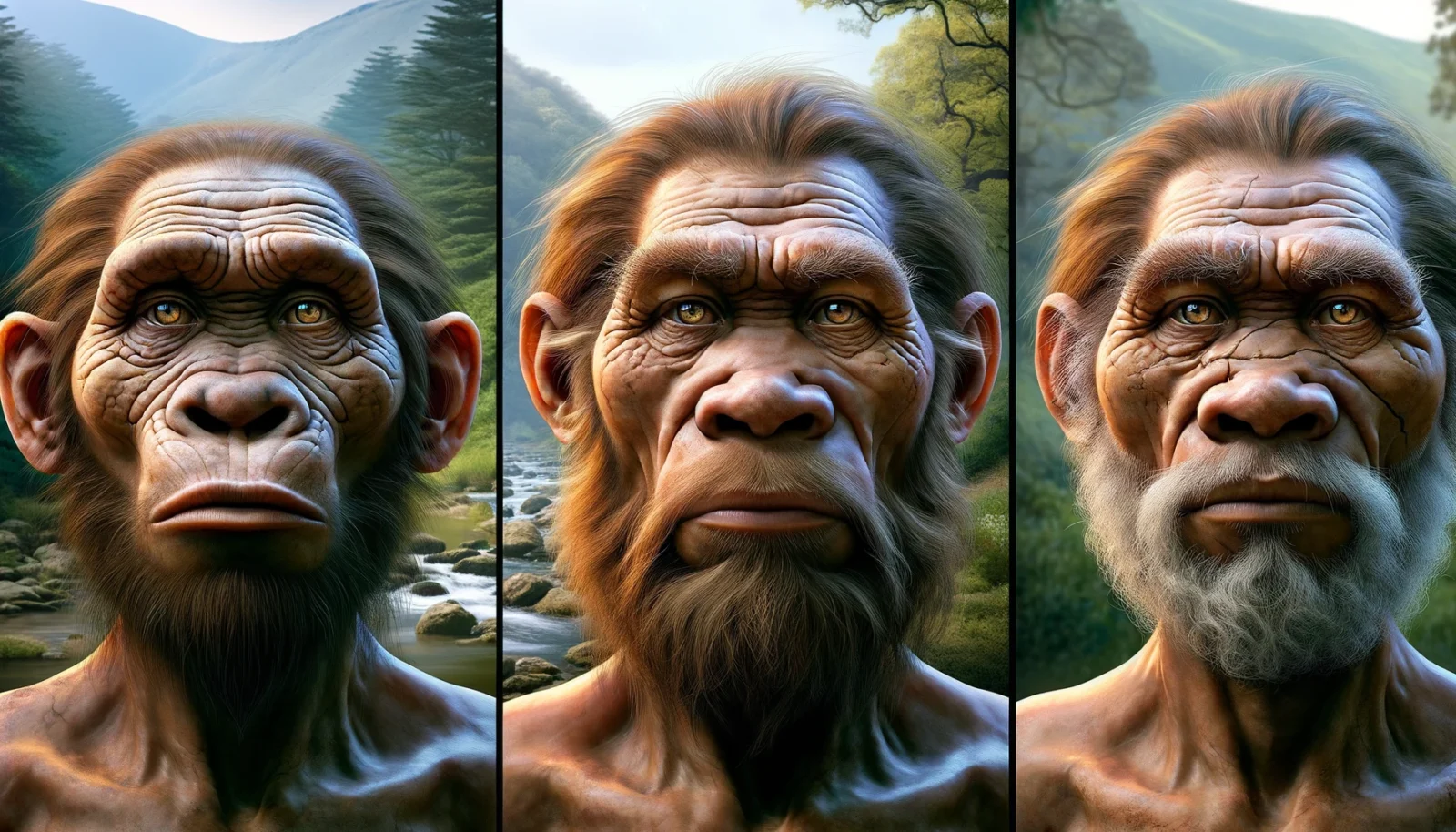
700,000 Years Ago
Homo heidelbergensis
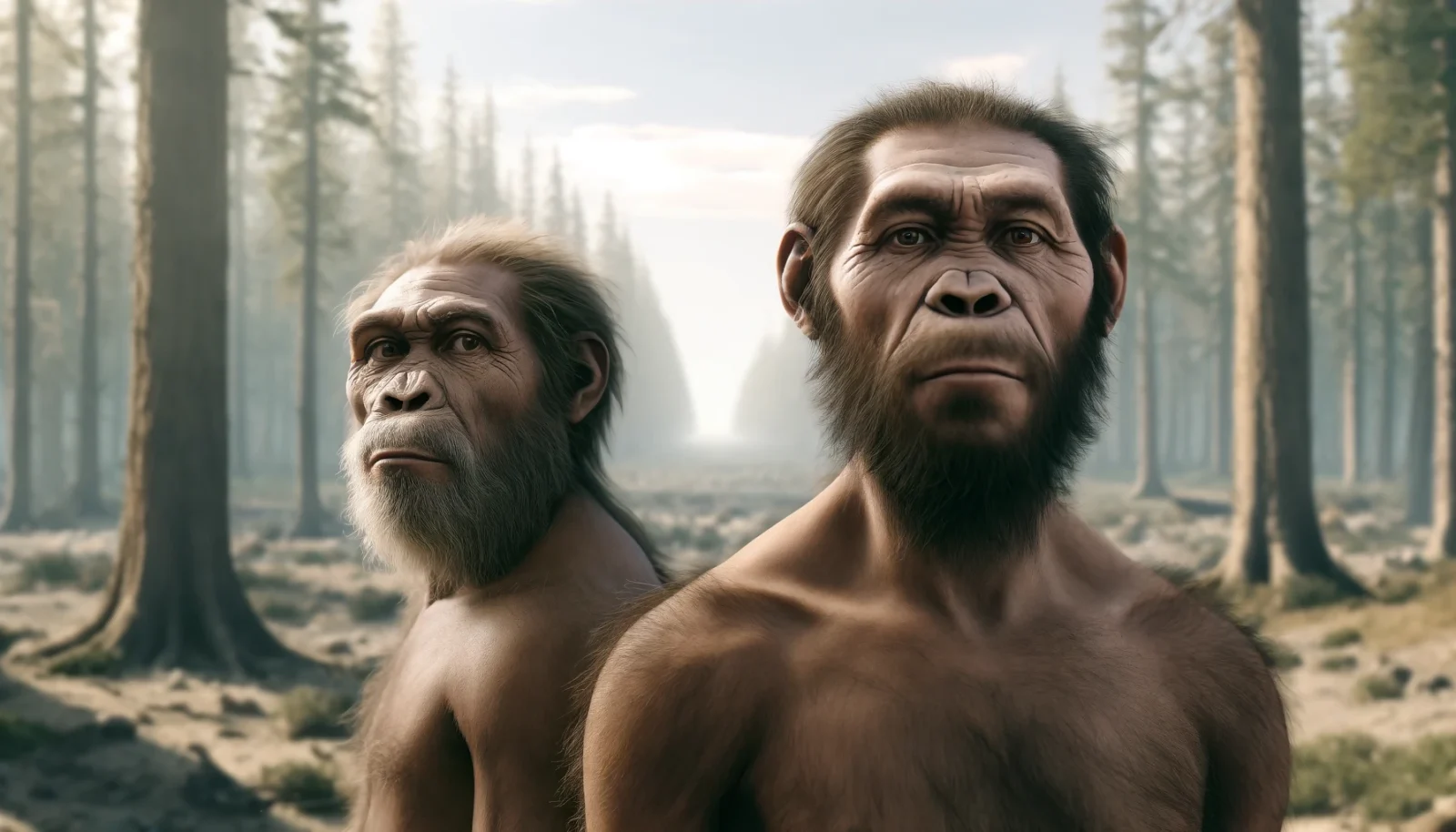
Imagined image depicting two Homo heidelbergensis individuals at different stages of their evolutionary timeline. The first individual represents what they might have looked like around 650,000 years ago, and the second shows them around 440,000 years ago, just before the transition towards Homo sapiens and Neanderthals.
Circa 640,000 Years Ago
Homo heidelbergensis on Earth from about 640,000 to 200,000 BCE.
First Clothes: Proto-Clothing and the Advent of Garments
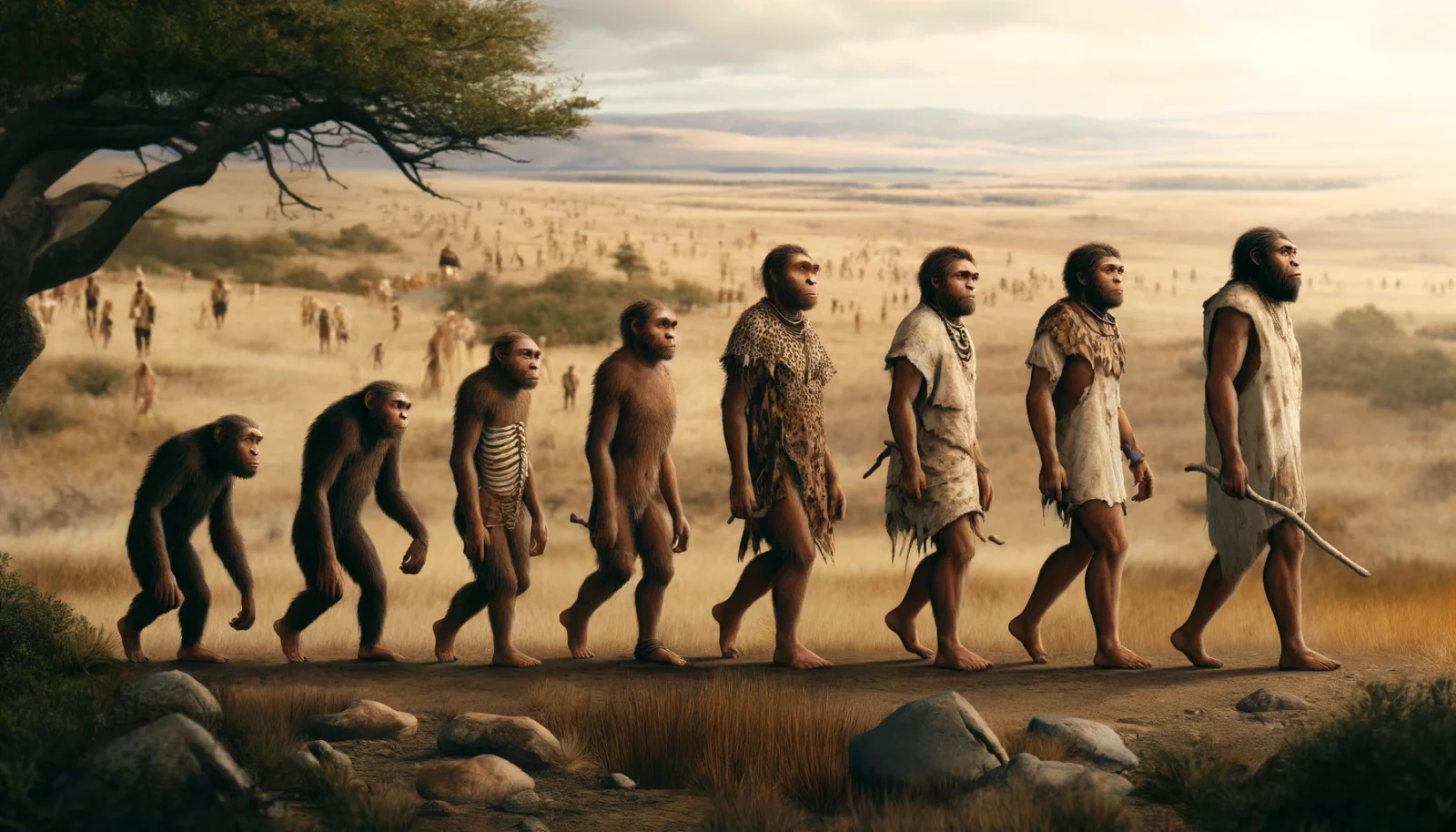
Imagined image depicting the evolution of early clothing among hominins. The image starts with a Homo erectus wearing very simple proto-clothing, such as basic animal skins or a simple decorative element like a bone or shell necklace. Progressing through the scene, an earlier Homo heidelbergensis or Homo antecessor is shown with slightly more advanced but still rudimentary clothing.
600,000 years ago
Transcendental Intelligence Emerges
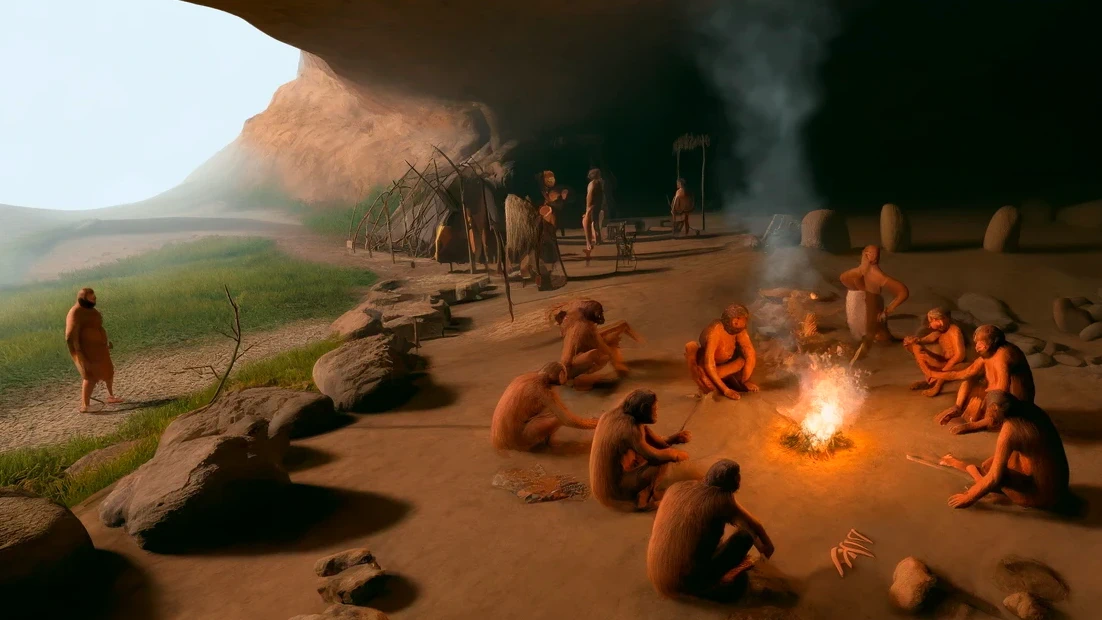
475,000 Years Ago
Neanderthal-Sapien LCA
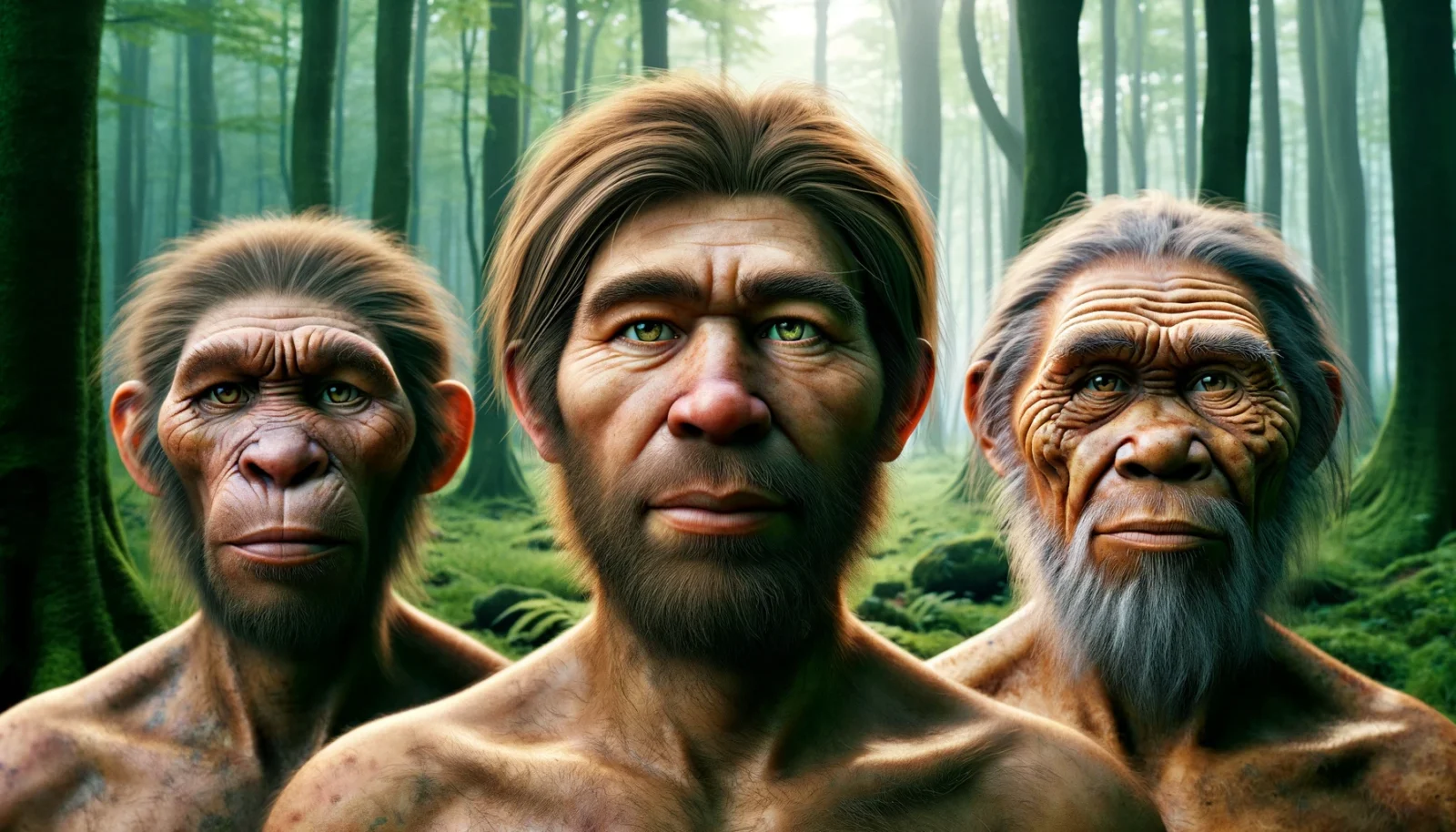
Imagined image: Homo sapiens (center) might be a hybrid of two extict human species: Homo heidelbergensis and Homo antecessor. Left is heidelbergensis with its protruding jaw. Right is antessor with his small brain and flatter face.
440,000 Years Ago (+/- 40,000 years)
Terra Amata Site, France
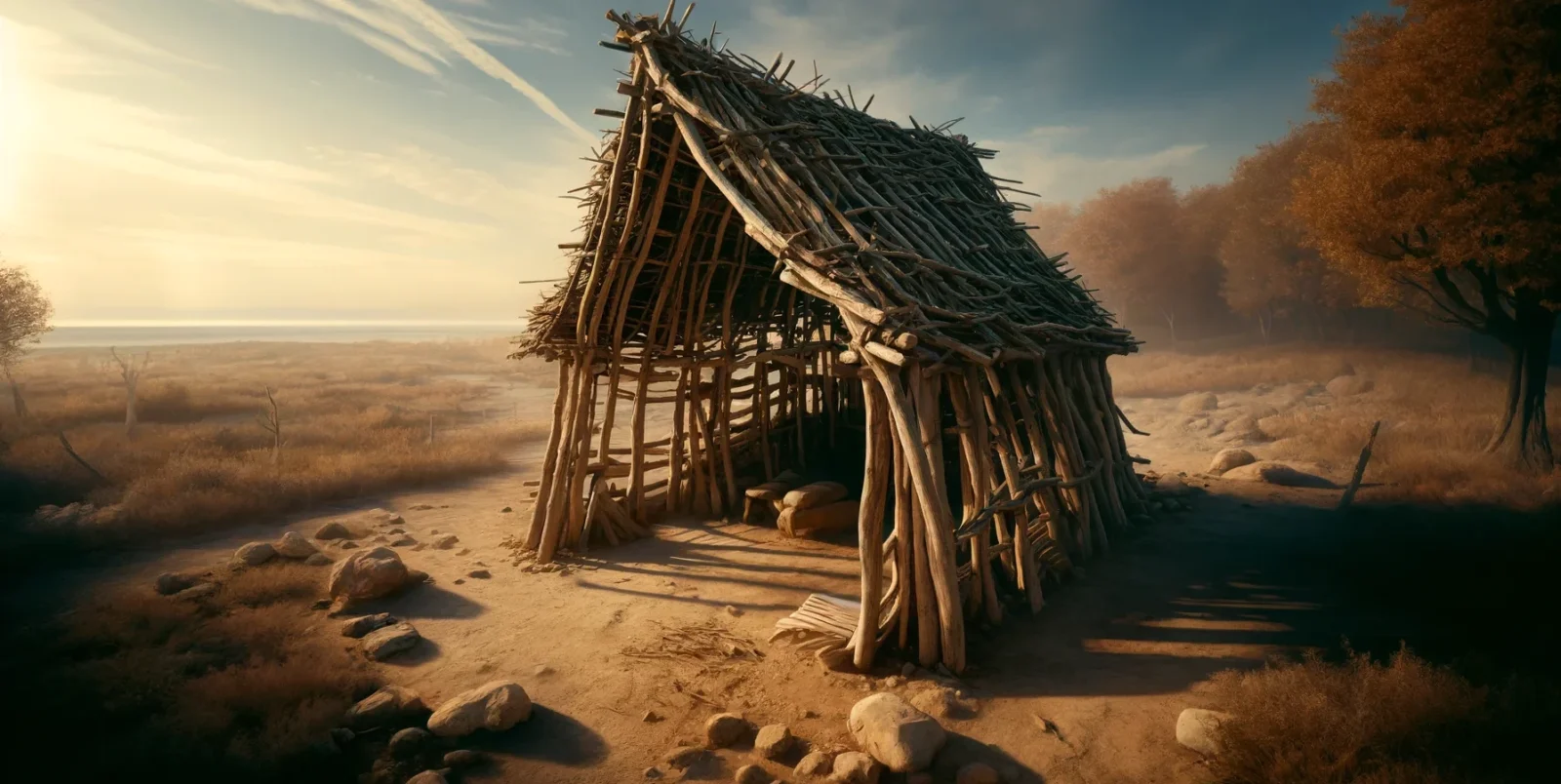
Imagined imaged of the 400,000-year-old structure likely built by Homo heidelbergensis in France located on the coast at the Terra Amata site in Nice, France. The shelter is estimated to be around 4-5 meters (13-16 feet) wide and 6-7 meters (20-23 feet) long. It's believed to have been constructed using a simple framework of wooden posts, with branches and leaves used to create a roof and walls.
circa 400,000 Years Ago
Nice, France
Oldest Surviving Spear
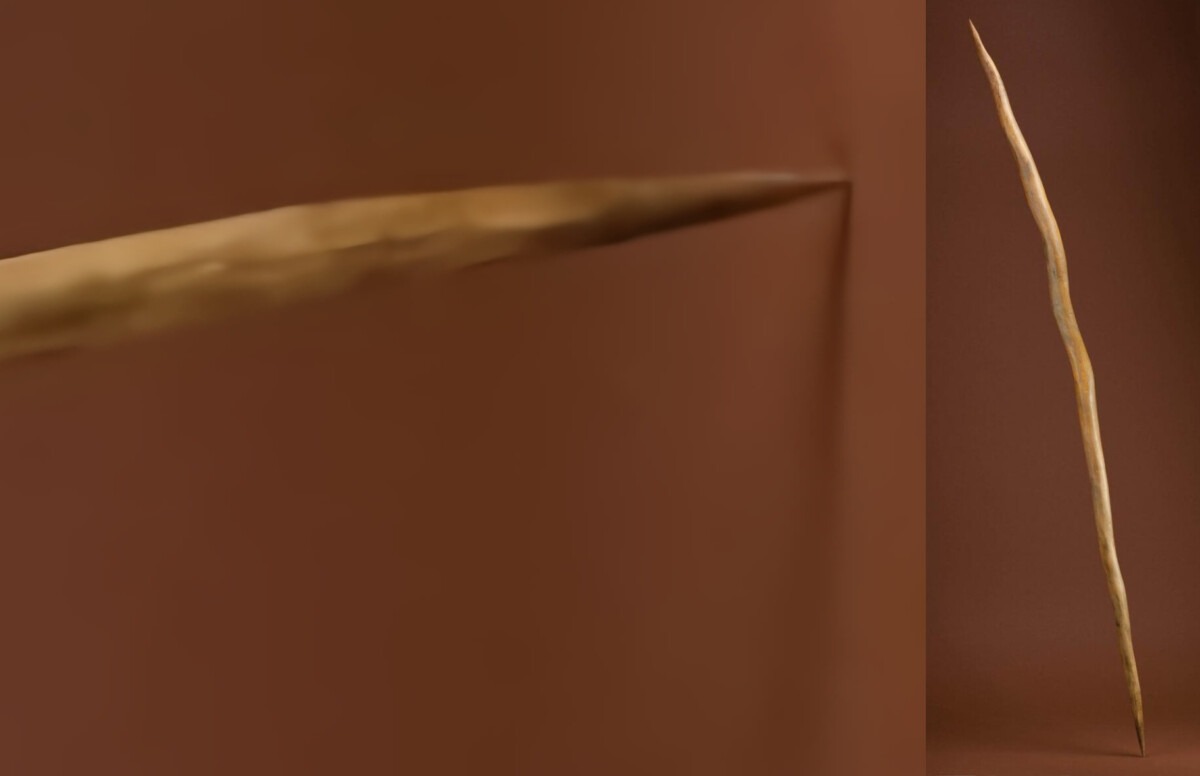
350,000 BCE
400,000 to 300,000 BCE
Homo naledi: A Likely Hybrid
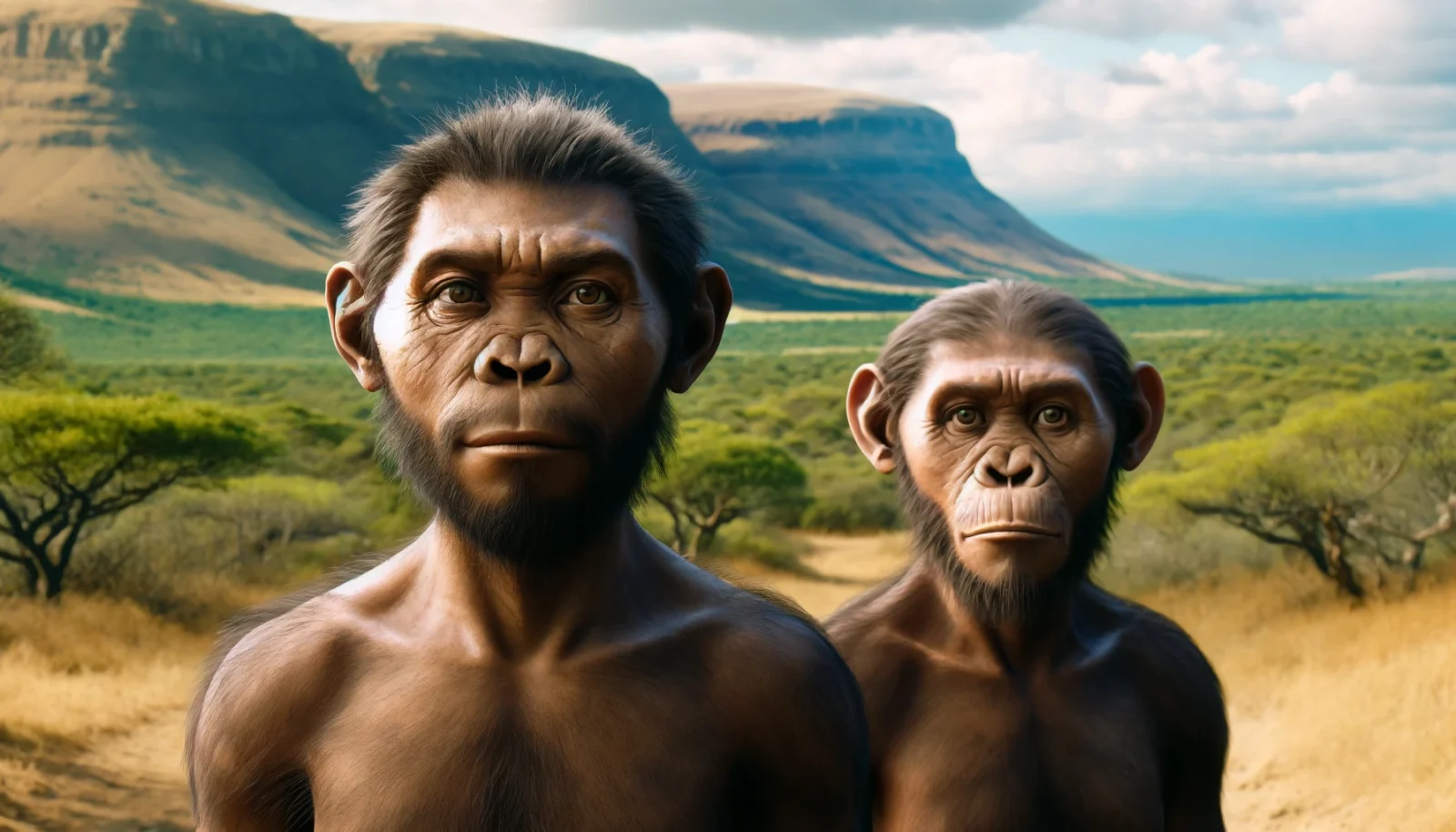
Imagined image: Homo naledi. Left is circa 250,000 BCE. Right is circa 335,000 BCE. The later Homo naledi individual as appearing more human-like is somewhat speculative but can be supported by the evidence of their anatomical features and behaviors.
335,000 BCE
Human, but probably not our human branch.
Homo Sapiens: Advanced Transcendental Intelligence
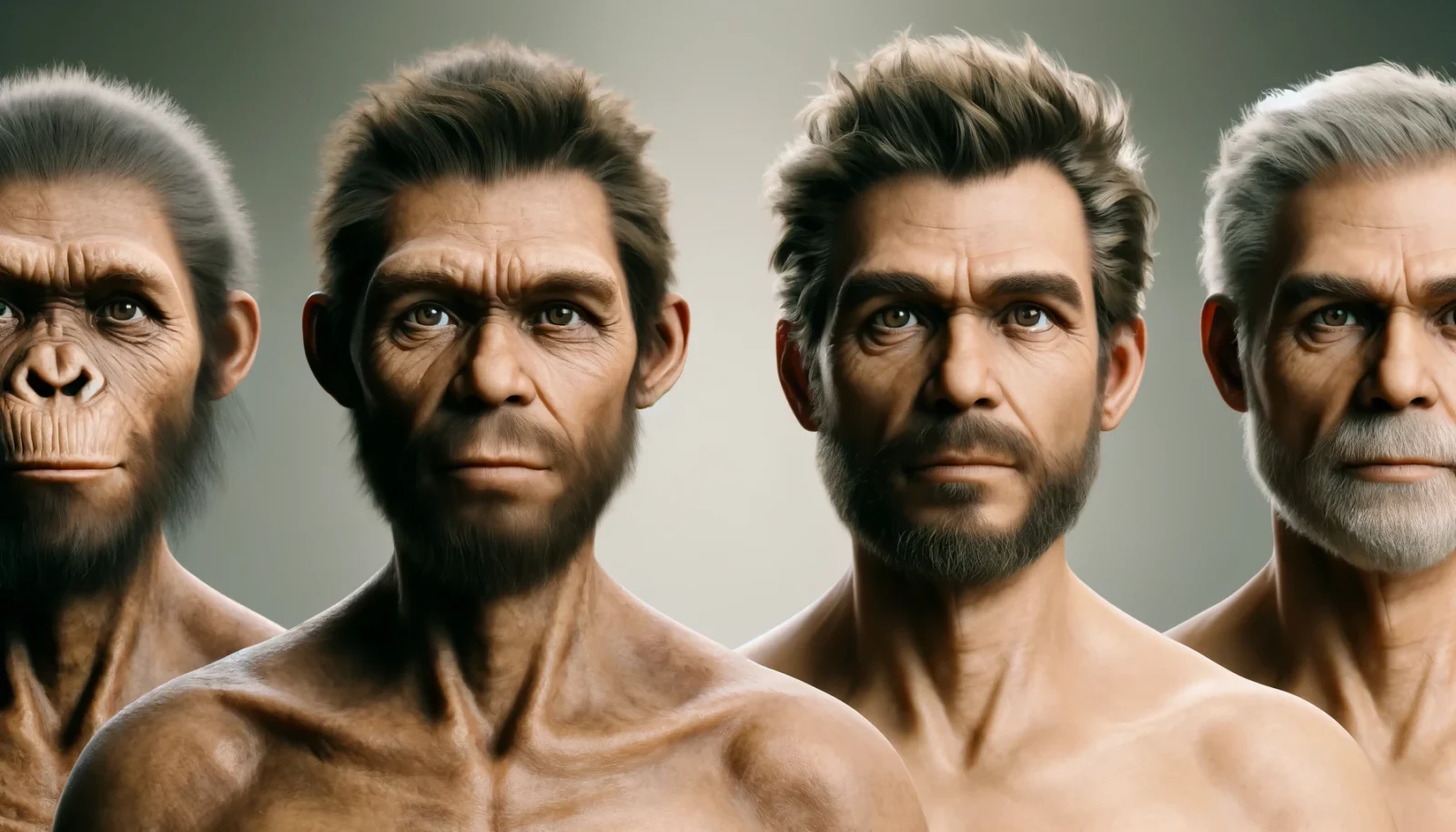
Imagined image: two Homo sapiens males from different stages of human evolution are featured. The first figure represents Homo sapiens from about 300,000 years ago, and the second from about 100,000 years ago, each with distinct features representative of their times.
315,000 BCE
Hominin World Population: 2 Million (maybe)
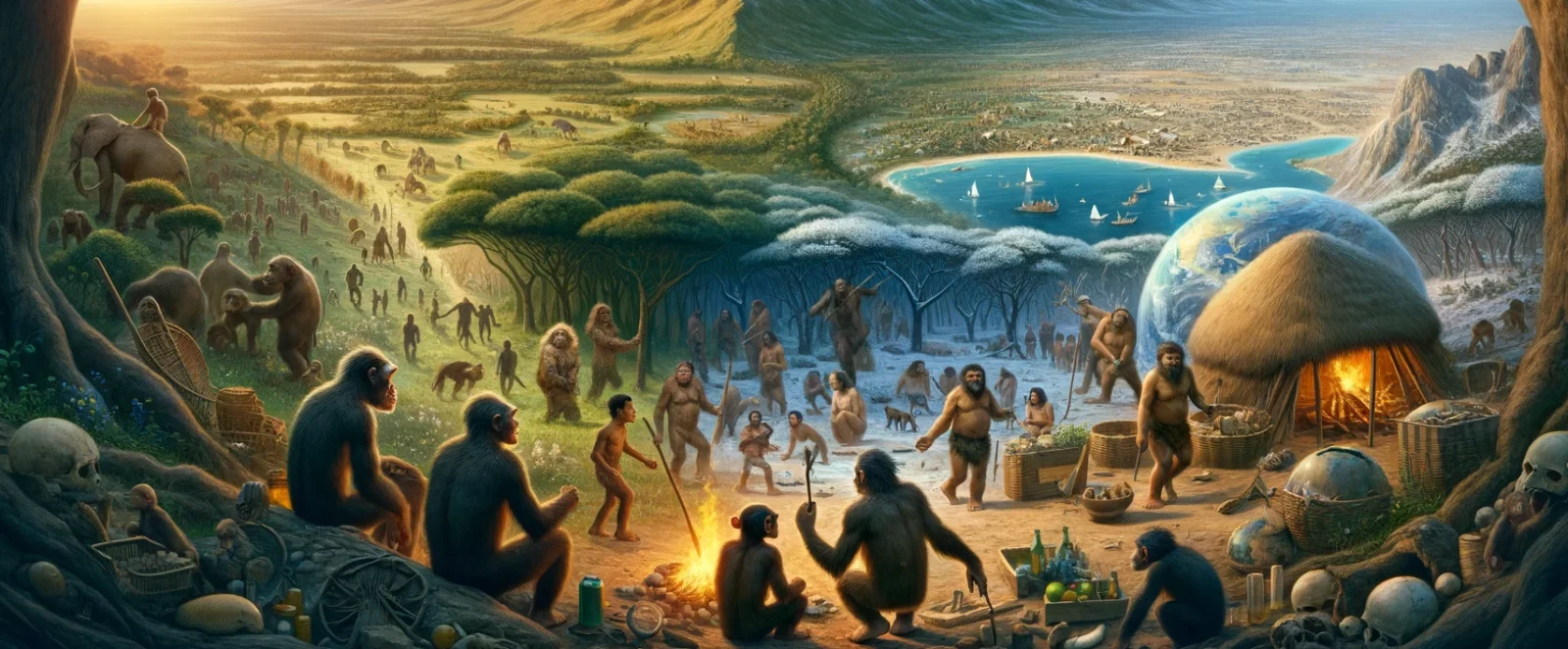
300,000 BCE
Very speculative.
Venus of Tan-Tan
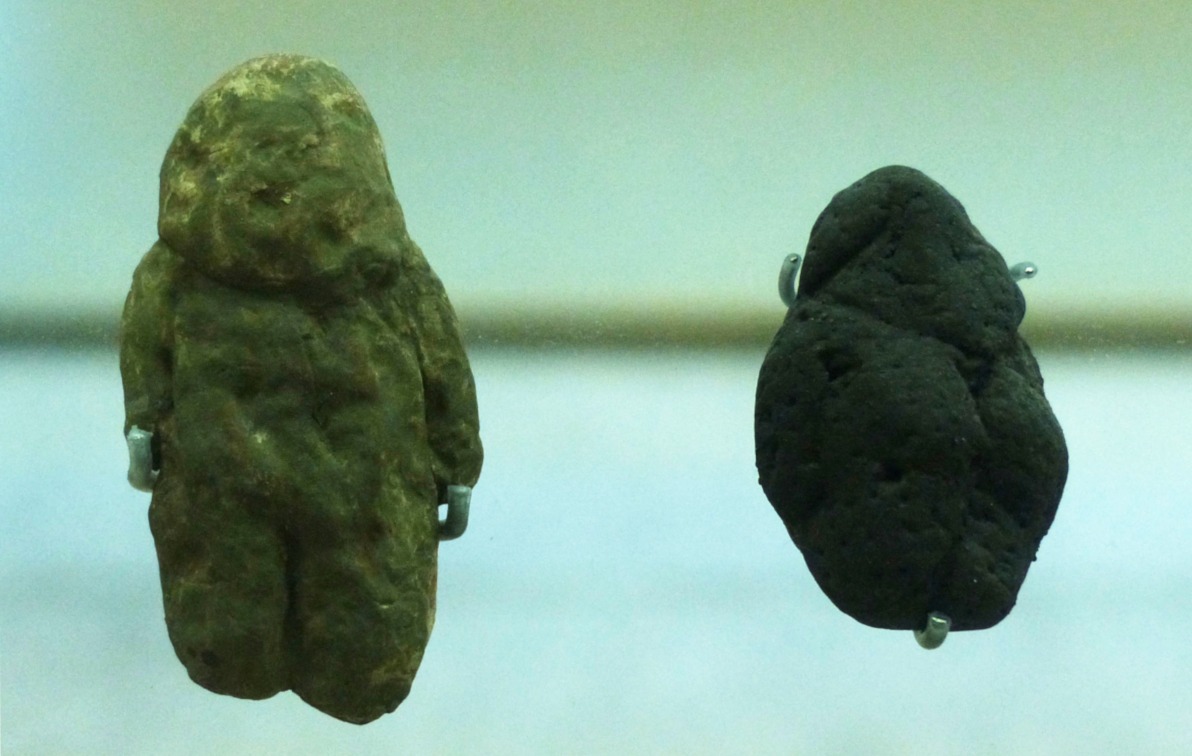
"<a href="https://commons.wikimedia.org/w/index.php?curid=72180942" target="_blank" rel="noopener noreferrer">Museo de la Evolucion Humana Burgos - Tan Tan and Berekhat Ram Pebbles</a>" by Own work is licensed under <a href="https://creativecommons.org/licenses/by-sa/4.0/" target="_blank" rel="noopener noreferrer">CC BY-SA 4.0</a>
300,000 BCE
Africa; 300,000 to 500,000 years ago
Homo rhodesiensis: A Hybrid Lesson

Imagined Image: Homo rhodesiensis portrayal based on the limited skeletal remains from Kabwe, blends established fossil data with speculative reconstruction of soft tissues, reflecting an interpretative visualization of this ancient human species leaning toward modern facial features.
300,000 Years Ago
Survived from about 300,000 to 125,000 years ago.
Neanderthal-Denisovan Split
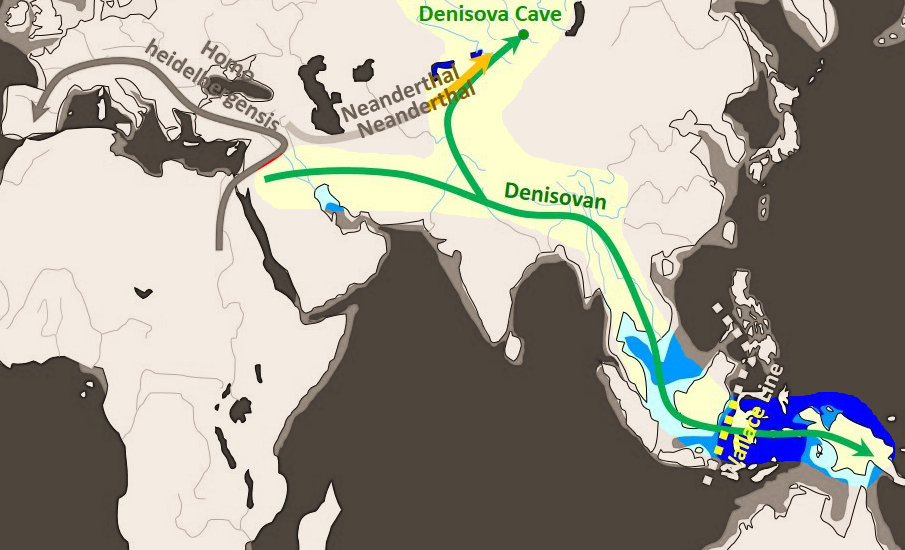
300,000 BCE
500 to 30 Thousand BCE
Bhimbetka Petroglyphs, Cupules
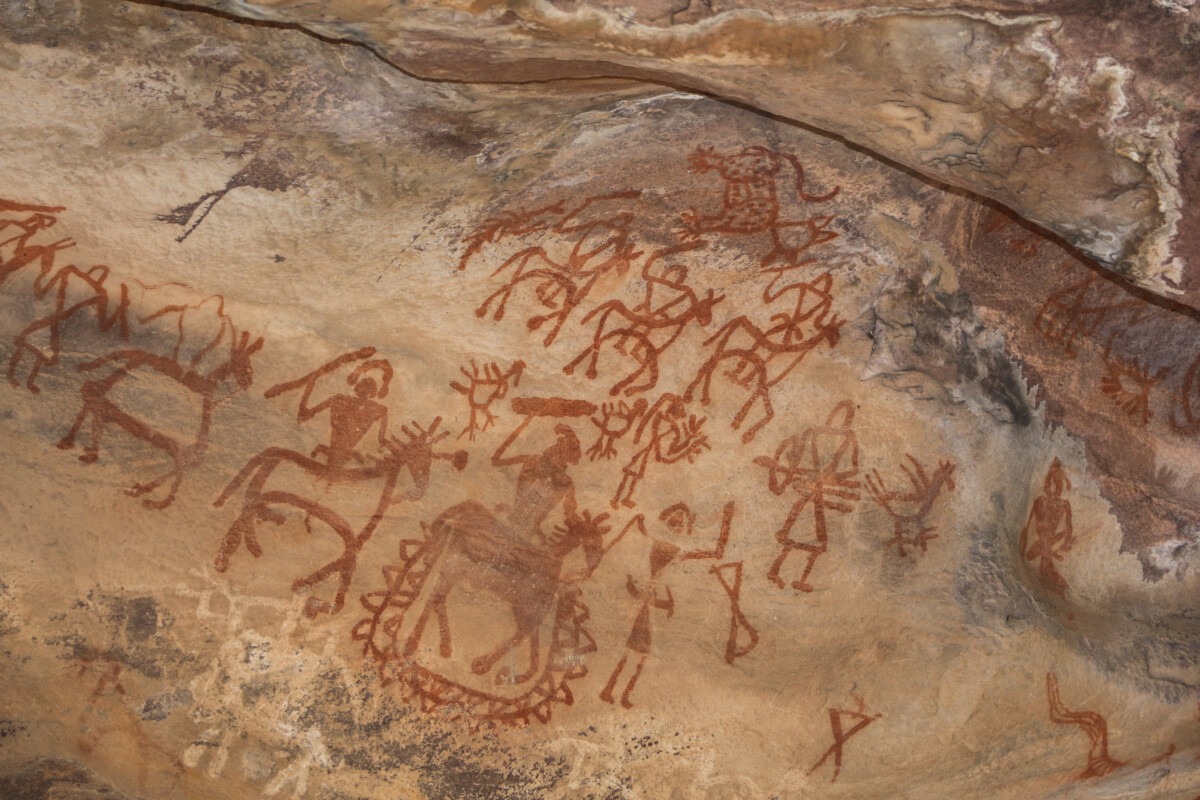
Cave are found in central India dated back to 290 thousand years ago has significant implications for the evolution of the human brain.
Before 290,000 BCE
Hominins; 290,000 to 700,000 years ago
Adam: Haplogroup A
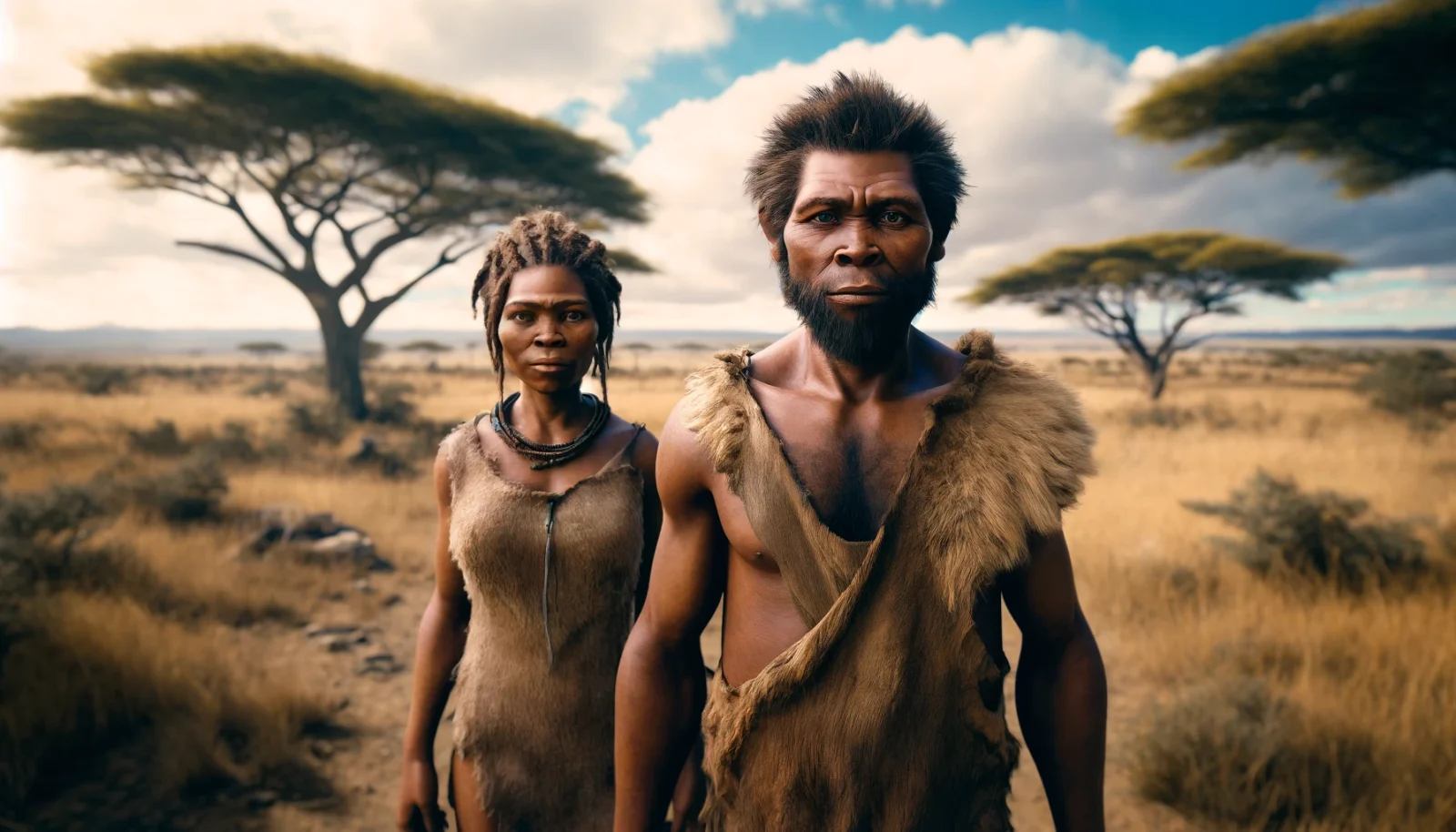
Imagined image: Homo sapien couple, circa 275,000 years ago. Even as early as this, humans all over Africa, the Middle East, Europe, and Asia essentially looked like we look now.
275,000 BCE
Extinction: Homo naledi
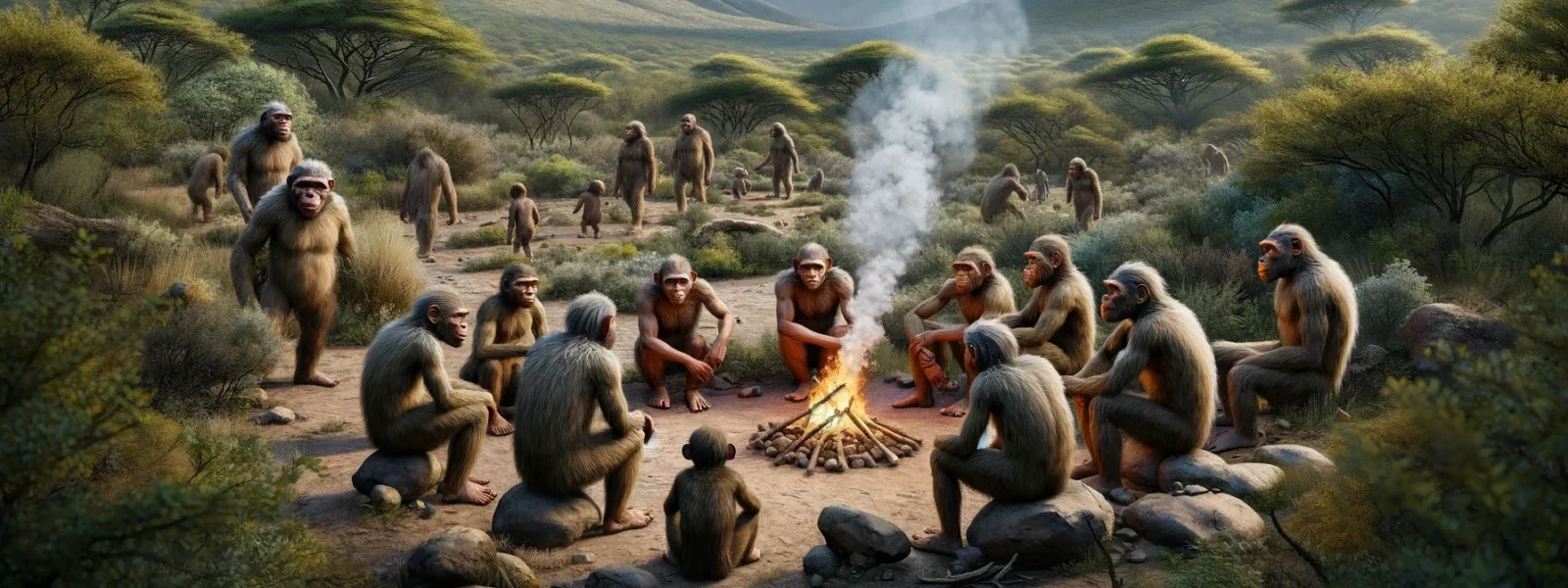
236,000 Years Ago
Extinction: Homo heidelbergensis
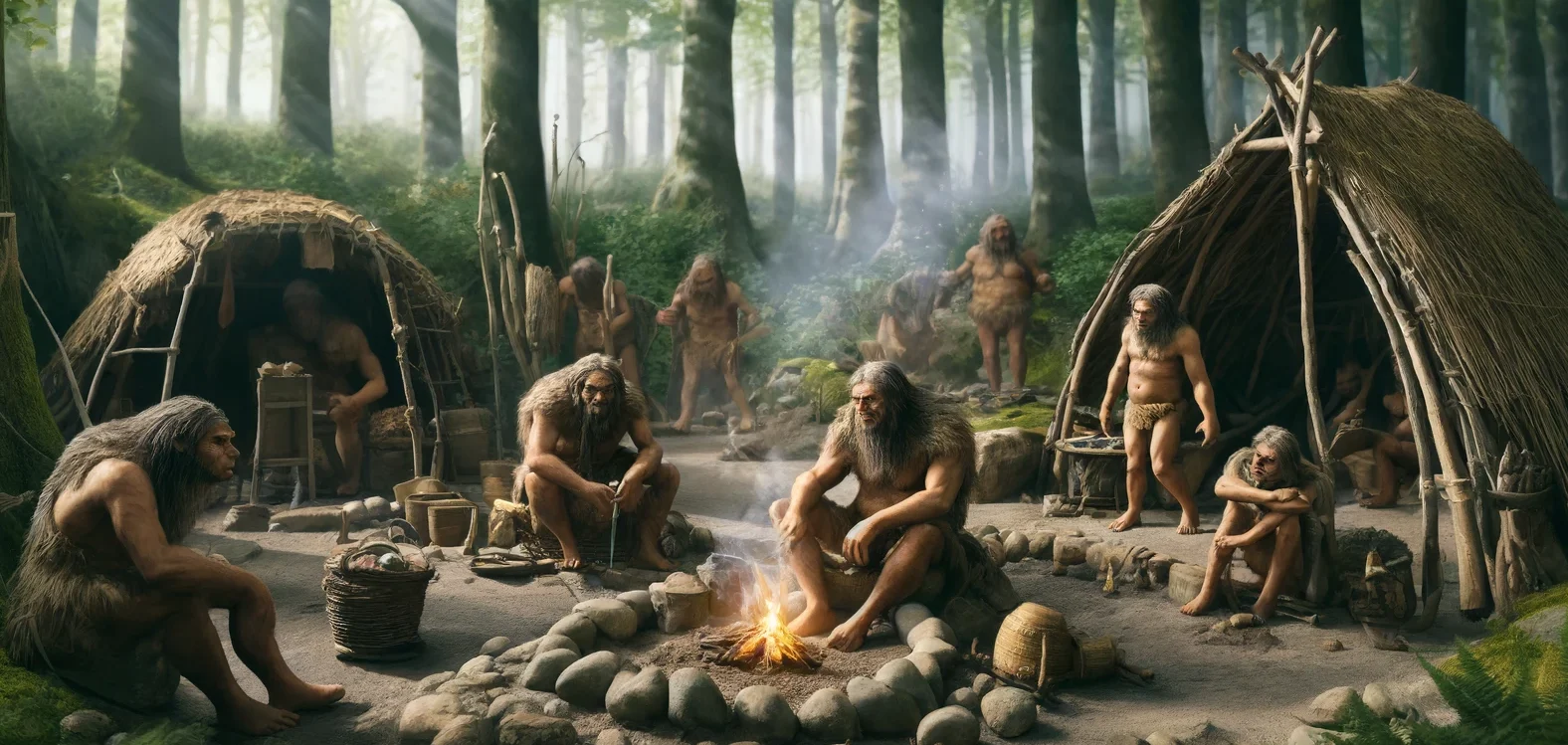
Imagined image: the last of the Homo heidelbergensis, circa 200,000 BCE.
200,000 Years Ago
Eve: Haplogroup L
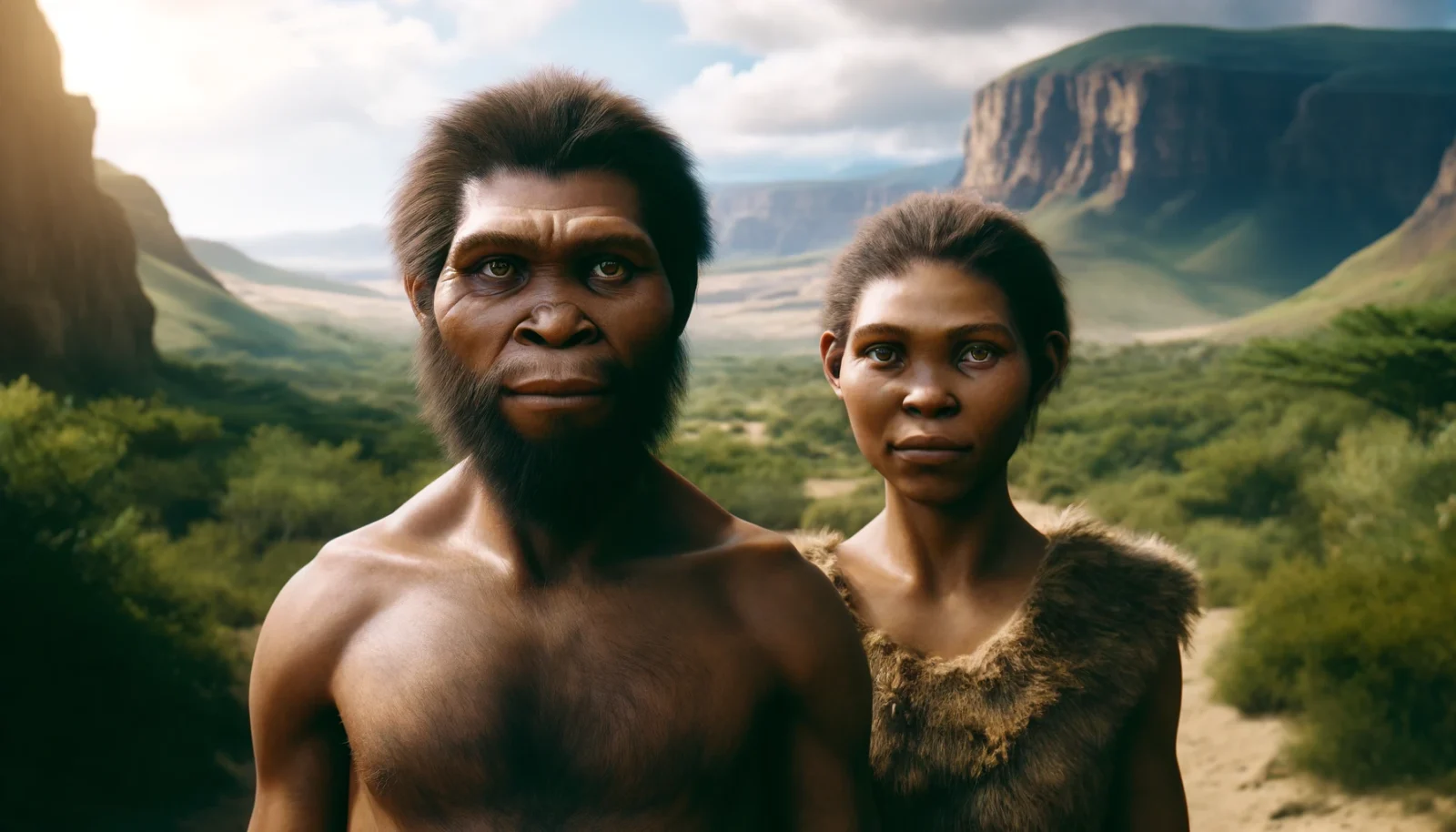
Imagined image: Homo sapien couple, circa 175,000 years ago. By this time, humans all over Africa, the Middle East, Europe, and Asia essentially looked like we look now.
175,000 BCE
200,000 to 150,000 BCE
Modern Human Looks and Brains

lover couple of caucasian male and female lay down at the beach relaxing
150,000 BCE
200,000 to 150,000 BCE
Homo longi: Rewriting Human Migration Narratives
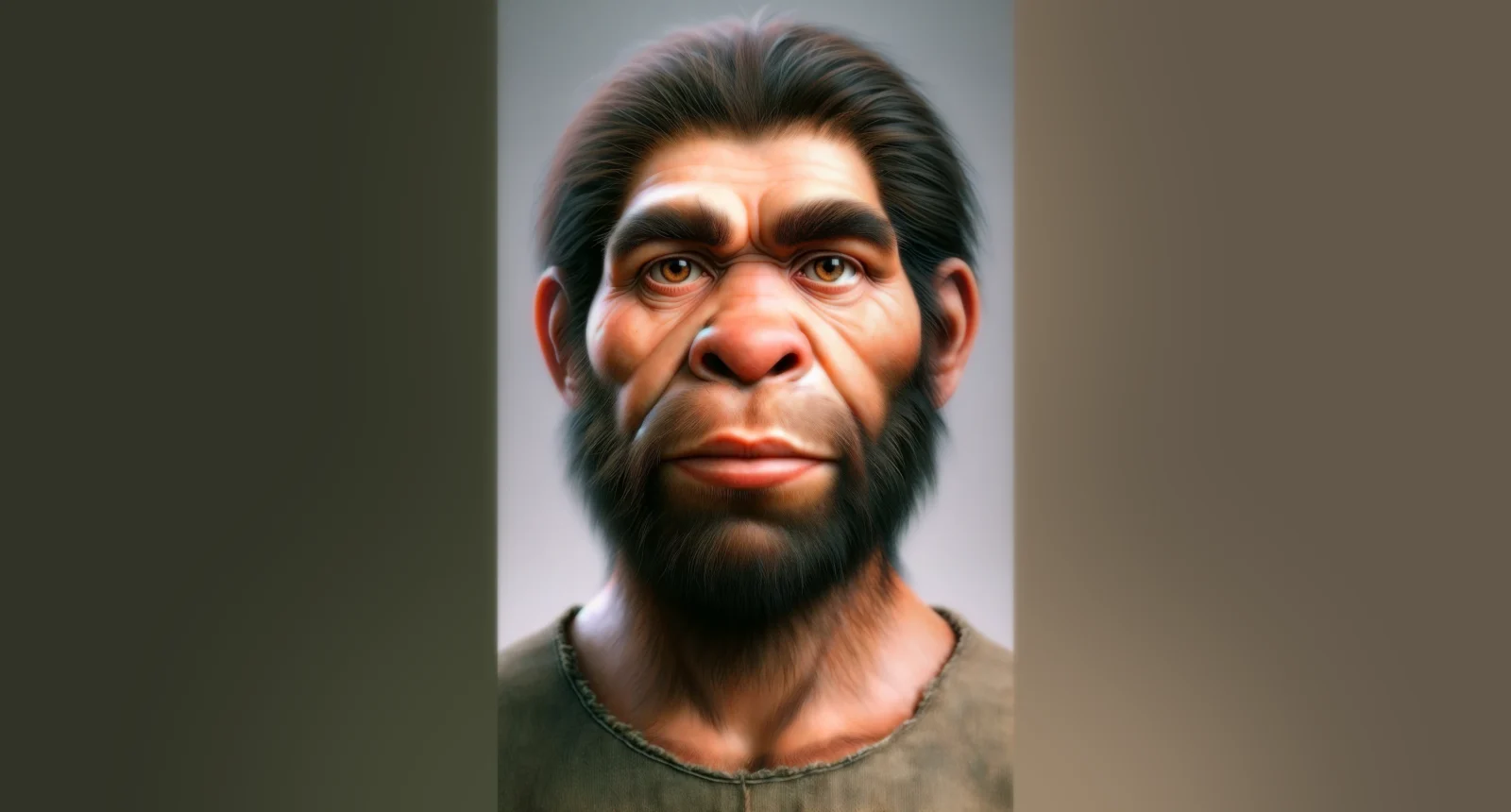
Imagined image: Homo longi man with a modern Neanderthal-sapien appearance, featuring characteristic traits such as a large and broad face, pronounced brow ridges, and a big nose. This look is to reflect an earlier migration out of Africa.
146,000 Years Ago
Extinction: Homo rhodesiensis
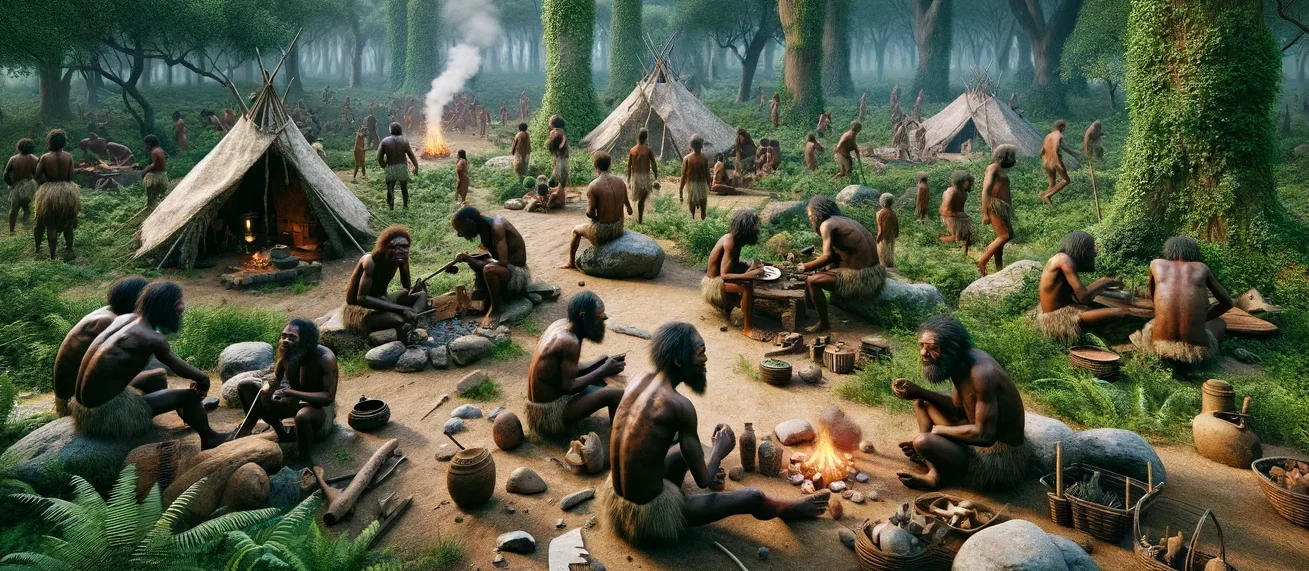
Imagined Image: Camp of Homo rhodesiensis around 125,000 years ago, set in a woodland area.
125,000 Years Ago
Many Early Out of Africa Migrations
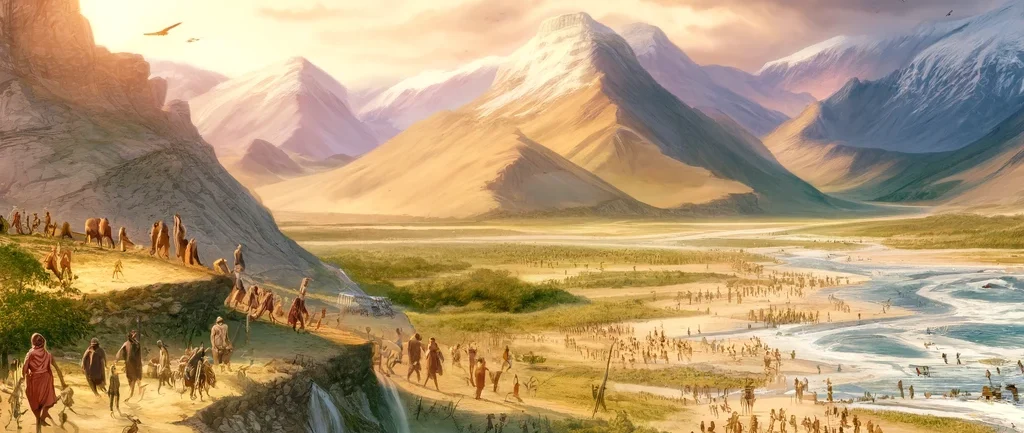
120,000 BCE
130,000 to 100,000 BCE
Extinction: Homo Erectus
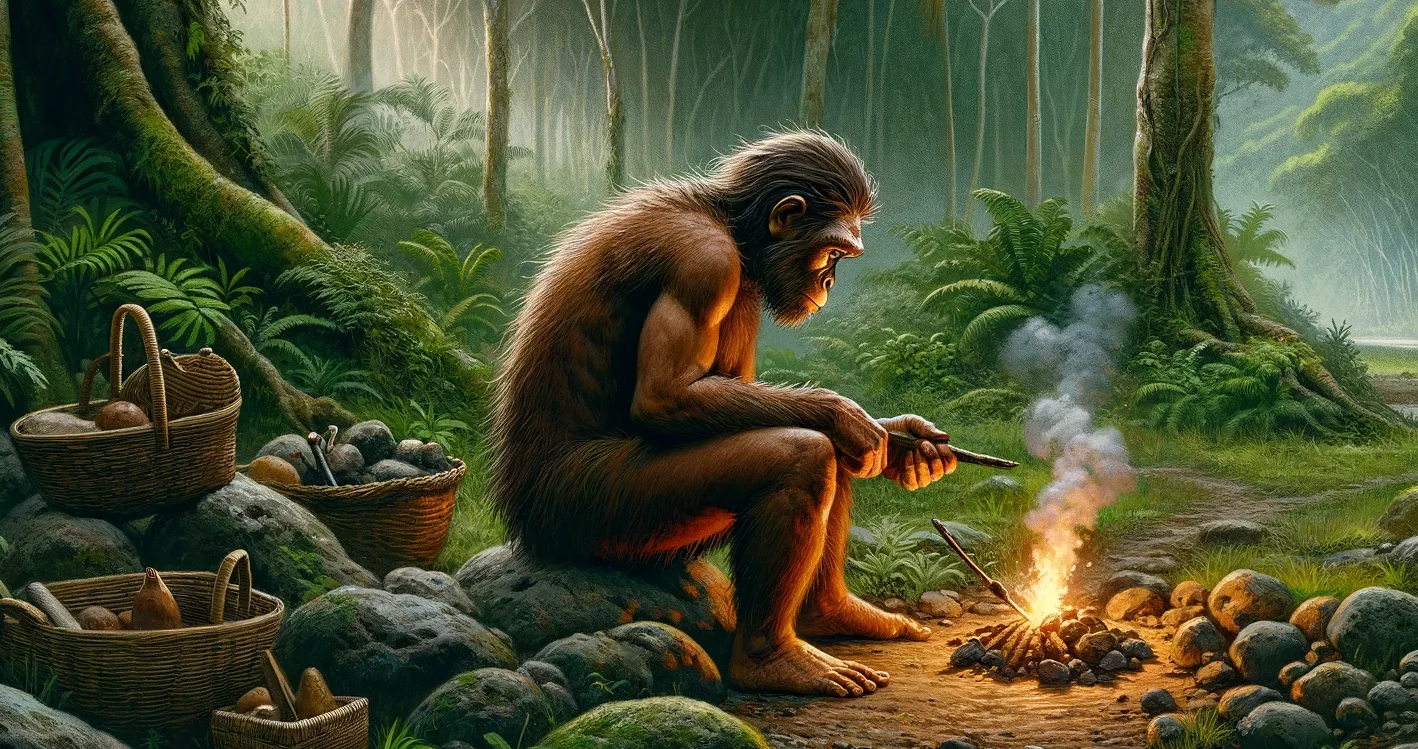
Imagined image of the last of the Homo erectus, circa 50,000 BCE. By this time, Homo erectus had lived in many parts of Africa, the Middle East, Europe, and Asia. Now, as their numbers keep dwindling, they are mostly in just a few spots in Asia.
112,000 Years (+/- 3000 years)
Blombos Cave Engravings
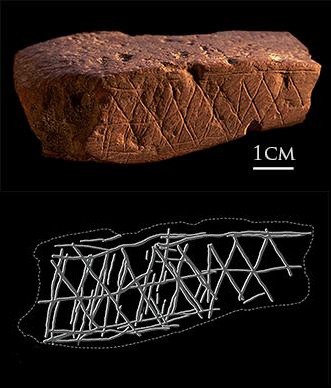
"<a href="https://commons.wikimedia.org/w/index.php?curid=110908714" target="_blank" rel="noopener noreferrer">Blombo</a>" by Chris S. Henshilwood is licensed under <a href="https://creativecommons.org/licenses/by-sa/4.0/" target="_blank" rel="noopener noreferrer">CC BY-SA 4.0</a>
75,000 BCE
World Population: 1.5 Million
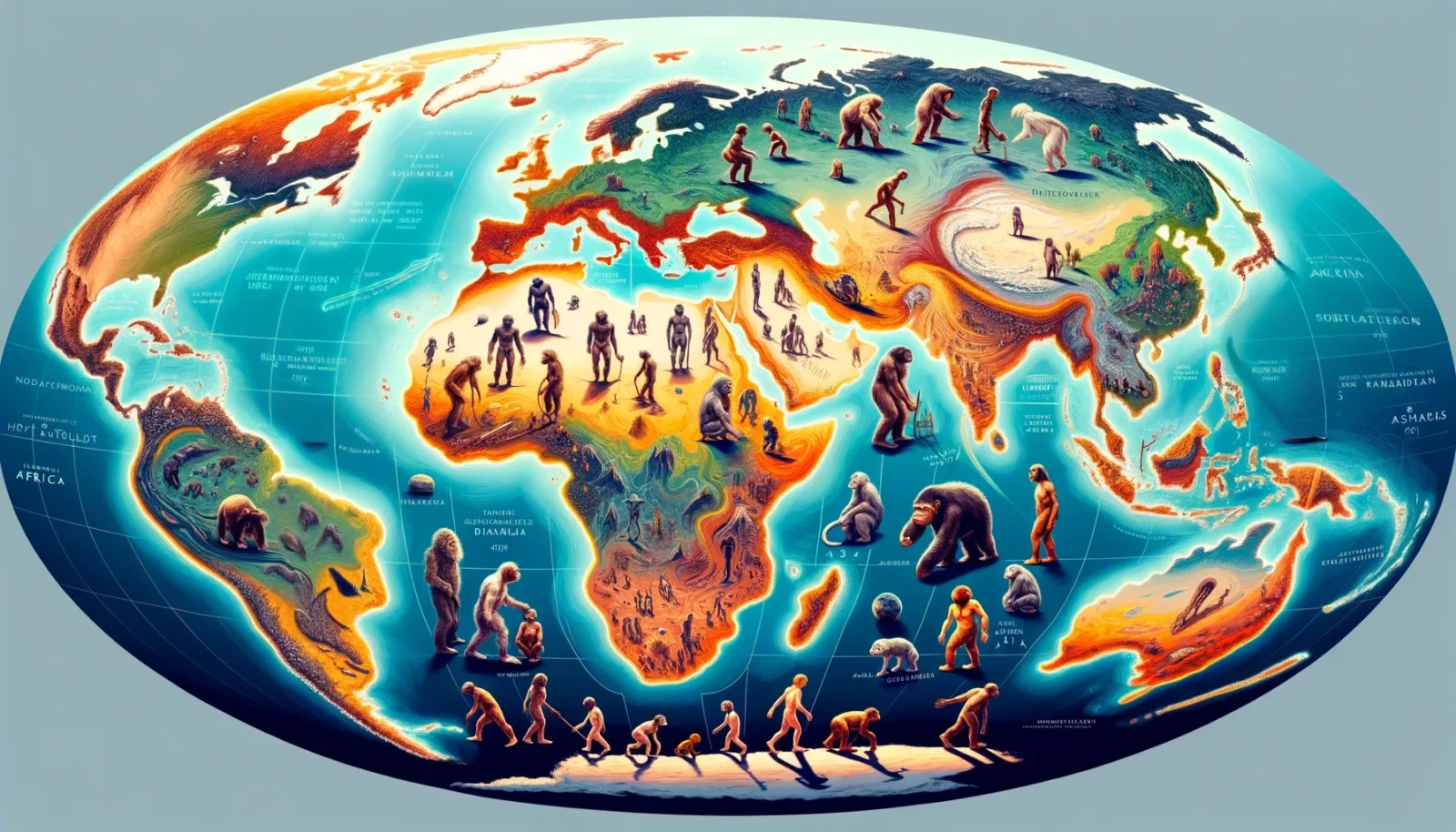
By 70,000 BCE
“The” Human DNA
Spiral strands of DNA on the dark background
70,000 BCE
2,800 Generations Ago
Successful Out of Africa Migration
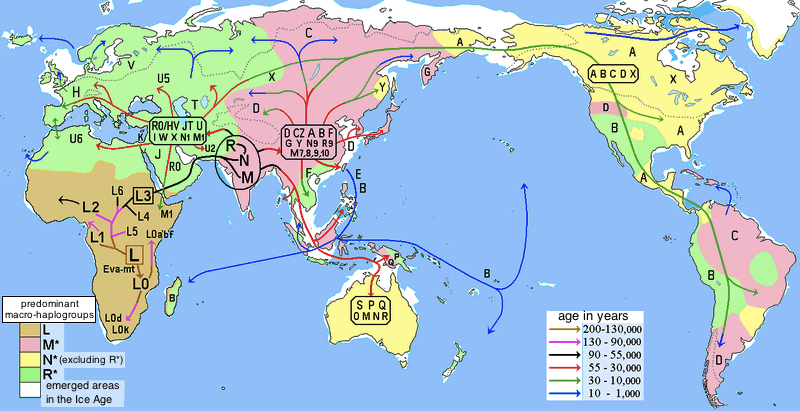
70,000 BCE
Starting by 70,000 BCE
Oldest Known Bracelet
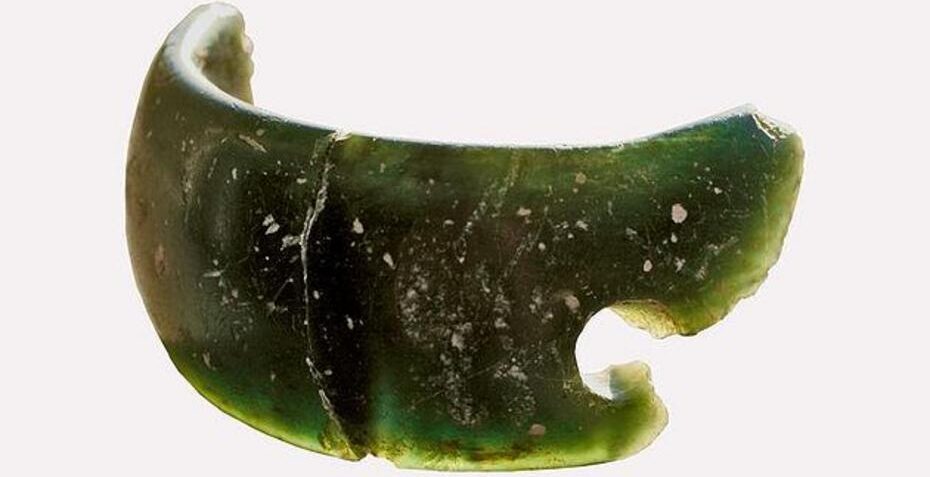
70,000 BCE
2,880 Generations Ago
The Settlement of Australia
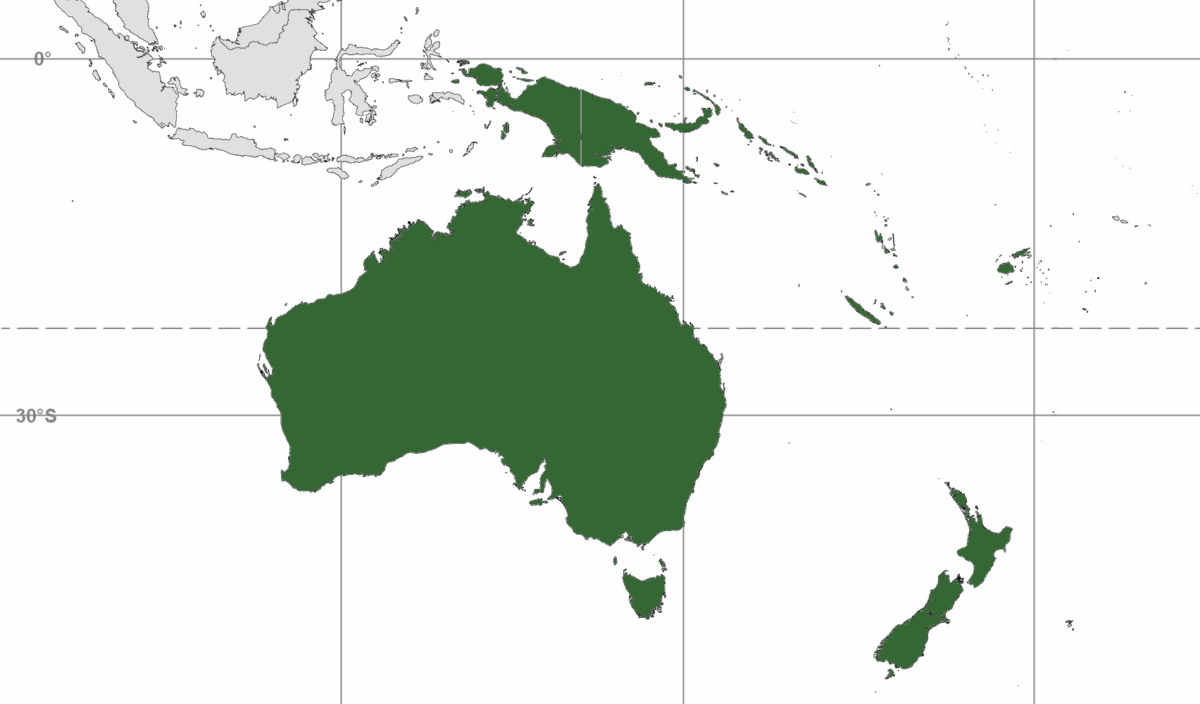
"<a href="https://commons.wikimedia.org/w/index.php?curid=80962081" target="_blank" rel="noopener noreferrer">Location Australasia cylindrical</a>" by <a href="https://commons.wikimedia.org/w/index.php?title=User:Emok&action=edit&redlink=1" target="_blank" rel="noopener noreferrer">(a) Blank map: Emok (b) Map content adapted from CIA World Fact Book via User:E Pluribus Anthony~commonswiki. That image is in the public domain because it contains materials that originally came from the United States Central Intelligence Agency's World Factbook.</a> is licensed under <a href="https://creativecommons.org/licenses/by-sa/3.0/" target="_blank" rel="noopener noreferrer">CC BY-SA 3.0</a>
65,000 BCE
Homo sapiens or an earlier Homo species
Extinction: Homo luzonensis
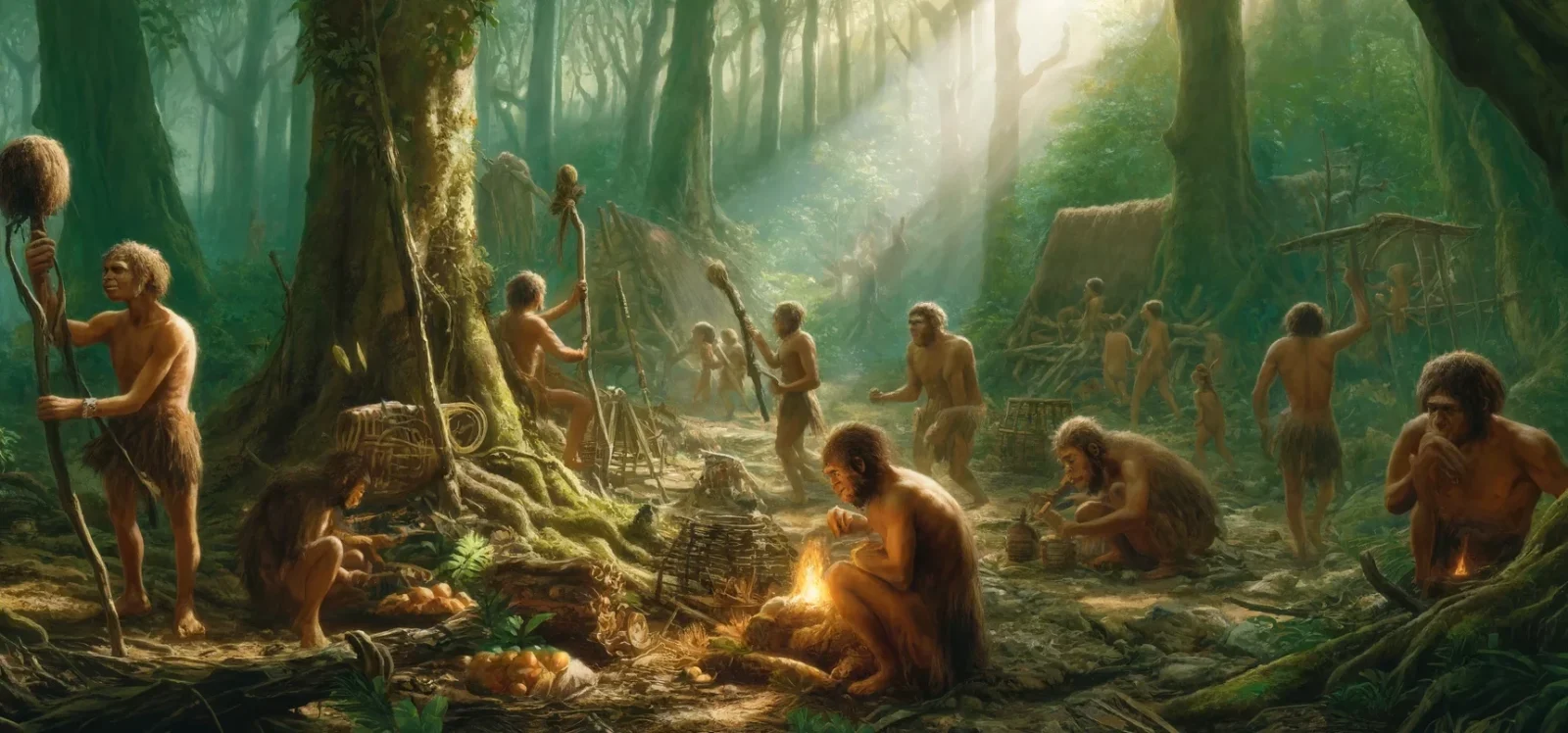
Imagined image: the last of the Homo luzonensis in the philippines circa 67,000 BCE. This is about 15,000 years before Homo sapiens arrive in the area.
65,000 BCE
Extinction: Homo floresiensis
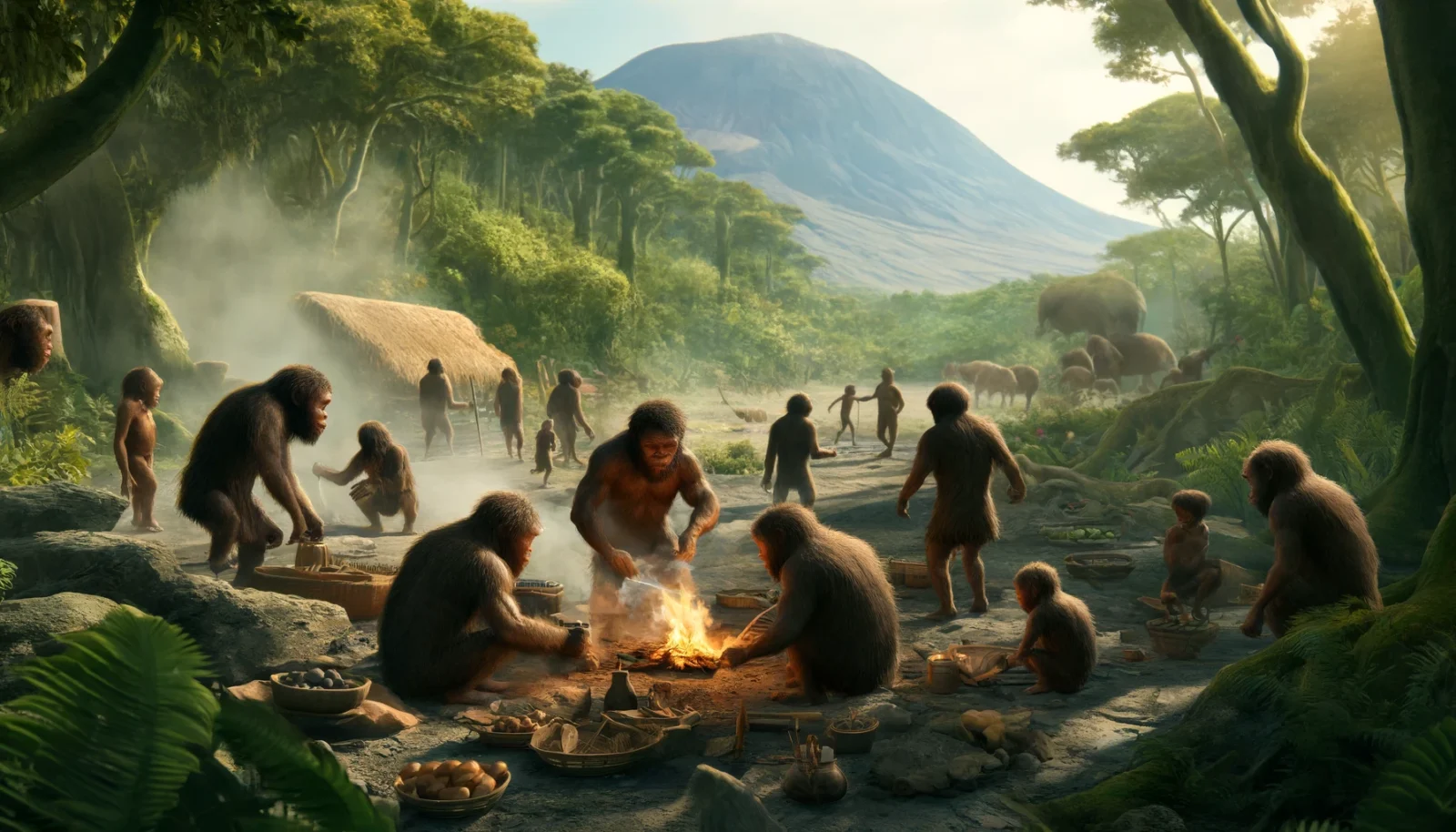
Imagined image: the last of the Homo floresiensis. This intriguing human species might have been the last descendents of Homo habilis or the Asian Homo erectus: the famed Dmanisi people.
48,000 BCE
58,000 to 48,000 BCE
Extinction: Denisovans
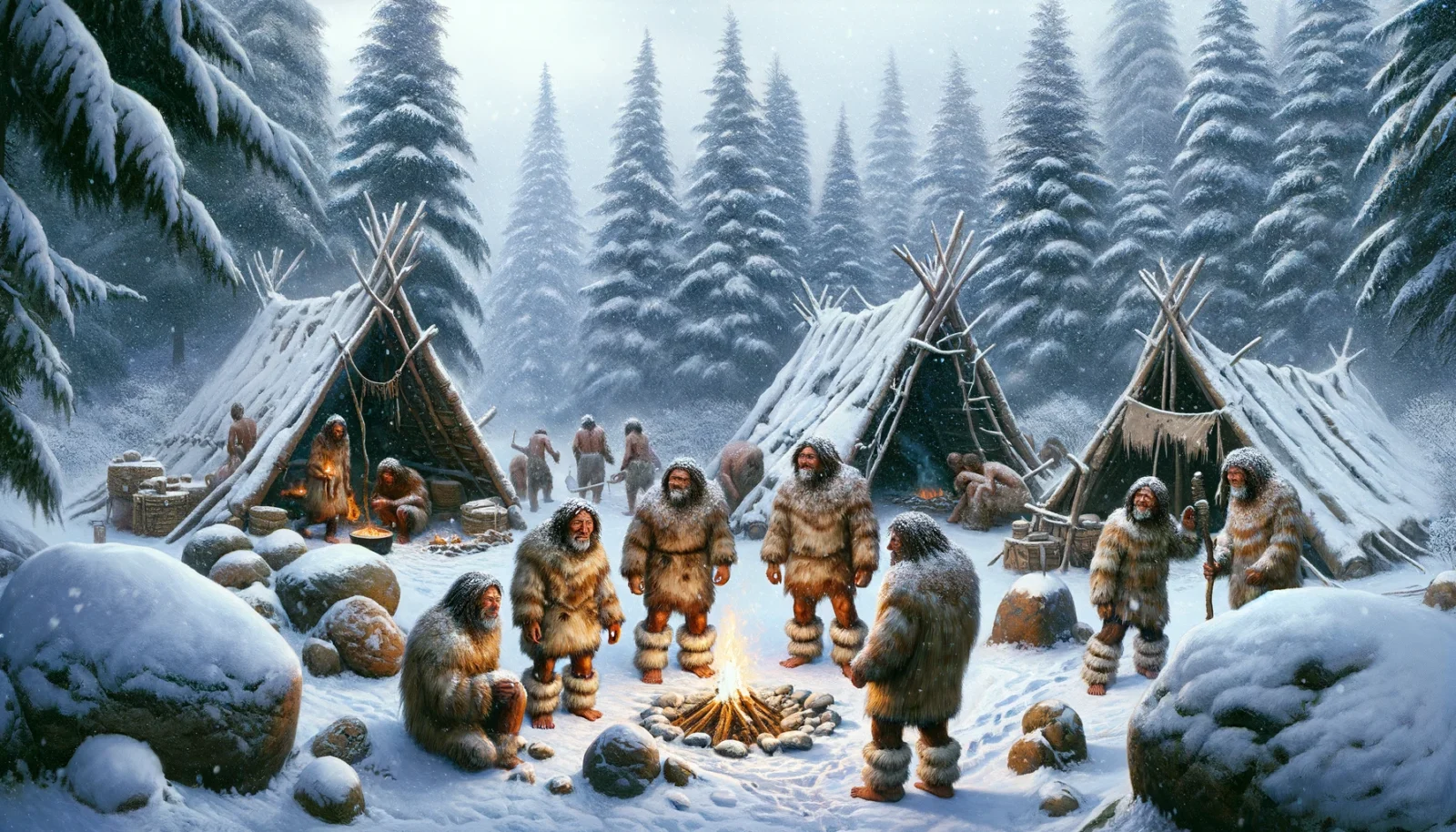
Imagined image of the last of the denisovans in Siberia, circa 40,000 BCE.
40,000
Phenotype Variation: Eye Shape and the Epicanthic Fold
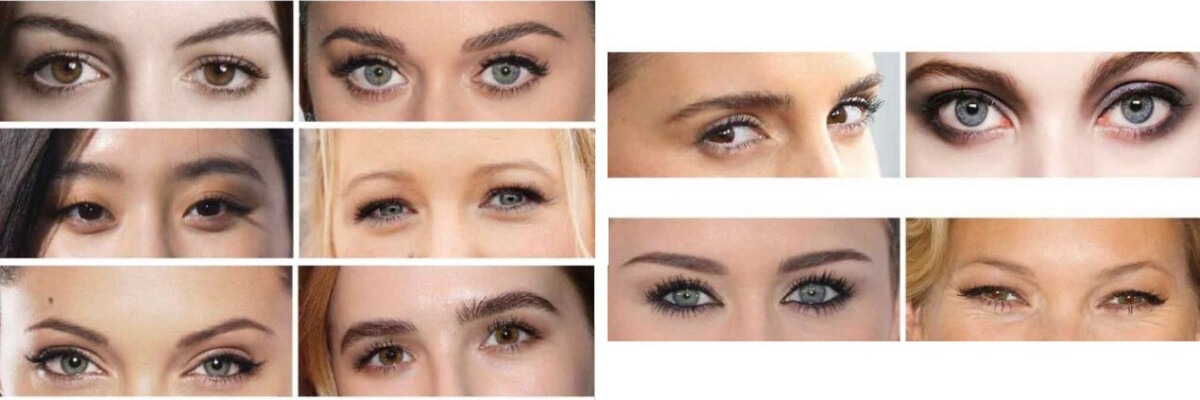
circa 40,000 BCE
Extinction: Neanderthals
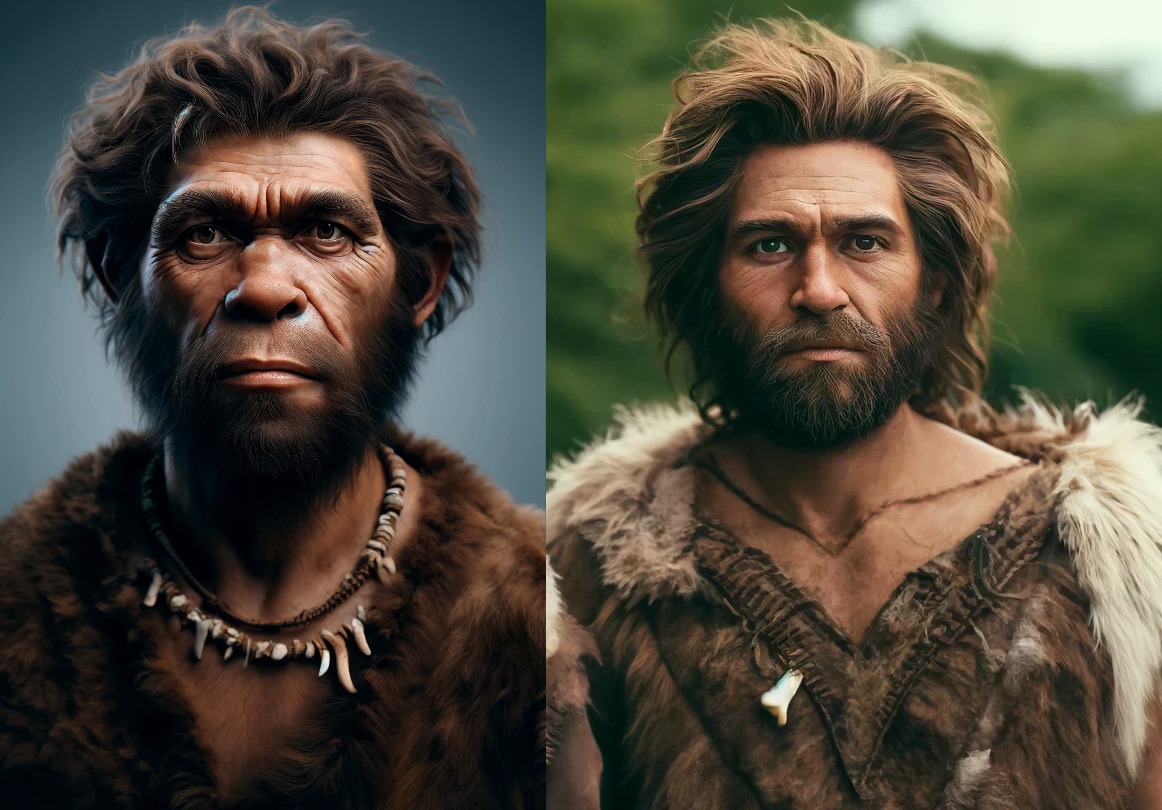
Imagined image, circa 29,000 BCE. Left is a neanderthal; right is a Homo sapien.
38,000 BCE
Extinction range: 38,000 BCE to 22,000 BCE
Advanced Sewing Needles
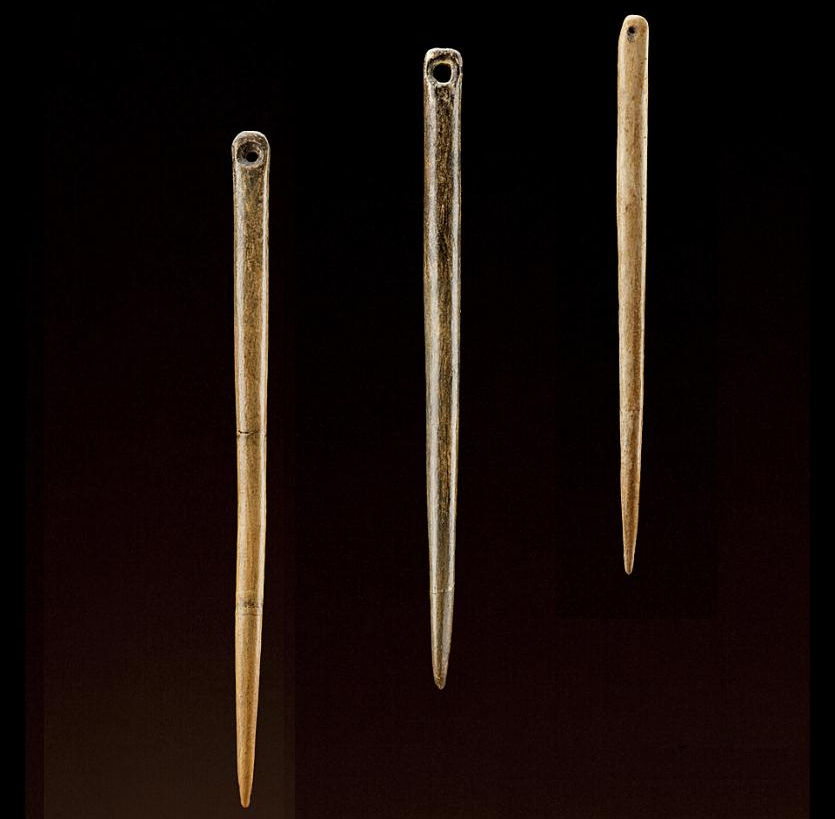
28,000 BCE
28,000 to 21,000 BCE
Modern Skin Color Variety Emerges

By 25,000 Years Ago (+/- 10,000 years)
Phenotype Variation: Blue Eyes

Photo by <a href="https://www.pexels.com/@valeriya?utm_source=instant-images&utm_medium=referral" target="_blank" rel="noopener noreferrer">Valeria Boltneva</a> on <a href="https://pexels.com" target="_blank" rel="noopener noreferrer">Pexels</a>
8000 BCE
Genetic Mutation from the Neolithic Era
Mexico: Guilá Naquitz (Agrarian)
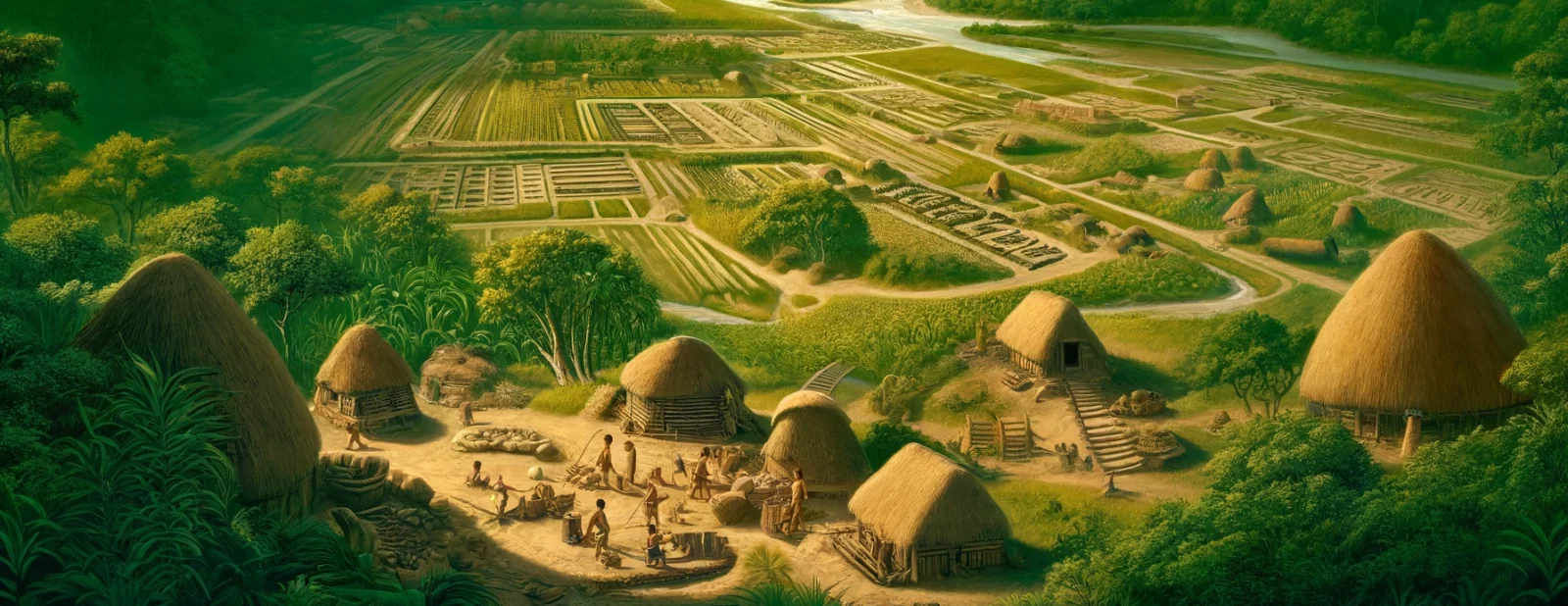
circa 8000 BCE
Americas Agrarian Society
Nüwa (女娲)

Nüwa, showing multiple possible portraits representing what Nüwa might have looked like. The scene includes ancient Chinese architecture, cultural elements, and symbols of her contributions, such as the creation of mankind and repairing the pillar of heaven.
Circa 8000-7000 BCE
Phenotype Variation: Lactose Tollerance

7500 BCE
Fuxi (伏羲)

Fuxi, showing multiple possible portraits representing what Fuxi might have looked like. The scene includes ancient Chinese architecture, cultural elements, and symbols of his contributions, such as the creation of humanity, the invention of writing, and teaching people to fish and hunt.
Circa 8000-7000 BCE
Cuneiform Writing
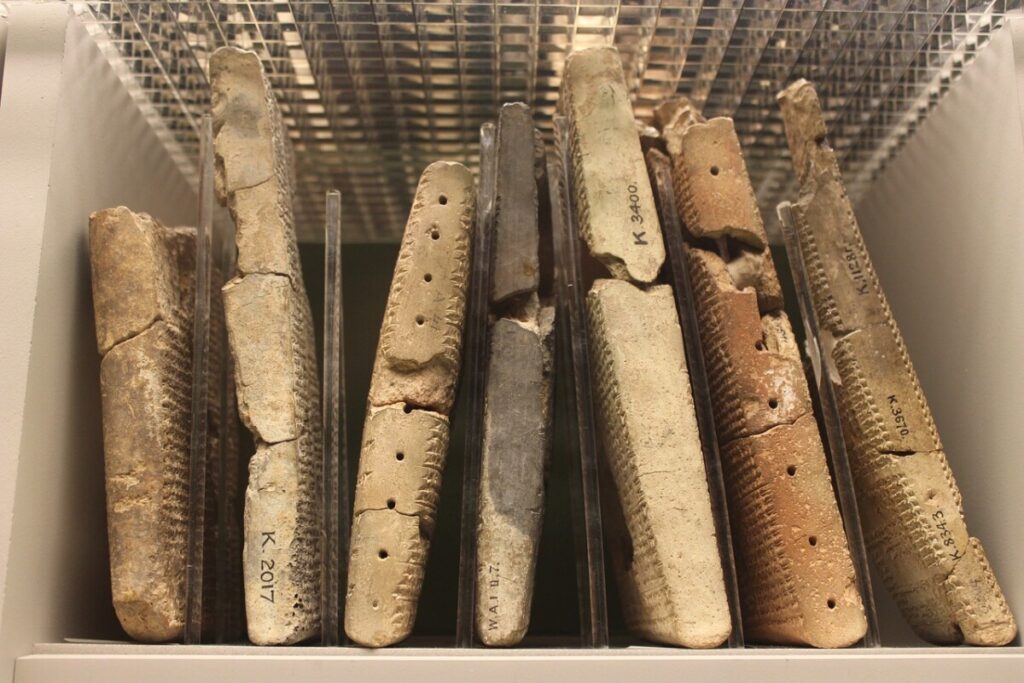
3400 BCE
3400 BCE to 100 CE (end of use for scholarly work)
The Yellow Emperor (Huangdi)

Ancient China during the time of the Yellow Emperor, featuring various possible portraits of what he might have looked like, along with symbolic representations of Yin and Yang, traditional architecture, and a harmonious landscape.
circa 2650 BCE (+/- 50 years)
Thales of Miletus
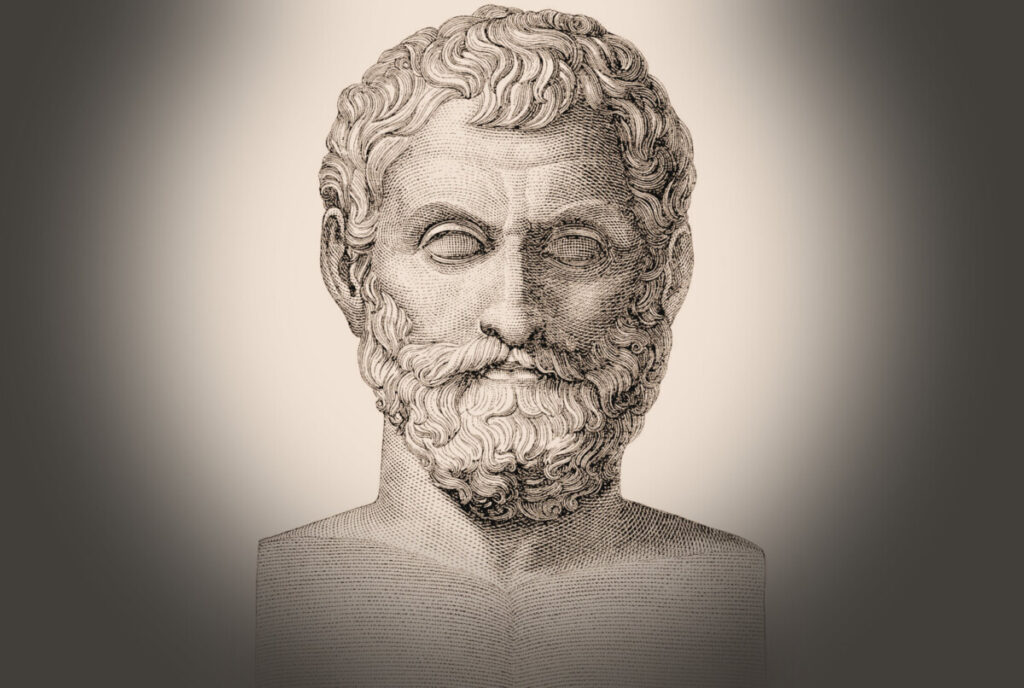
Early or "First" Science
Born about 624 BCE, died about 546 BCE, at around age 78.
Library of Ashurbanipal

A conservative recreation of the exterior of the Library of Ashurbanipal, illustrating the architectural style of ancient Assyrian buildings. The image depicts a grand structure on a raised platform, adorned with carvings and motifs characteristic of Assyrian art. While the depiction includes speculative elements, such as the building's size and detailed adornments, it aims to capture the historical significance and imposing presence of this legendary library in the heart of Nineveh.
Built circa 700 BCE, destroyed 612 BCE.
Socrates (469 – 399 BCE)

Portrait of Socrates. Marble, Roman artwork (1st century), perhaps a copy of a lost bronze statue made by Lysippos
Socratic Questioning
Father of Western Ethics
Francis Bacon
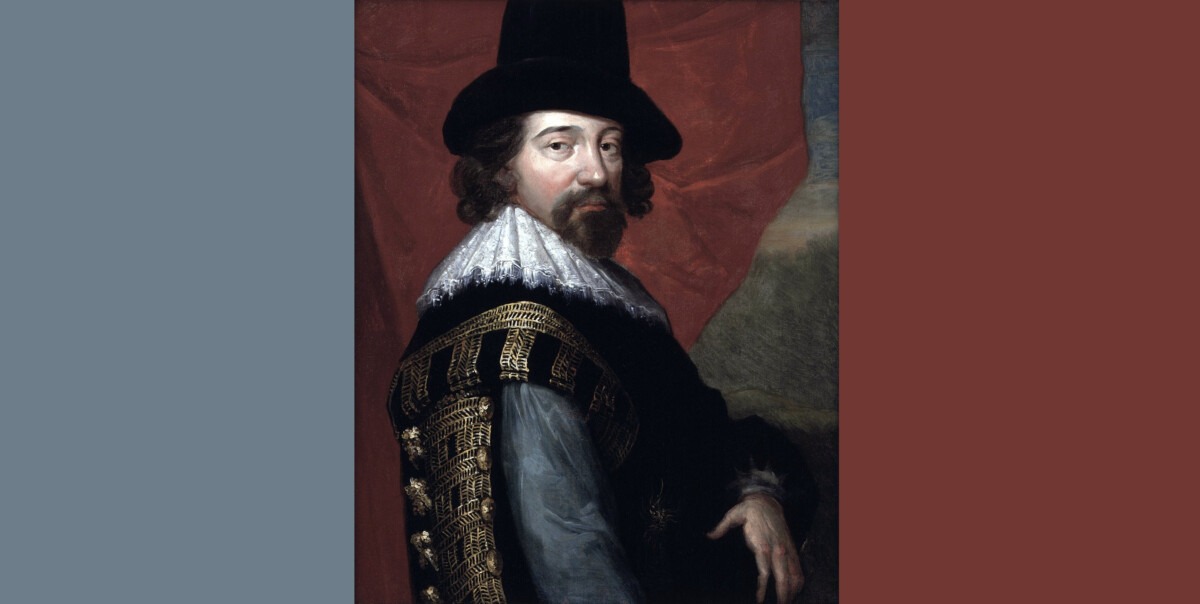
born 1561
1561 to 1626
Charles Darwin (1809-1882)
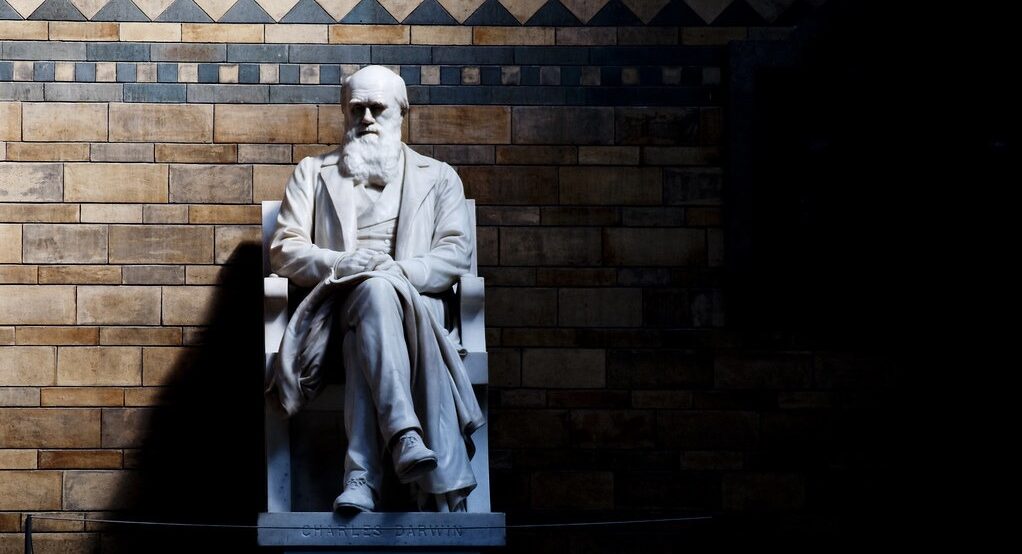
British Naturalist
Special Relativity
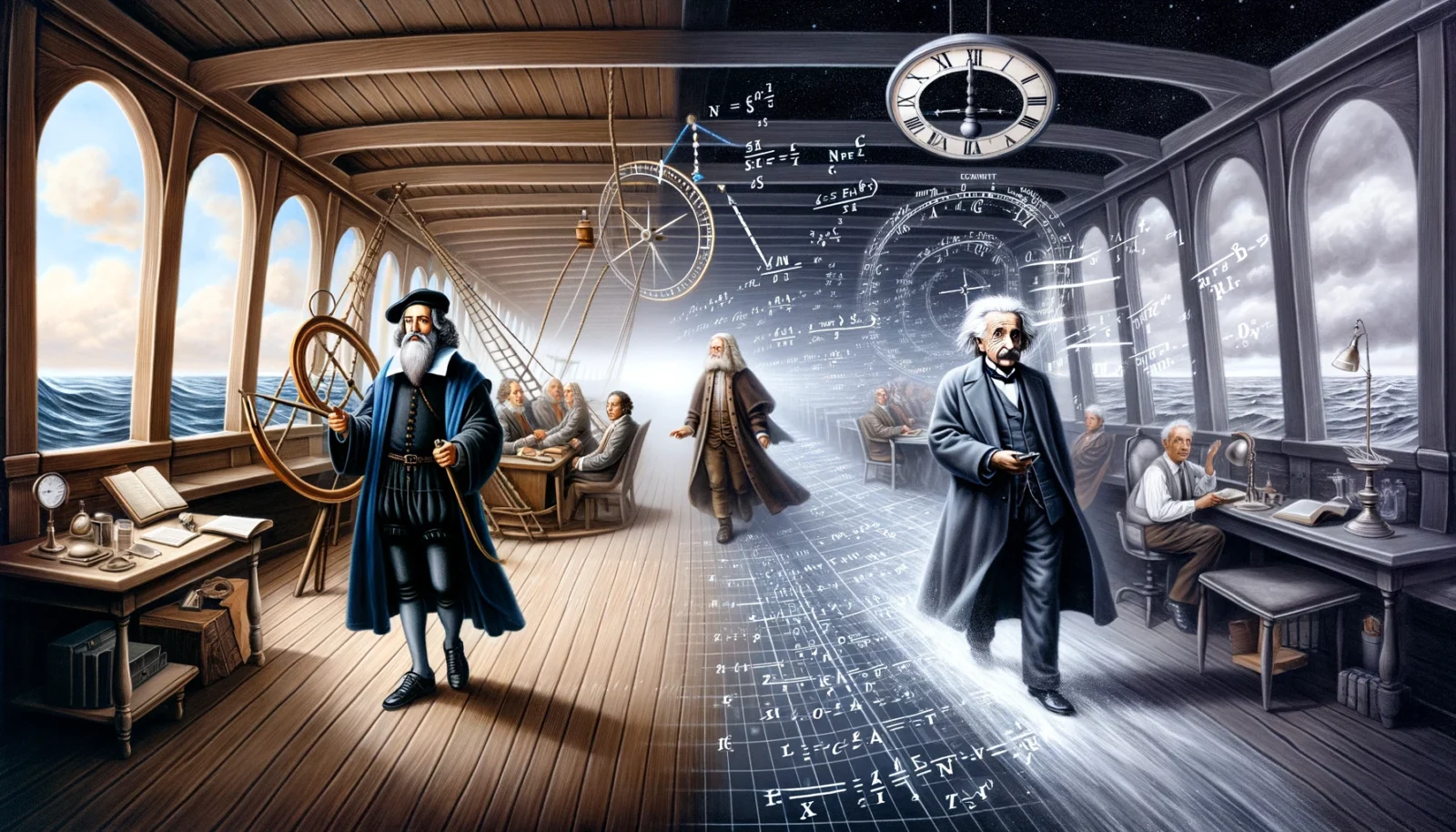
Jun 1905
General Relativity

Nov 1915
Cosmic Microwave Background (CMB)
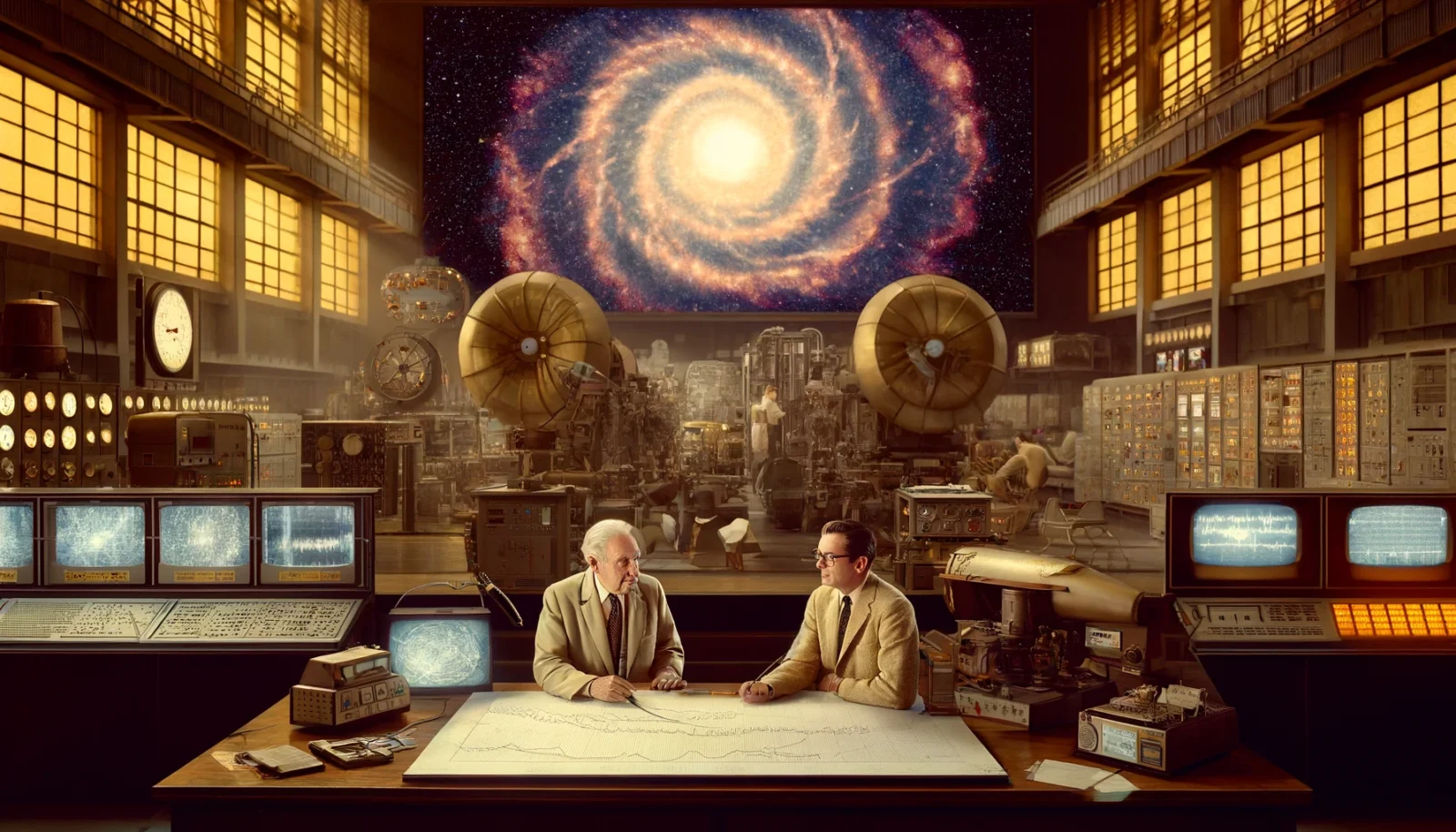
20 May 1965